In 1991, Rich Bielen joined Protective with a particular assignment: responsibility for the company’s securities portfolio. It was a job in which the numbers mattered and the consequences could take years to arrive. Thirty-five years later, he is preparing to retire as chief executive. The assignment has expanded somewhat.
Along the way, he became an investment chief, a finance chief, an operating chief and, in July 2017, the seventh CEO in Protective’s history. That small ordinal is revealing. The Birmingham insurer was founded in 1907. Bielen entered a succession line with few names on it, then spent his own tenure changing the business he had spent decades learning.
His story offers a useful counterpoint to the executive biography built around the dramatic arrival. Here the interesting movement happened within one institution. The portfolio manager eventually inherited the whole balance sheet, the workforce and the responsibility of explaining why an insurance company should help put a stadium on Birmingham’s skyline.
Before the corner office, the securities portfolio
Bielen’s working life began at Arthur Andersen, where he served from 1983 to 1986. He then joined Oppenheimer as a sales analyst concentrating on new product development and rose to senior vice president. His education included a bachelor’s degree and an MBA from New York University. He also qualified as a Certified Public Accountant.
Those early jobs put accounting and financial products next to each other in his career. At Protective, the remit widened in stages: chief investment officer and treasurer in 2002, vice chairman and chief financial officer in 2007, president and chief operating officer in January 2016. The CEO appointment followed the next year. There was ample time between the titles to learn what each one required.
Read that sequence as a route through the machinery of an insurer. Investments, finance and operations all appear before the top job. It suggests a leader whose preparation came from several different views of the same enterprise. By the time he became responsible for its direction, he had already been responsible for substantial parts of its workings.
Seventh in line, with room to change
Protective had joined Japan’s Dai-ichi Life group in 2015, before Bielen became CEO. His tenure therefore unfolded inside a company with a Birmingham address and an international parent. Continuity at home sat alongside a broader corporate relationship. The business could remain recognizably local while participating in a financial group that reached far beyond Alabama.
By 2021, Protective had reached $1 trillion of life insurance in force. In a September podcast conversation, Bielen described contracts with more than 12 million customers. These are different measures: insurance in force describes coverage, while customer contracts describe relationships. Both help explain the scale of the institution behind a name many Birmingham residents would soon see at a football game.
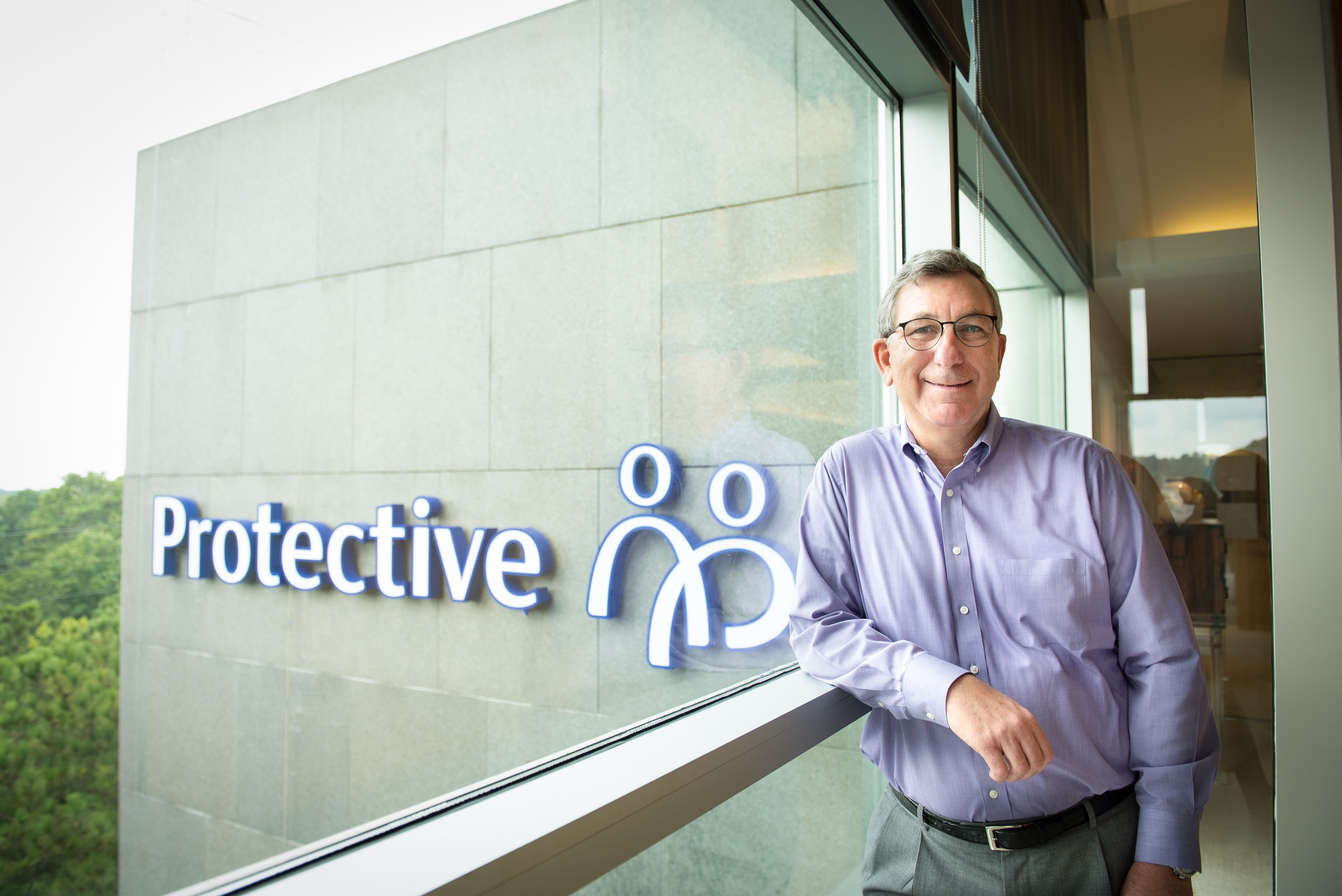
That year also brought a rebrand. A new logo appeared behind Bielen in a company photograph and was destined for the new Protective Stadium downtown. Corporate identity work rarely promises much entertainment for an outsider. Attaching the identity to a place where people actually gather gave this particular exercise a more public life.
A stadium comes with neighbors
In April 2019, Protective secured the stadium’s naming rights in an agreement reported at $1 million annually for 15 years. Bielen appeared with other local leaders at the announcement. A corporate naming agreement can be described in dollars and years. In Birmingham, it also put the insurer into an undertaking involving public bodies, the university and local businesses.
The stadium opened in October 2021. In March 2022, Bielen and Birmingham Mayor Randall Woodfin jointly wrote about the partnerships behind it. They also turned their attention to the surrounding neighborhoods. A large venue gives a city a new gathering place; the residents next door still have the ordinary business of living there.
The Protecting Good initiative began by listening to those residents. One early project connected Fountain Heights business owner Andrew Jones and his FLY V brand with stadium merchandise, sharing proceeds with The Penny Foundation. Another brought together partners to renovate homes in Northside’s five neighborhoods, with Habitat for Humanity administering the work. These were concrete ways to connect the venue’s arrival with the streets around it.
There is a useful detail in the sequence: listening preceded the projects. It would be easy to reduce a naming-rights agreement to the size of the lettering on the building. The neighborhood work supplied another measure, involving local commerce and houses. A roof is less photogenic than an opening ceremony, but it has a longer engagement with the rain.
“This has truly been a special time for all of us.”
Rich Bielen, on Birmingham’s World Games, July 2022
When Birmingham hosted The World Games in July 2022, Protective Stadium held the opening and closing ceremonies. At the close, Bielen celebrated what the event had meant for the city Protective had called home for 115 years. The public setting was a long way from a securities portfolio, yet the connection to his employer remained direct: the company’s name was on the venue welcoming the world.
Making room at other tables
Bielen’s civic work also reached into Alabama’s effort to build its innovation economy. Governor Kay Ivey named him an at-large director of the Alabama Innovation Corporation in December 2021. Innovate Alabama’s mandate concerns entrepreneurship, technology and innovation. Its board places business leaders alongside public officials, making cooperation part of the organization’s design.
In 2022, Bielen served on the working group searching for Innovate Alabama’s founding CEO. The board selected Cynthia Crutchfield that November. His part in the search offers a specific example of civic involvement beyond lending a name to a board roster: helping choose the person who would turn the organization’s plans into daily work.
He also took a turn representing the insurance industry nationally. Elected chair of the American Council of Life Insurers for 2025, he succeeded Boston Mutual’s Paul Quaranto. The association’s work involves public policy and financial and retirement security. Thrivent’s Teresa Rasmussen subsequently succeeded him as chair for 2026, with Bielen moving into the immediate past chair role.
These positions broaden the picture without requiring a second career to explain them. An insurer’s chief executive encounters questions about capital, household finances and economic development at work. The outside roles bring those questions into rooms shared with competitors, policymakers and people trying to establish businesses of their own.
The business keeps moving
Protective’s history during Bielen’s leadership includes acquisitions that changed its reach and distribution. The 2018 and 2019 additions of Liberty Life Assurance Company of Boston and business from Great-West Life & Annuity brought more policies and distribution channels. ShelterPoint, acquired in 2024, added an employee-benefits business. The company was expanding the ways it reached customers as well as the number it served.
In January 2026, Protective completed its acquisition of Portfolio Holding and its subsidiaries. Portfolio’s work includes vehicle protection products and programs through which dealers participate in reinsurance. The deal extended Protective’s asset-protection operation across automotive, RV, powersports and marine markets. Bielen described that division as an increasingly important part of the overall business mix.
In April, Protective announced an agreement to buy Obsidian from Genstar Capital, proposing an entry into specialty property and casualty insurance. The announced timetable anticipated closing in late 2026 or early 2027, subject to approvals and customary conditions. The distinction matters: an agreement describes an intended expansion, while a completed acquisition changes the operating business.
The figures require some care. Company assets are different from the amount of insurance coverage in force, and revenue is different again. Putting those measures beside one another helps show the breadth of the business without treating them as interchangeable trophies. For an executive who came through accounting and investments, the distinctions belong in any fair reading of the record.
Across these transactions, the recurring theme is a wider set of businesses under one corporate roof. That makes Bielen’s last year more interesting than a farewell tour. Even with succession arranged, there are still decisions whose consequences will belong partly to the next chief executive. Retirement announcements do not suspend the calendar of the business.
A larger balance sheet, a larger business
The last assignment is a handover
On May 14, 2026, Protective announced that Bielen planned to retire at year-end. Paul Wells, president and chief financial officer, would become president and CEO on January 1, 2027. Wells had spent 20 years at the company. The successor, like the departing chief executive, had already had a long introduction to the institution.
The company’s tenure comparison put assets at $142 billion, up from $75 billion, and revenue at $8 billion, up from $4.5 billion. It also counted six acquisitions during Bielen’s time as CEO. Those numbers describe expansion. The arrangements for Wells describe another part of the job: ensuring the next person has room to take responsibility.
“Serving as CEO of Protective has been an honor,” Bielen said. On LinkedIn, he expressed confidence in Wells and looked ahead to supporting the transition through the end of the year. His stated immediate ambition was practical and time-bound. There was a colleague to support and a change of leadership to complete.
In 1991, he arrived to look after a portfolio. In 2026, he is preparing to leave an organization that has grown across businesses while becoming more visible in its home city. Between those dates sits a career in staying long enough to take on a different job, and then another. The final one is to make the next person’s beginning work.
Read, listen & follow
- Protective’s official website Company information
- Rich Bielen on LinkedIn Personal professional profile
- The announced CEO transition May 14, 2026
- Listen: Bielen on Protective’s rebrand Business Alabama podcast · September 13, 2021
- Watch: Bielen’s 2016 United Way campaign video United Way of Central Alabama · Vimeo
- Bielen and Woodfin on Birmingham’s partnerships Joint column · March 31, 2022
- Innovate Alabama’s board Entrepreneurship, technology and innovation
- Protective Life on LinkedIn
- Protective Life on X
- Protective Life on Facebook