Turn a square of cereal 45 degrees and, with the right line, it becomes a diamond. Mary Ventresca remembers the Diamond Shreddies billboard because the move was tiny, the joke landed immediately, and the whole thing respected the street. A passerby did not need an instruction manual. A driver did not need a second lap. The idea arrived in a glance.
Ventresca has spent close to three decades learning what can fit inside that glance. Her career has crossed full-service agencies, media sales, new business development, and marketing. Today she is Chief Marketing Officer at PATTISON Outdoor, leading brand strategy, communications, research, and product marketing. The job puts her between two demanding constituencies: people who want advertising to be more measurable and people who still want it to be worth seeing.
That tension defines modern out-of-home. The medium still occupies the stubbornly physical parts of a day: the road to work, a station platform, an airport concourse, the elevator ride upstairs. But the decisions behind those surfaces increasingly resemble digital media. Data helps decide where a message belongs. Software changes what a screen shows. Measurement follows the campaign after the poster has come down.
The discipline of the glance
Outdoor advertising is a useful school because it removes excuses. There is no long caption to rescue a muddy visual. There is no landing page above the fold. Context changes by the second: traffic moves, trains arrive, crowds turn corners. The planning can be complicated, but the encounter has to feel simple.
Ventresca’s fondness for Diamond Shreddies says plenty about her taste. The campaign did not invent a new cereal. An agency intern reportedly rotated the existing one and called attention to the absurdity. “New Diamond Shreddies” turned geometry into positioning. Years later, the campaign remained her example of the right outdoor mixture: funny, memorable, immediate.
You have seconds to land a message.Mary Ventresca on the enduring constraint of outdoor creative
She sees a fresh source of talent for that constraint in Gen Z. Her observation is playful but practical. A generation trained by the scroll understands speed, visual hierarchy, emotional immediacy, and cultural shorthand. Those instincts map neatly onto a billboard or station screen. The creative lesson can travel in both directions: a social post can learn scale from the street, while public media can borrow pace from the feed.
There is also a management lesson hiding in the seven-word rule. A team can do immense work behind a message without forcing the audience to see the machinery. Research, negotiation, route analysis, production, and scheduling may take months. The finished communication should not feel like a meeting transcript. Complexity is a backstage function.
A bus route can be an argument
In 2019, a wrapped Toronto bus carried a Pride campaign beyond the downtown core. Ventresca’s comment on the work focused on the media choice. The client selected a bus rather than a streetcar because the vehicle would travel into neighborhoods beyond downtown. The surface mattered, but the route did more.
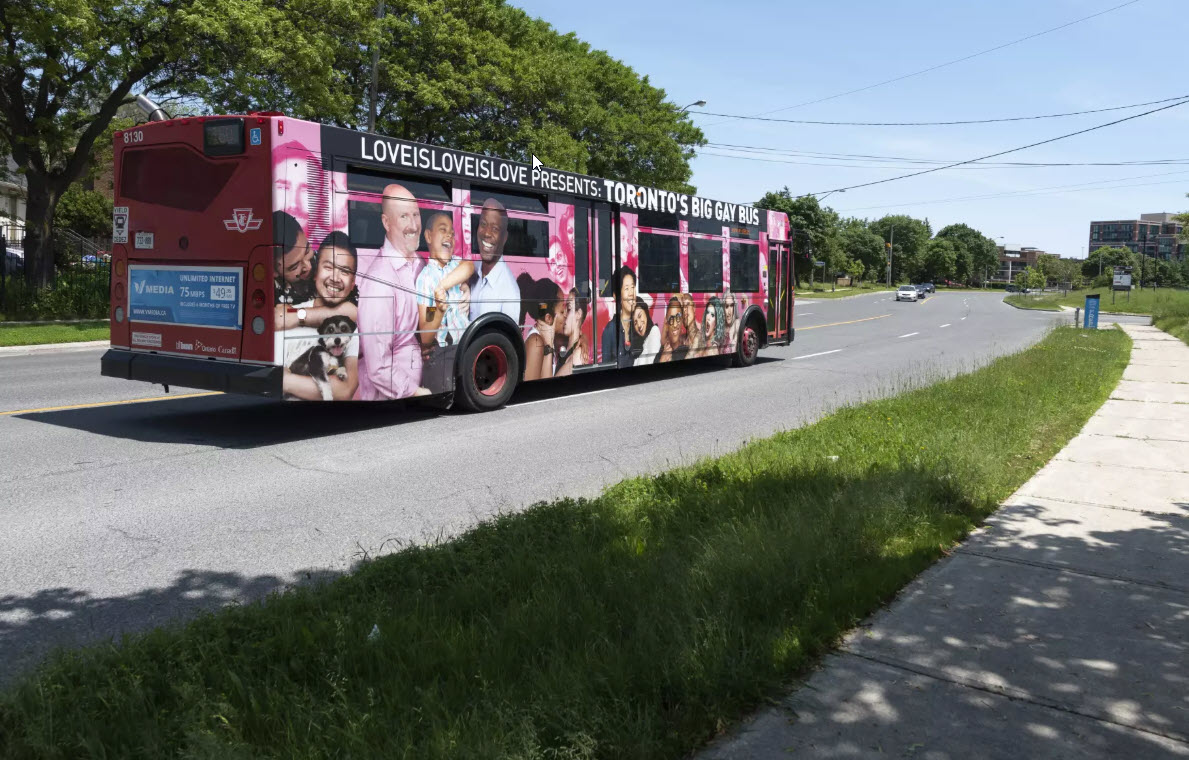
This is where media planning becomes civic geography. A bus passes schools, storefronts, apartment blocks, and intersections. It moves between groups that may not share the same cultural calendar. The campaign’s distribution was visible in public, not hidden inside an auction. Placement gave the message an itinerary.
The public-space route
MessageA compact idea people can understand at a glance.
MovementA format that travels through distinct communities.
ContextThe surrounding neighborhood changes how the work is read.
ConversationPublic visibility gives the campaign a life beyond paid exposure.
Ventresca made a related point years earlier when PATTISON added Burlington transit inventory. She described the value as cohesive coverage across the western Greater Toronto Area. The view was operational: a network becomes more useful when its pieces connect. A bus wrap may be creative, but the system beneath it is a map.
Twenty billion points, one useful recommendation
The newer map contains far more dots. In 2026, PATTISON introduced PULSE, a planning platform built with Vieta Technologies. It combines 20 billion data points from partners and open sources. Its transit tool helps planners identify systems that align with target audiences. Its airport tool combines ticketing, demographic, and behavioral information to create a clearer view of who travels and how.
Ventresca described the launch as a step toward greater precision and accountability. The phrasing matters. Data is not presented as decoration or a futuristic layer placed on an old channel. It is supposed to produce a better recommendation and connect an outdoor investment to a broader marketing objective.
Data can choose the corner. Creativity still has to earn the glance.The operating tension inside modern out-of-home
This is the bridge Ventresca keeps building in public appearances. At IAB Canada events, COMMB panels, and marketing education programs, she treats digital out-of-home as part of the larger digital ecosystem. The physical screen is not an exception to modern planning. It can be bought, changed, targeted, and assessed with tools familiar to digital teams, while retaining a presence those teams cannot reproduce inside a personal device.
At a 2023 conference on AI in outdoor advertising, the industry panel she joined explored practical uses rather than science-fiction theater: assistance with analytics, more precise movement data, dynamic creative optimization, and personalized interactive campaigns. The discussion also kept creative purpose in frame. Faster tools are useful only if they help people make clearer work.
A screen you can locate in the world
Ventresca has recently added another distinction to the case for digital outdoor: physical legibility. Online, an image can arrive without a reliable sense of origin. Synthetic media has made that ambiguity more visible. A screen in a station or an airport is different. The audience knows where the message is, what surrounds it, and who else can see it. Context is built into the encounter.
She argues that this public prominence carries value as people become more cautious about what is real and what has been manipulated. The point is not that every message on a city screen deserves automatic trust. It is that the medium has a verifiable address. A person can point to it. The advertiser has chosen to occupy a shared environment, under the practical rules and social scrutiny that come with that choice.
The setting also changes attention. A 2026 office study, discussed by Ventresca with fellow media leaders, examined how professionals interact with screens in lobbies and elevators. These are short, bounded moments. People are moving toward a meeting or waiting for a door to open. The screen shares the architecture rather than competing with a row of browser tabs.
For a planner, that creates a more specific question than reach alone: what is this audience doing at the moment of exposure? An airport passenger, an office worker, and a subway rider may all appear in the same demographic segment, but their time, attention, and expectations differ. Data can describe the audience. Place explains the occasion.
This is also why Ventresca resists treating creative and measurement as rival camps. Contextual relevance needs both. Research identifies a useful environment. Creative earns its space inside that environment. Measurement tests whether the pairing did the job. Remove any one of the three and the campaign becomes harder to defend.
Growing the room
Ventresca’s work extends beyond one company’s inventory. Her public service includes a Vividata board seat and volunteer leadership at COMMB, where she has contributed to marketing and diversity, equity, and inclusion efforts. She has helped present and co-host the Canadian Out-of-Home Awards. In 2026, IAB Canada recognized her as an Outstanding Digital Citizenship honouree for contributions to the country’s digital advertising community.
Her response to that recognition was revealingly communal. She wrote about being surprised to hear her name, then thanked the staff, members, and peers whose time and expertise move the field forward. She also noted the significance of an honouree from the outdoor-operator side. The award became another opening to explain where digital out-of-home fits.
That instinct - accept the moment, then widen the category - appears throughout her commentary. She has argued that outdoor media’s share of spending remains below comparable markets, even as digital outdoor grows. Her proposed response is educational. Invite voices from markets that have expanded the channel. Speak to the people who control digital budgets but may not understand public screens. Give young copywriters and art directors a reason to work at city scale.
The ambition is less about defending a legacy label than updating the buyer’s mental model. “Outdoor” can suggest a static rectangle by a highway. The actual portfolio includes transit vehicles, airport displays, office screens, digital networks, and formats that update in real time. The category has stretched. Its language has to catch up.
The idea still has to travel
Ventresca’s career runs alongside that evolution: from the sale of physical locations to a chief marketing role concerned with brand, research, communications, and product. The tools became more technical. The public remained human. Someone still has to notice.
Her examples offer a compact playbook. Treat location as part of the message. Put the complexity into the plan. Let data improve the decision instead of crowding the creative. Study how new generations communicate. Build the industry room beyond the people already convinced.
And remember the cereal. A square became a diamond because someone looked at a familiar object from a slightly different angle. The medium did not require a speech. It needed a clean line, a visible surface, and enough wit to make the next few seconds feel less ordinary.