Alison Savage’s career makes an argument before she says a word. It says that attention is a renewable resource only if you leave room to renew it. Her public résumé crosses the usual borders of marketing work: client service and planning, agency and client, permanent leadership and independent practice. Between some of those chapters, she travelled. Then she returned to the work with a different set of eyes.
The pattern matters because strategy is vulnerable to enclosure. A person can spend all day discussing customers without meeting one, translating culture into slides while seeing very little of it firsthand. Savage chose a career shape that repeatedly opened the circuit. She moved seats. She stepped out. She came back. What looks nonlinear on a conventional résumé reads as a coherent system when viewed through the craft she has practiced for more than two decades: gather perspective, locate the human tension, make the problem legible.
Today, her public professional profile places her at Prime Quadrant in Toronto, where supplied business information identifies her as a fractional chief marketing officer. The firm is an independent multi-family office serving affluent families. It is a different setting from an advertising agency, but the central marketing question is familiar: how do you turn a complex offering, heavy with consequence and trust, into a proposition people can understand?
The first useful seat
Savage began after university in client services at Leo Burnett Toronto. She has written warmly about the agency, recalling its heart, purpose, drive, and genuine care between colleagues. More important than nostalgia is the professional foundation. Client service teaches the whole machine. You learn the gap between a presentation and a decision, between the idea everyone applauds and the version that can be produced, approved, and paid for.
Strategic planning was not yet established in Canada when she began, according to a 2013 interview. Her route into strategy therefore started beside it. After roughly five years agency-side, she took a year to travel and then moved to the client side. The logic was clear: clients made the final calls, and she wanted to understand that seat.
Once there, she found the role came bundled with pricing, operations, and other responsibilities beyond communications. Those tasks were essential, but they were not the part that held her interest. After another stretch of about five years, she travelled again. Then she returned as an independent strategist.
Four seats, one accumulating view
By 2013, Savage had worked freelance assignments at TAXI, Leo Burnett, john st., and Blammo Worldwide. The list is less revealing than the arrangement. An independent strategist enters a living organization with limited time and incomplete context. There is little room for ceremonial cleverness. She must understand the brief, read the people, find the pressure point, and give the team something sturdy enough to use after she leaves.
“A good planner is a student of life.”Alison Savage, 2013
A curriculum without a campus
That sentence is the centre of Savage’s public philosophy. In the same interview, she described a strong planner as a sponge: someone who notices widely, explores beyond familiar territory, and practices seeing through different perspectives. Travel was not presented as a perk postponed until the work was done. It was part of how the work stayed good.
Her rhythm was unusually explicit. Roughly every five years, she said, she would take meaningful time away to travel. The breaks helped her do her job. It is easy to romanticize that choice, but the useful lesson is more practical. Curiosity needs a calendar. If every week is optimized for output, a strategist eventually starts recycling the same inputs with nicer typography.
A trip changes more than scenery. It removes shorthand. The traveller must observe before interpreting, ask questions whose answers seem obvious to locals, and tolerate the mild incompetence of not knowing how things work. Those are also strategic muscles. A planner enters a market, category, or audience with assumptions and then has to earn a clearer view.
In September 2022, APG Canada invited Savage and Darla Miazdyck onto its Grow Op podcast for a 49-minute conversation about thriving as a freelancer. The appearance placed her experience inside a broader professional community: planners teaching planners how to make a flexible career work. By then, public campaign credits also identified her as chief strategy officer at Toronto agency The Local Collective.
Strategy you can participate in
Campaign credits are collaborative documents, and they should be read that way. They show the many hands required to turn strategy into something public: creative leaders, designers, account teams, illustrators, production partners, media, public relations, and clients. Savage’s name appears among those hands on two pieces of work that made large social subjects graspable through one strong device.
For Food Banks Canada’s 2022 “Starve the Hunger,” the campaign personified hunger as a small caterpillar that keeps eating until it becomes impossible to ignore. The metaphor did the strategic compression. A growing problem became a growing creature. The work ran across film, cinema, online video, and outdoor media, with Savage credited as chief strategy officer.
The later “One in 100” project for Safehaven Toronto used an illustrated search book. Readers were asked to find one overlooked child within scenes of one hundred people. The audience did not merely receive a statistic; it performed the act of looking. Participation carried the argument.
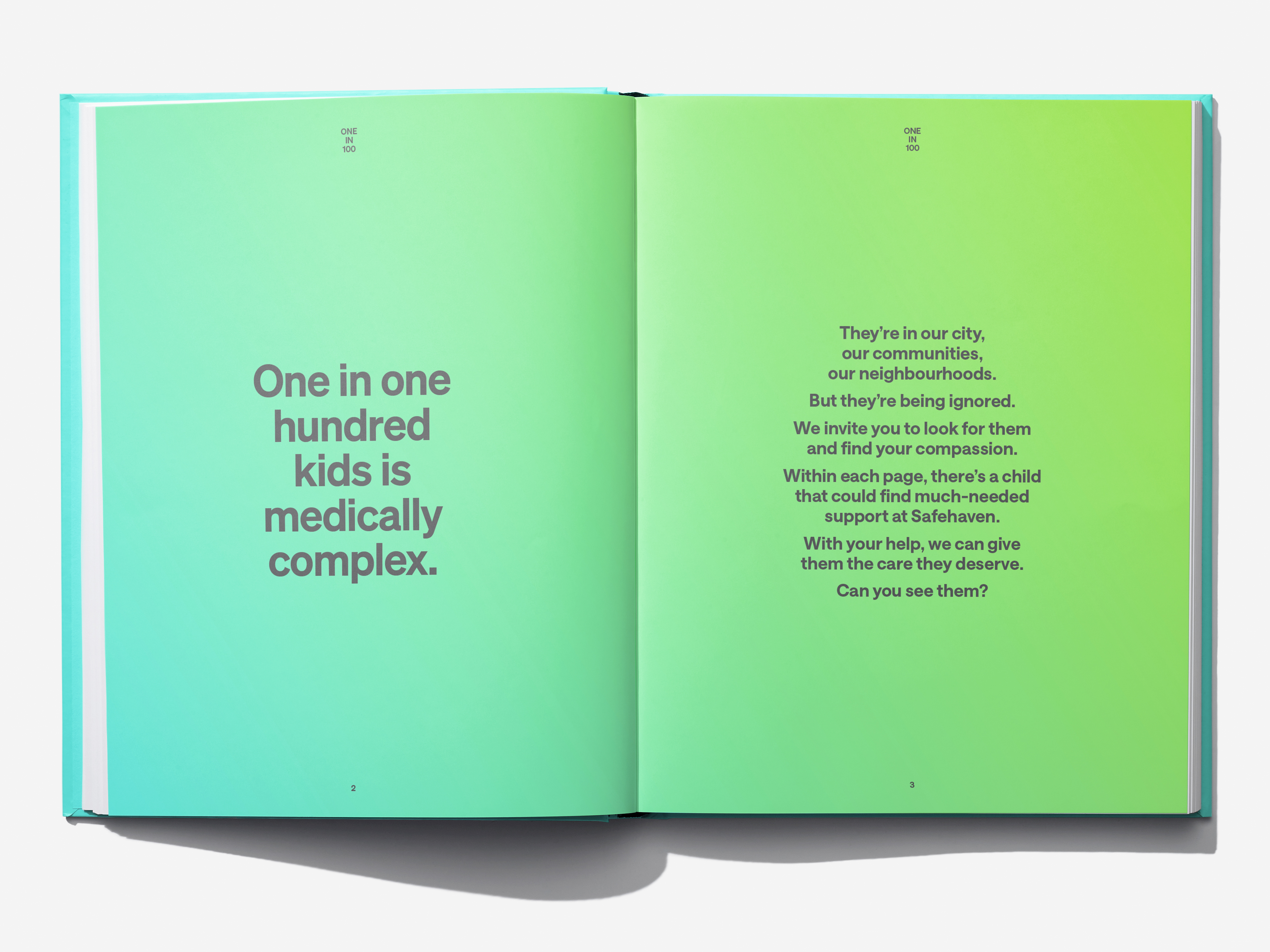
The reported results came from the whole campaign team. The 2025 Strategy Awards case says the book sold out in its first week, reached Indigo and public-library collections, generated six million earned-media impressions, and accompanied a sharp increase in donations. The One Club awarded the work a Silver Cube in 2025. An industry portfolio database connects Savage’s credited work across the two campaigns with five recognitions from the Clio Awards, London International Awards, and ADC.
One in 100 / reported campaign signals
The strategic lesson is not that every cause needs a book or every social problem needs a creature. It is that abstraction needs a handle. “One in 100” gave people a tiny assignment. “Starve the Hunger” gave an expanding problem a visible appetite. Each mechanism helped the audience feel the shape of the issue before asking them to remember a message.
The fractional turn
Savage’s present connection to Prime Quadrant brings the story into financial services, a category rich in abstraction. The firm says it serves more than 260 families and consults on $26 billion in assets. It frames wealth across four dimensions: wealth itself, the individual, the family, and impact. For a marketer, that is a positioning problem with unusual stakes. Numbers establish scale, but relationships establish meaning.
Fractional leadership suits someone whose career has already crossed organizational edges. A fractional CMO has to enter quickly, understand what the company believes, distinguish message problems from operating problems, and create enough alignment that the work continues without constant translation. Those demands rhyme with independent strategy. The title is newer than the practice.
Her accumulated advantage is not simply tenure. It is the number of vantage points contained inside it. She knows what an account team protects, why a client decision may stall, how a freelancer makes a day count, and what an executive must connect. The perspectives compound because each one corrects the blind spots of the others.
That translator’s view is especially useful when a company’s language has drifted away from the way its customers make choices. An internal team naturally organizes the story around departments, products, and processes. A customer arrives with a situation. The strategist’s job is to cross that distance without sanding away the complexity that makes the offer valuable. Someone who has worked on both sides of the agency-client table can hear where the translations fail. Someone who has repeatedly entered teams as an independent can also spot the phrases insiders no longer question. Fractional work turns those habits into leadership: listen for the inherited assumptions, identify the few decisions that will unlock the rest, then leave behind a system the organization can operate.
The best career move may be the one that changes what you can notice.
There is restraint in the public record around Savage. She is present in credits, a handful of interviews, professional conversations, and the work itself. That restraint fits the occupation. Strategy often disappears into the finished object. When it succeeds, the audience sees the caterpillar, searches the picture, understands the proposition, or decides to act. The strategist’s fingerprints remain in the sequence.
Savage’s sequence is clear enough. Learn how the agency works. Sit where the client decides. Leave long enough to widen the lens. Return independently. Lead strategy. Carry the combined view into a new category. The itinerary is personal, but the principle travels: a career can be designed as a way of staying awake.