Somewhere in a Content Guru meeting room, a failed piece of hardware has found steady employment as a paperweight. The project ran beyond its budget and timetable. By delivery, the component was obsolete. Martin Taylor kept the prototype. Among the usual corporate ornaments, a small monument to getting something wrong has rather more to say.
Taylor has returned to this episode in public discussions of business mistakes. His lesson is practical: recognise when an initiative deserves to end. There is an appealing economy to the arrangement. A development project that failed to earn its keep can still prevent another one. Few paperweights are expected to contribute to capital allocation.
It is an unexpected opening to the career of Content Guru’s co-founder and deputy CEO. The Bracknell-based business sells the cloud technology behind customer conversations. Taylor’s working life has taken in overseas markets, television audiences and public services. Across those changes, he has had to decide which ideas can travel and which should remain on the meeting-room table.
A company name with room to move
Before the cloud business came the telecommunications business. Taylor studied Business Management at King’s College London, then worked as a futures market analyst in Asia. In 1993, he returned to Britain to help launch Redwood Technologies. His remit involved developing overseas territories, including emerging markets, and finding new applications for its technology.
This was a commercial education in the connections between an invention and a customer. A technology could have more than one use, and a useful market could lie beyond Britain. His work on real-time billing for telecommunications operators also fed into the accounting capabilities that would later sit behind Content Guru’s services.
By 2005, Taylor and his brother Sean were establishing Content Guru. Their earlier business was associated with television voting. That was useful experience, but a narrow description of what they wanted to build. When the brothers discussed a name, they wanted something that could accommodate communication in several forms: spoken, written and visual.
The resulting name had an advantage over one tied to a particular telephone technology. It left space for the business to change. Taylor’s account of the naming discussion includes sceptics who thought “Guru” sounded too mystical. Oracle, he pointed out, had managed. Naming a technology company apparently leaves a little room for comparative theology.
- 1993Redwood Technologies
Telecoms and overseas markets - 2005Content Guru
A new company for cloud communications - 2018Outside investment
£25m minority equity funding from SEP - 2026The AI conversation
Automation, quality and customer contact
When the audience picked up the phone
Early Content Guru work included phone-ins for Big Brother and Pop Idol. It is easy to remember the contestants and forget the telephone traffic. Yet a television audience has a useful quality for a communications business: large numbers of people may decide to act at roughly the same moment.
The company’s subsequent work moved into critical national infrastructure. The common problem is a crowd arriving through a communications channel. The circumstances differ considerably, but both require systems that can cope when a quiet period turns abruptly busy. Taylor’s career crosses that boundary between entertainment and the practical business of keeping services accessible.
Consider electricity distribution. In 2019, Content Guru received a Ventana Research Digital Leadership Award for work with UK Power Networks. The company reported that its system could handle contact volumes above ten times normal levels at peak demand, alongside customer satisfaction scores of nine out of ten.
Those figures describe a different sort of audience participation. People contacting an electricity distributor want an answer about a service they rely on. The technology has to absorb the rush without requiring every customer to understand what is happening behind the scenes. Taylor’s early experience with concentrated demand had acquired another setting.
The money arrived with a minority stake
Expansion eventually brought a decision about outside capital. After years of organic growth, the founders sought investment in 2017. Scottish Equity Partners supplied £25 million of equity funding for a minority stake in January 2018. The choice of partner involved relationships, a technology focus and a record of previous work.
The funding supported more engineering, sales, marketing and customer service capacity, as well as product development. By the 2019 account of that investment, cloud services were being offered in more than 30 countries. International expansion meant building the organisation around the product, with people to develop it, sell it and answer for it.
For Taylor, the commercial ambition also had an arithmetic. In 2020 he described a three-part discipline: revenue growth, operating earnings and pre-tax profit all mattered. The proposition was sustainable growth. The insistence on margins belongs in the same portrait as the paperweight: enthusiasm for building things accompanied by attention to what they cost.
That combination complicates the familiar founder story. Taylor talks about enjoying invention, yet also describes rules for containing its appetite. A company can keep finding new applications for technology while refusing to treat every project as indispensable. The difficult work is making those judgements while an idea still has enthusiastic defenders.
“Creating new, interesting stuff drives me.”
Martin Taylor, 2020
A larger stage, a longer checklist
By 2024, Taylor was describing a multinational contact-centre contract worth nine figures, with a rollout across 70 countries. He also discussed a new Scottish headquarters in Glasgow and a development centre in Porto. These were concrete signs of a business extending its footprint, rather than simply adding another destination to a sales presentation.
Scale introduces an awkward multiplication. A product may be consistent while its customers’ operating conditions vary. More countries mean more settings in which the service must work. The title “strategic market development”, part of Taylor’s responsibilities, covers some distinctly unglamorous questions about turning geographical reach into something customers can actually use.
In 2025, Taylor described a four-year effort to secure FedRAMP High authorisation for the company’s American offering. He saw it as a route into further US government work. Four years is a revealing interval in a sector fond of announcing the next era before lunch. Access to a market can demand a long apprenticeship in its requirements.
He also spoke about the growing significance of where data is stored and processed. His November 2025 conversation about data ownership explored the expanding records created across customer-contact channels. Voice is one contribution among several. Written messages and connected devices enlarge the information a business must organise and protect.
The next call may involve an AI agent
Customer service gives artificial intelligence a particularly concrete test. A customer has a request. Someone must understand it, retrieve the relevant information and produce a useful result. The performance is judged by the person waiting. An elegant demonstration can earn applause; an unresolved enquiry earns another enquiry.
Taylor’s public discussions have followed that practical territory. In April 2026, he joined interviewer Nicole Willing to discuss the move from generative AI towards agents, including the tasks they can reliably perform and those requiring human involvement. The discussion also considered how organisations could build on automation they already had.
That last question matters to a founder whose career extends back to 1993. Customers have existing systems, investments and routines. New capabilities must find a place among them. A technology’s arrival does not wipe the slate clean, however tempting a clean slate might be to the people selling the technology.
In July 2026, another interview with Willing addressed vendor consolidation, AI development, rising customer expectations and older contact-centre platforms. Then, in an August contribution on quality assurance, Taylor considered the problem of maintaining consistent standards across voice, email, chat, messaging and social channels.
The quality discussion reaches a detail that broad promises about AI can miss. A written exchange and a telephone conversation have different characteristics. Fair assessment requires equivalent standards rather than blindly identical measures. Taylor’s subject has become the machinery of judging whether a customer conversation went well, as well as the machinery that makes it possible.
Chat
Email→One service
Several channels→Consistent
quality
Back to King’s, with something to teach
There is another route through Taylor’s working life: back to the university where he studied. He has returned to King’s College London to lecture on strategy and entrepreneurship. His public professional profile also lists elected service with the Confederation of British Industry. Business has given him material to take into other rooms.
The connection to King’s includes a prize supported by Sean and Martin Taylor. The university’s 2024-25 engineering awards programme lists the Content Guru Prize for Mobile and Personal Communications, awarded for the strongest overall performance on the relevant master’s course. In that year, the recipient was Yuying Bi.
Outside work, Taylor has a history in cross-country running. He was a Berkshire champion and competed, alongside Sean, in the English Schools Cross Country Championships. It is a small, specific detail about two brothers whose shared history extends beyond company formation. Their partnership has roots in something other than board meetings.
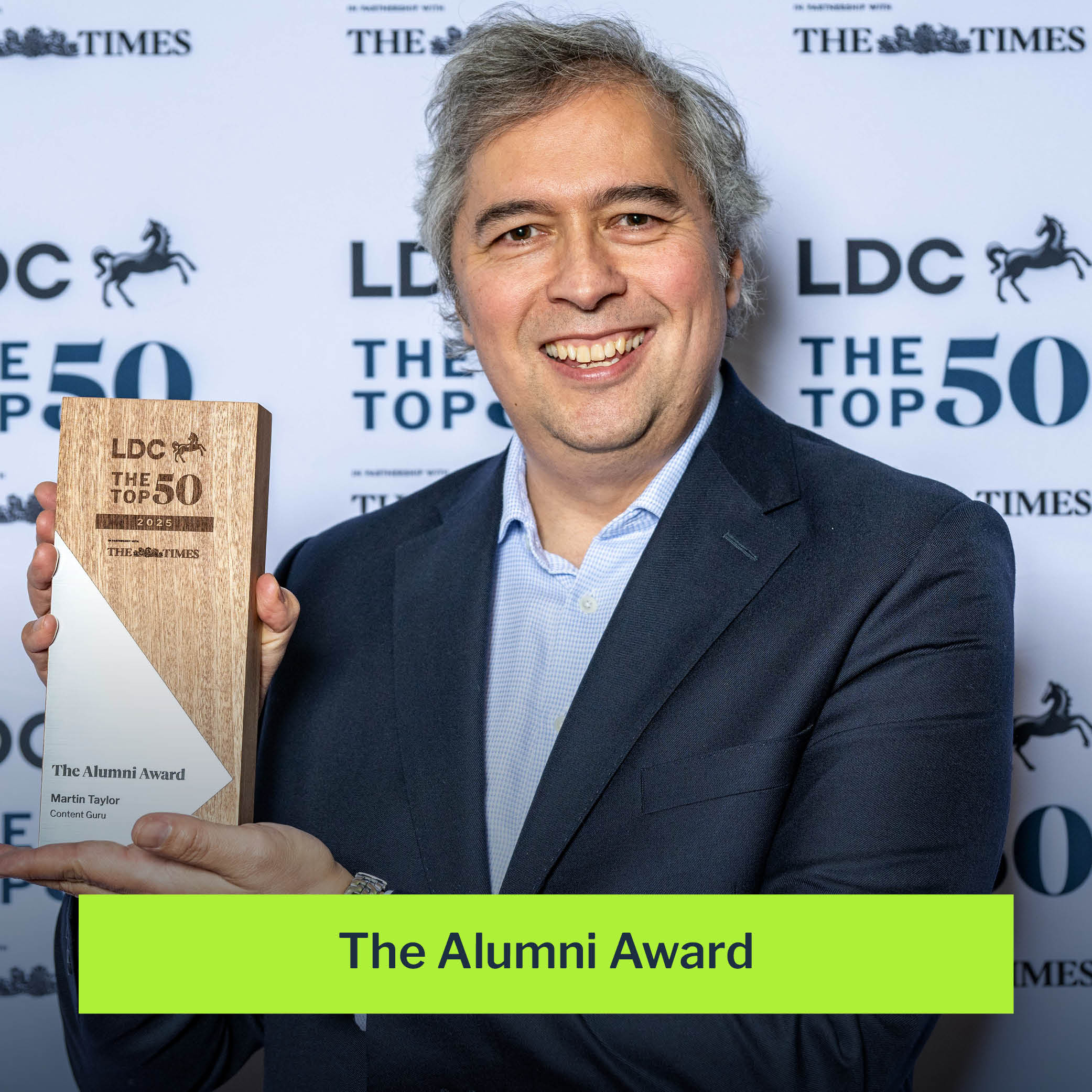
The 2025 LDC Alumni Award added a more recent marker of recognition. Taylor’s response to the award included the confidence colleagues could gain from seeing founders recognised outside the business. His account put the individual honour back into the company’s working relationships.
Return, finally, to that obsolete component. It offers a compact way to read a career spent moving technology between markets, names and uses. Taylor has helped build a business willing to change its occupation. He has also kept an object that argues for stopping. The paperweight has a modest job description. It seems to have found a suitable employer.
Continue the conversation
- Content Guru - leadership and career
- Martin Taylor on LinkedIn
- LDC - the 2020 conversation
- LDC - the growth journey and Alumni Award
- TalkingPointz - the story behind the names
- Forbes Technology Council - lessons from difficult projects
- British Patient Capital - the 2018 investment
- Content Guru - UK Power Networks award
- Computing - the 2024 interview
- CX Today - data ownership conversation
- CX Today - AI agents, April 2026
- CX Today - platform discussion, July 2026
- Call Centre Helper - quality across channels
- King’s College London - engineering prizes
- Forbes Technology Council - Martin Taylor’s profile
- YouTube - the 2025 interview
- YouTube - quality across channels