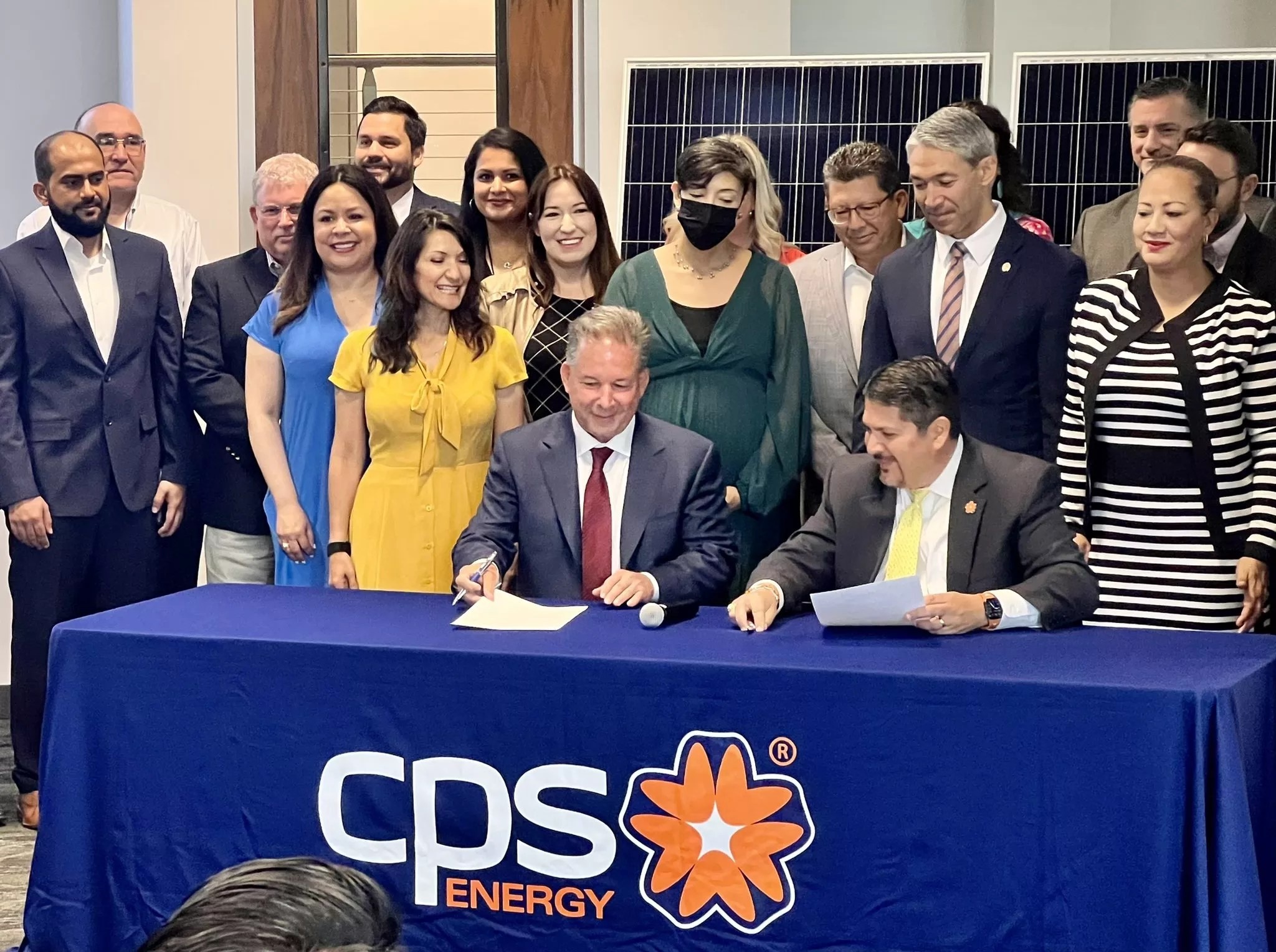
In the photograph, Mark Noyes is doing something less picturesque than standing beneath a wind turbine. He is signing a document. Beside him is Rudy Garza, then interim chief executive of CPS Energy, the San Antonio utility. The occasion, in May 2022, was a solar agreement. The pen is a useful place to begin.
The deal concerned 300 megawatts of solar power from a project in Goliad County, Texas. CPS Energy would buy the electricity for 25 years. Con Edison’s development business would carry the construction, operation and maintenance costs. There were commitments for community support, education and local spending. A photograph of paperwork turns out to contain quite a lot of the energy business.
Noyes was president and CEO of Con Edison Clean Energy Businesses. Within months, its parent would agree to sell the business to RWE in a transaction valued at $6.8 billion. The price made the news. The earlier agreement helps explain what an energy company is being paid to do: assemble equipment, money, customers and obligations into something that works for decades.
An engineer takes the long way back
Noyes graduated from Worcester Polytechnic Institute in 1986 with an electrical engineering education. He also earned an MBA at Rutgers. The combination gives his career an appropriate pair of coordinates: the machinery has to work, and so does the business around it. Neither discipline offers much sympathy when the other has been neglected.
His early professional years were at Con Edison. He eventually became vice president of asset management and acquisition. An account of that period describes responsibilities across 1,700 megawatts of generation, including acquisitions, operations, planning and environmental compliance. This was an education in power as an ongoing responsibility, with plenty to consider after a plant had been purchased.
Then he left. His entrepreneurial work included WebGen Systems, an energy management business serving commercial and industrial customers. Its activities reached across efficiency, demand response, energy purchasing and distributed generation. That placed him close to the customer’s electricity bill, where a clever technology still has to justify its presence in a building.
He also founded CPower and later advised energy clients through B4U Services. The consulting practice covered technology, acquisitions and business development. By 2008, Noyes was back at Con Edison, this time as a vice president of Con Edison Development. The return gave the career a loop: utility experience, smaller businesses, then another attempt at building within a larger organization.
Growth acquires a closing date
In 2009, he structured Con Edison’s Clean Energy Businesses. Solar became an important part of the platform. In 2015, for example, Con Edison Development acquired six California solar projects totaling 140 megawatts DC. Their output was tied to power purchase agreements with Southern California Edison and Pacific Gas & Electric. Expansion meant assets with customers attached.
The recurring work was development, acquisition and operation. By the time of the RWE agreement, the business had become a substantial renewable energy platform. On October 1, 2022, Con Edison agreed to sell it. The transaction closed on March 1, 2023, with a stated enterprise valuation of $6.8 billion. Those two dates belong together: an agreement still has a journey to make before ownership changes.
Enterprise valuation of Con Edison’s clean energy business in its sale to RWE.
Noyes became CEO of the newly combined RWE Clean Energy on the closing date. RWE brought its existing American renewables activities together with the acquired business. At launch, the combined portfolio contained eight gigawatts of operating assets, with more than 24 gigawatts in development. Integration put another kind of engineering on the agenda: making organizations function together.
He remained through January 2024. When RWE announced his departure by mutual consent, its chief executive, Markus Krebber, credited him with positioning the combined business in the American market and helping deliver its first year. Andrew Flanagan succeeded him. Noyes’s part in the transaction had extended from the business being sold to the company that emerged afterward.
Electricity has an appointment
One project during his RWE tenure makes the operating problem particularly clear. In June 2023, RWE announced the grid connection of the battery portion of Fifth Standard, in California’s Fresno County. The plan paired 150 megawatts AC of solar with a battery capable of delivering 137 megawatts over four hours.
That four-hour interval matters. Sunshine and customer demand keep their own schedules. A battery creates a way to hold electricity for later delivery. At Fifth Standard, the announced energy storage capacity was 548 megawatt-hours. The distinction between megawatts and megawatt-hours is practical: one describes the rate of delivery, the other how much energy can be stored.
The project fits a longer thread in Noyes’s working life. Before managing large portfolios of generation, he worked on managing consumption. He is also an inventor in automatic energy management and energy consumption reduction. The scale has changed, but both kinds of work concern how an electricity system behaves when people actually use it.
The neighbors are part of the calculation
In a 2023 interview, Noyes described three conditions for renewable development: the quality of the wind or sunlight, transmission access and the associated connection cost, and partnership with the local community. The list is refreshingly resistant to a glossy rendering. A strong resource can only take a project so far.
“It’s driven really ... by demand from the customers.”
Mark Noyes, discussing renewable development in 2023
The CPS Energy agreement supplies a concrete example of the community element. Con Edison Development committed $500,000 over ten years to community priorities and planned annual spending with local suppliers and vendors. These commitments were part of a long commercial relationship. The electricity would travel through a grid; the economic relationship would remain attached to particular places.
His connection to Renewa adds the ground beneath those projects to the picture. In 2023, QIC announced Noyes’s appointment as an independent director alongside Peter Tumminello and Natalie Jackson. Renewa supplies capital through land and rental-payment interests beneath renewable infrastructure. A solar farm occupies a financial arrangement as well as a field.
For Noyes, this board role sits alongside experience in generation and customer energy services. It is another view of the arrangements that let infrastructure exist. Developers, landowners and investors can have different needs and time horizons. Giving a project a durable place to stand involves more than selecting a sunny location.
Another pipeline, another calendar
TerraForm Power named Noyes president and CEO on November 19, 2024. The Brookfield-backed business offered another setting for development, acquisitions and the operation of existing assets. His stated aim was to scale the company in the American market. The appointment brought a familiar set of responsibilities under a different company name.
In February 2026, TerraForm announced the acquisition of Steward Creek Solar from Hexagon Energy. The Illinois development carried a planned capacity of 1.56 gigawatts. It also had a 600-megawatt interconnection agreement involving Commonwealth Edison and PJM. That agreement was a milestone within a larger development, with substantial work still on the calendar.
The announced schedule put first-phase construction in 2027 and commercial operation in 2029. The second phase was expected to begin construction in 2028 and operate in 2030. Each phase was projected to produce about 1.3 terawatt-hours annually. These were plans, with completion ahead of them. Keeping the future tense is part of understanding the business.
The acquisition brought TerraForm’s pre-construction solar and storage pipeline to nearly seven gigawatts. Its February announcement separately described 2.6 gigawatts of operating wind, solar and storage across 16 American states and Ontario. A pipeline and an operating portfolio deserve separate lines. One describes opportunities to deliver electricity; the other describes assets already in service.
The organization behind the equipment
Noyes calls his leadership approach “One Team, One Mission.” He emphasizes organizational alignment and diversity of thought. That is a relevant ambition for someone whose career includes the combination of established businesses. A common owner does not automatically create a common way of working. People still have to make decisions together.
In November 2025, he joined Vinay Shandal on the Pitching Progress podcast to discuss renewable energy, storage and electricity demand. Shandal later described his humility and appetite for growth. Away from project announcements, Noyes has shared an uncomplicated enthusiasm for Thanksgiving: family, food and football. Even an electricity executive can appreciate an afternoon whose fixtures are already arranged.
In October 2026, WPI named him a recipient of its Robert H. Goddard Alumni Award for Outstanding Professional Achievement. Four decades after his graduating class, his work still sits between technical systems and the organizations that build them. The pen in the San Antonio photograph captures that position neatly. Once the agreement is signed, there is electricity to deliver.