Suzette has a jeweled necklace, a Louis Vuitton carrier and a place in an airport lounge. She is three years old, accustomed to business class and entirely untroubled by the historical significance of her travel arrangements. Suzette is a Chihuahua. In the opening pages of Pet Nation, Mark L. Cushing gives her the entrance of a society hostess. The joke works because the reader recognizes the scene. Somewhere along the way, the family dog acquired an itinerary.
Cushing has made a career out of paying attention to what follows such apparently small changes. A dog comes indoors. A hotel changes its rules. A landlord demands a deposit. Eventually, an ordinary household preference becomes a question for a legislature, an employer or a lawyer. Cushing happens to be a lawyer, and he has spent years following the dog through the door.
As founder and CEO of Animal Policy Group, he works where private affection meets public rules. As an author, he asks how that affection rearranged American life. The combination gives him an unusual vantage point: he can appreciate the comedy of an extravagantly equipped Chihuahua while taking seriously the institutional machinery that permits her to accompany her owner.
The call before the boarding call
His route into this world began with another airport moment. He was preparing to fly from Ottawa to Washington when the founder of Banfield called about a pet-microchip problem in Congress. Cushing was then working largely for Canadian interests. Pets were about to become considerably more than a passing assignment.
The coalition needed someone who could navigate Washington. He did the job, expected to collect his fee and continue with other business, and discovered that the next call was about animals too. Then came another. There are carefully plotted career changes, and there are careers that gradually occupy the telephone.
He had already spent roughly twelve years trying business cases in Portland and across the West. Jury work appealed to him. As disputes increasingly went to mediation and arbitration, the work was changing underneath him. A successful turn in Oregon electoral politics had meanwhile brought lobbying opportunities. The person who liked persuading jurors found another audience for persuasion.
That helps explain the tone of his later work. Cushing approaches an argument as something that has to survive contact with other people. The pet assignment drew on skills he already had: understanding institutions, identifying the people who can make decisions and assembling a group willing to act together.
A historian with a practical streak
Long before the policy firm, there was McMinnville, Oregon. Cushing grew up fourth in a family of five children, with a lawyer father and an older brother who also entered law. He remembers competition, sports and the freedom of a small-town childhood. Law school was an expectation he shared; becoming an animal-policy specialist was a development still some distance away.
At Stanford, his interest was medieval and Renaissance history. He later taught that subject to boys at a Jesuit preparatory school in Los Angeles and coached basketball. Persuading sophomores to care about the Renaissance struck him as particularly demanding work. A jury, at least, has been instructed to listen.
He eventually graduated from Willamette University College of Law. His professional biography also includes leading government-relations practices at Tonkon Torp and Winstead Sechrest & Minick. These were substantial stretches in law and politics before the public came to know him as the author of a book about pets.
The history degree deserves a second look. In a 2024 column, he returned to his undergraduate interest in ideas and culture when considering institutional change. That is a useful clue to his approach. He is interested in the interval between a society adopting a habit and its institutions adjusting to the consequences. A household can move rather faster than a rulebook.
“Dogs are knitting society together.”
Mark L. Cushing
A book arrives by telephone, too
In May 2018, literary agent Kitty Cowles called. Cushing's brother in Manhattan knew her. Publishers wanted an insider's account of America's changed relationship with pets: the figures, stories, arguments and humor behind a transformation people were living through without necessarily stopping to examine it.
He had been watching it from the inside. By 2010, he wrote, the pet sector occupied all his professional time. The book invitation offered a chance to connect the individual disputes and assignments to a larger cultural story. The practitioner had accumulated a subject; now he needed to make it readable.
That distinction matters. A policy professional can assume an audience already cares about the next procedural obstacle. A general reader owes the writer no such courtesy. Cushing had to make the reader see why a change in where a dog sleeps could belong in the same account as a change in commerce, politics or public space.
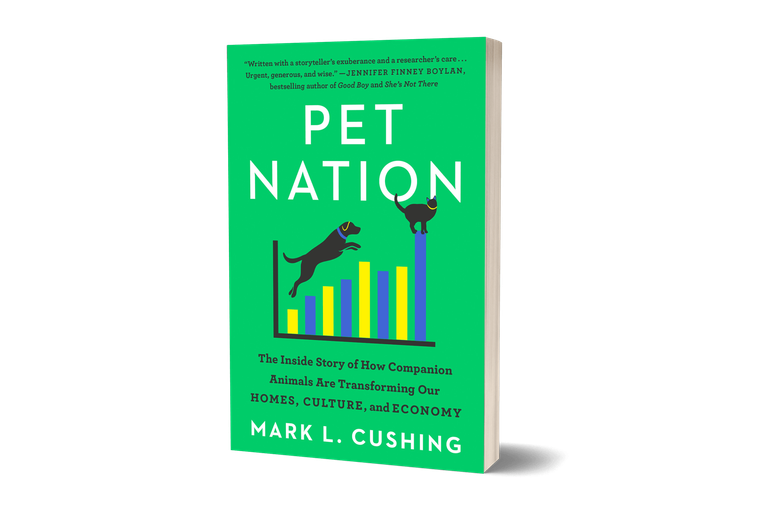
Avery published Pet Nation on September 8, 2020. The original subtitle was The Love Affair That Changed America; the later paperback used The Inside Story of How Companion Animals Are Transforming Our Homes, Culture, and Economy. The first title supplies the romance. The second begins listing what the romance has done to the furniture.
Lassie gets a seat at the table
Cushing's explanation reaches back to the entertainment people grew up with. Lassie, cartoon dogs and movie animals helped make pets familiar as personalities. Later, car advertising could put a dog in the passenger seat and allow the audience's feelings about the animal to do some of the selling.
He sees the late 1990s as a turning point in the story. Animals became more closely integrated into homes, then accompanied people into the wider world. Restaurants, shops, hotels and planes became places where the practical meaning of companionship had to be negotiated. The dog's social calendar began to resemble the owner's.
The appeal of this account is its attention to ordinary behavior. No central committee instructed Americans to reorganize their households around their pets. People made small decisions, repeated them and came to regard the new arrangement as natural. Businesses and institutions then had to decide what to do with the result.
- 01The backyardPets at the edge of household life
- 02The bedroomCompanions inside the family routine
- 03The front doorPets accompanying people into public life
His own tastes are reassuringly specific. He has named Lassie and the animals in Homeward Bound among his favorites. In 2021, his household included two cats and a dog. The observer of national pet culture was living in a small, mixed-species constituency of his own.
Affection does not settle every argument for him. He has opposed changing pets' legal status from property, warning of economic consequences. That position complicates the easy assumption that someone celebrating pets as family will support every proposal expressed in the language of animal rights. Cushing's attachments and his policy judgments do not always use the same vocabulary.
The revolution meets a rental agreement
In February 2025, he turned to a question with very little glamour and considerable practical importance: how to make it easier to own a dog. Housing rules were central to his argument. Restrictions on size, number and permission itself can determine whether a person and a pet can share a home.
He described Animal Policy Group's work with the American Pet Products Association on housing initiatives. He also reported progress on pet deposits for lower-income households in two cities, while leaving the cities unnamed. The aim was to develop approaches that could travel to other jurisdictions.
Workplaces were another concern. Cushing urged employers to consider controlled arrangements for bringing dogs to work or schedules that gave owners more time at home. He framed these as choices organizations could explore, with rules and limits, rather than an automatic entitlement for every employee with a leash.
Here the author and the advocate converge. A culture can celebrate dogs constantly and still make owning one difficult. The important question becomes who gets to participate in the arrangement. A pet-friendly advertisement is pleasant; a rental agreement has considerably more authority over where someone sleeps.
 Watch the conversation ↗
Still taking the next call
The work has continued beyond the book tour. Cushing received the 2023 VIS Veterinary Innovation Award. His professional life also includes teaching at law schools and advising educational institutions. Animal Policy Group describes a practice extending across the United States, Canada and Mexico, giving his work a wider geography than the American households in his book.
His writing continues alongside it. He has contributed the Politics and Policy column to Today's Veterinary Business since 2017. In a February 2026 dispatch, he described January travel from Arizona through Orlando to Toronto. The weather supplied some of the humor: a person wintering in Arizona has a clear reason to notice Toronto's temperature.
There is a pleasing continuity here. The history student became a teacher, trial lawyer, strategist and author, retaining an interest in how people can be persuaded and how institutions change. His subject now supplies endless small encounters between the two. Every newly welcomed dog raises a practical question about the next doorway.
Suzette, one suspects, would consider all this paperwork somebody else's concern. Cushing has chosen to make it his. The jeweled necklace gets the laugh. The permission to come along is where his work begins.
Follow the conversation
Read Cushing’s website and Pet Nation; explore Animal Policy Group.