In October 2008, Jeffrey J. Kimbell had a charitable proposition for his Washington friends: bring a car, choose a cause, and find out whose confidence could survive a quarter-mile track. The proposed venue was Capitol Raceway in Crofton, Maryland. His intended ride was a 1969 Plymouth Belvedere V8 highway patrol car. A Washington fundraiser had acquired an unusually literal starting line.
Nearly 30 participants were expected for the first “Lobbyists for Speed” event. Entry cost $300. Drivers needed helmets and street-legal cars; enthusiasm alone would not pass inspection. Kimbell, who raced several times a year through the National Hot Rod Association, had assembled a nine-person board. Even an afternoon of acceleration apparently required a committee.
“Running is one mile per hour. I prefer 130 miles per hour,” he said at the time. The arithmetic was playful. The preference was clear. Here was an organizer who thought a familiar purpose might benefit from an unfamiliar occasion. Charity could accommodate a little horsepower.
“Running is one mile per hour. I prefer 130 miles per hour.”
Jeffrey J. Kimbell, discussing his 2008 charity race
That episode belongs in the same story as the firm he founded in 1998, the entertainment business he co-founded in 2003, and the Washington visits he helps arrange for school students. Across these activities, Kimbell repeatedly takes on the practical task of gathering people. The guest list changes. So does the dress code. His willingness to organize the occasion has proved rather durable.
The music came along
Kimbell grew up in Lake Forest, Illinois, with Chicago’s music scene within reach. Older siblings helped introduce him to live performances. That interest followed him east to St. George’s School in Newport, Rhode Island, and later to Southern Methodist University in Dallas. New geography supplied new venues.
At SMU, he was twice elected his fraternity’s social chair and booked bands including Beanland and Jackopierce. There is an early indication of the work he would keep returning to: turn an enthusiasm into an event, then accept responsibility for making it happen. Enjoying a band is straightforward. Booking one introduces a calendar, a budget and other people’s expectations.
Washington supplied a larger stage. Kimbell became president of the Capital Club from 1997 to 1999. Its events included the Santa Soirée, the Sinatra Summer Soirée and Swine on the Vine, a title admirably resistant to bureaucratic solemnity.
The summer of 1999 provides a particular scene: the Kennedy Center’s Rooftop Terrace, young Washington professionals, and live music from Swingtown at the club’s fifth annual Summer Sinatra Soirée. Kimbell was the club’s president. The setting placed music and social life together, several stories above the usual office routine.
In 2003, he and John Green made their shared interest a company, Magnum Entertainment Group. They had come to know one another through Washington politics and music venues. Their partnership gave the event organizing its own business address and obligations. A pastime that had traveled through several cities now had a formal enterprise attached.
A profession with other people in it
St. George’s placed him in its Class of 1989. He then studied at SMU from 1989 to 1993, earning a B.A. in Political Science. The sequence puts the music bookings beside a defined academic interest: how public decisions get made. Both interests would remain visible in the businesses and educational work that followed.
His Washington career had begun with an apprenticeship around public officials. He worked for Congressman Sam Johnson while studying political science at SMU. After college, his early roles included personal aide to former senator Howard H. Baker Jr. and personal attaché to former secretary of state Lawrence S. Eagleburger at Baker, Worthington, Crossley & Stansberry.
These are unusually personal job descriptions. An aide or attaché occupies the working space around someone else’s responsibilities. The titles themselves place him close to people whose careers depended on knowing how institutions operated. They also help explain the sequence of his résumé: individual support roles, association leadership, and then a firm carrying his own name.
He became an association’s first executive director in 1994 and remained until 1998, the year he established Jeffrey J. Kimbell & Associates. He has continued to lead the business. His professional record also includes congressional testimony and speaking engagements at business schools and industry gatherings.
His work also involved tracking legislative activity for corporate clients at Baker-Worthington. That task supplies a useful detail beneath the recognizable names in his early career. Before leading an organization, he had work to do with the documents, schedules and decisions that give Washington its daily rhythm.
Other enterprises widened the map. Kimbell became managing director of Jackalope Real Estate, with holdings in Washington, Park City and Cabo San Lucas. Magnum’s events have extended beyond the United States. The combination gives him a professional life with several settings, rather than one office serving as the backdrop to every chapter.
There is a temptation to make all these interests prove one grand theory of success. The record supports a more modest observation: Kimbell has repeatedly chosen work that requires dealing with people, arranging circumstances and following through. The results belong to different businesses. The recurring activity is easy to recognize.
Who gets an invitation?
Club leadership offers a particularly clear view of his social interests. After the Capital Club, Kimbell served as president of Washington’s City Tavern Club from 2004 to 2007. During that period, the club was recruiting younger professionals. In a 2006 account, roughly 30 percent of its members were under 35; most of its 90 new members in the preceding year came from that age group.
Those figures put his presidency inside a concrete institutional question: how does an established club attract another generation? The appeal of an old room depends partly on whether new people want to spend time there. Tradition still needs somebody to accept the invitation.
By June 2025, Kimbell was among the Republican lobbyists appearing in an account of Washington’s Ned’s Club, where members of both parties mixed in a setting with dining and live music. His presence fits the social geography of his earlier career. The larger setting also raises a legitimate question about who can enter such places.
Private clubs offer opportunities to meet people and exchange information. They reserve those opportunities for members and guests. Both facts matter when considering Washington sociability. A convivial room can make conversation easier while remaining difficult to enter. Any portrait of a well-connected organizer is more useful when it keeps the doorway in view.
A teacher remembered in Washington
In 2008, Kimbell established an endowment honoring his former St. George’s history teacher, William S. R. “Robin” Rogers. The tribute supported public-policy study through visits to Washington. Other alumni and colleagues helped turn the idea into a program with speakers, meetings and an itinerary.
The choice of honoree gives the undertaking its personal center. A student returned to the influence of a teacher and found a way to carry it forward. Instead of requiring that later students imagine government entirely from a classroom, the program brought them into contact with people working inside it.
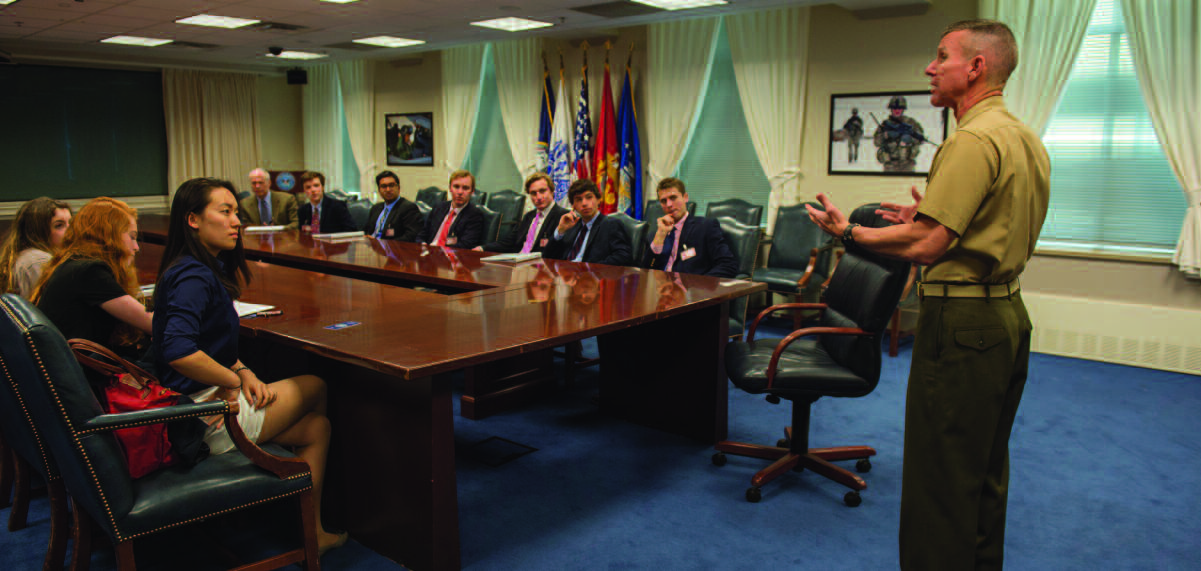
In March 2016, ten St. George’s students spent four days in the capital. Their Pentagon visit included briefings and conversations with senior military personnel, with alumnus and Pentagon press secretary Peter Cook helping host them. Kimbell and the program’s board coordinated themes and speakers with school staff and student input.
The scale matters: a small group can ask questions, hear answers and experience the distance between a public institution’s reputation and its daily work. A program like this gives an abstract subject faces and voices. It also asks busy adults to make time for people who have no professional claim on their calendars.
Kimbell’s own path had taken him from school to university to work around experienced officials. The endowment created a way for younger students to encounter a similar world before choosing a career. Remembering a teacher became an invitation for somebody else to begin learning.
Take the meeting outside
Park City is Kimbell’s home, and the outdoors occupies a regular place in his family life. He and his three children enjoy fly fishing, hunting and skiing. These interests appear alongside his professional commitments, with congressional recesses providing opportunities to travel.
In April 2025, the firm’s 27th-anniversary account described an offsite hosted at his Utah home. Colleagues skied at Deer Valley and Park City, fished the Provo River, and heard from Olympian Steven Nyman. There was music from John R. Ray of the Washington band Wet Chicken. Kimbell supplied elk burgers.
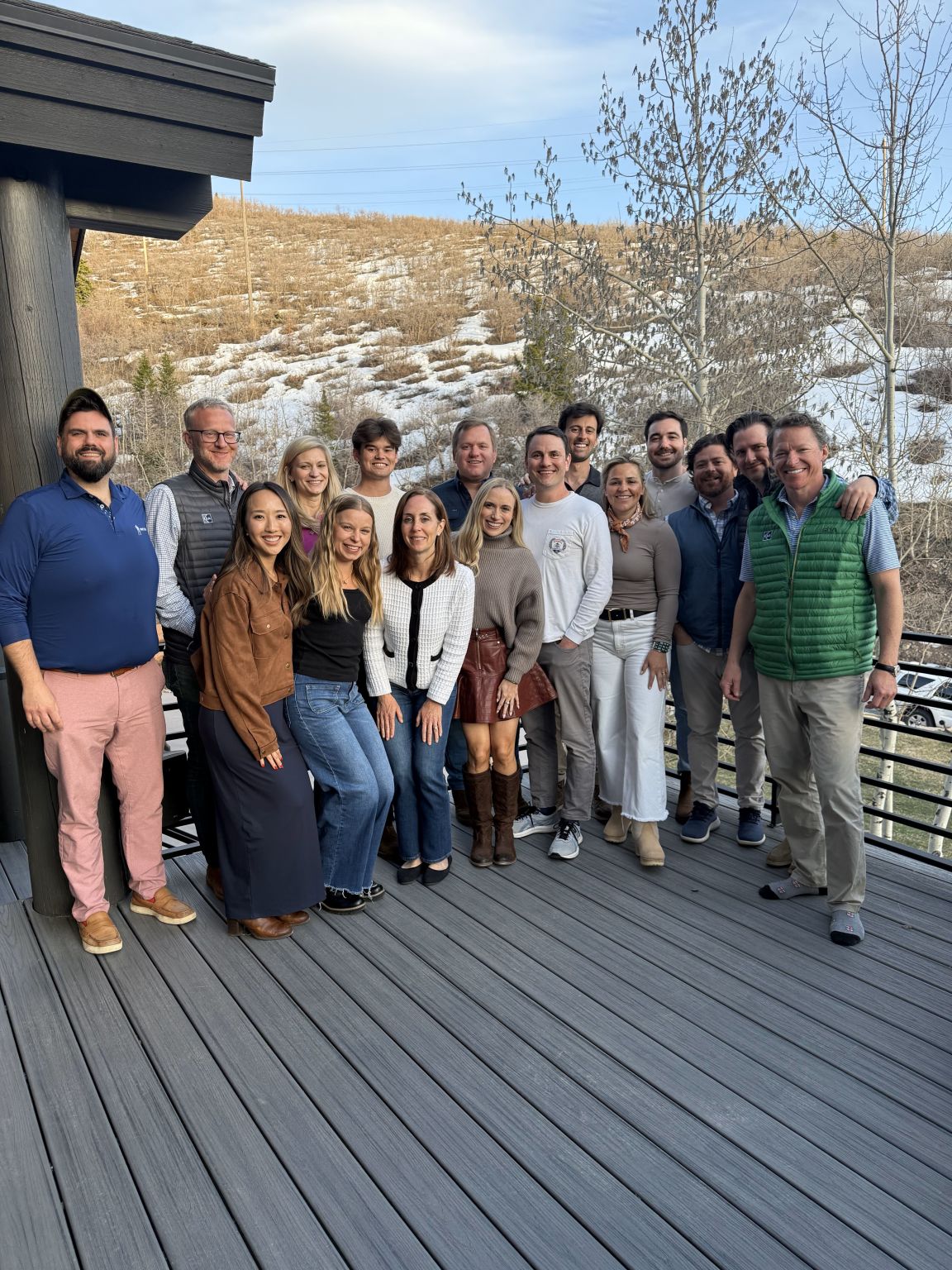
It is an appealingly specific alternative to an offsite described only as team building. There is a river, a skier with something to tell them, a musician and lunch. Each person has something concrete to do or hear. The activities give colleagues experiences to remember together after returning to work.
The firm had previously held gatherings in places ranging from West Virginia to Newport. Utah added a more personal setting: the founder’s home. That choice brought colleagues into a part of his life usually listed near the end of a biography, under interests. For a few days, those interests became the schedule.
Return to the proposed race in 2008 and the family resemblance is visible. Kimbell starts with people and supplies an occasion worth leaving the usual routine for. Sometimes there is a band. Sometimes there are students with questions. Sometimes there is a Plymouth at the starting line. The calendar fills in different ways, but somebody still has to make the invitation.