In 1987, Adam Schwarz arrived at The Jakarta Post through a Luce fellowship. He had studied economics at Duke and international business at Columbia. A newspaper in Indonesia might have looked like an interesting interval between more conventional jobs. Nearly four decades later, Southeast Asia remains the centre of his working life. The assignment became a much longer education in the relationship between money, government and the people who make decisions.
Today he is the founder and CEO of Asia Group Advisors, based in Washington, DC, and advising executives on Southeast Asian opportunities and risks. His route there passed through regional journalism, a book about Indonesia and twelve years at McKinsey. It is an unusually coherent collection of occupations once you notice their shared difficulty: a promising economic story can become troublesome when somebody asks how the political machinery actually works.
A newspaper assignment with a long afterlife
His early career had already supplied a different view of international business. After graduating from Duke in 1983, Schwarz worked in investment banking at Banco Roberts in Buenos Aires. He subsequently edited the Columbia Journal of World Business while attending business school. His 1997 professional CV records work on an issue about the international debt crisis. Before Jakarta, he had been learning how financial decisions travel across borders.
The Luce placement put him in a newsroom. Later, as a correspondent and bureau chief for the Far Eastern Economic Review, he worked across Indonesia, Hong Kong, Thailand and Vietnam; his current biography also includes Australia. The job required looking at each place on its own terms. “Southeast Asia” is a convenient phrase on a conference programme. For a reporter, it contains a great deal of work before the first sentence can be written.
That geography matters to the career that followed. A regional adviser’s credentials can resemble a list of airports. Schwarz’s include newspaper assignments and a sustained attempt to understand one country in book-length detail. The distinction is useful: familiarity with a capital is a beginning, while explaining its political economy is a task that can keep changing long after the visiting correspondent has unpacked.
- 1987The Jakarta Post
Luce placement - 1994A Nation in Waiting
First publication - 2001McKinsey
Advisory chapter begins - 2013Asia Group Advisors
Founder & CEO
The country that would not fit the spreadsheet
A Nation in Waiting appeared in 1994. Its original subtitle, Indonesia in the 1990s, placed the reader firmly inside a country still governed by Suharto. Schwarz examined economic development alongside political rigidity, questions of succession, the role of business interests, Islam and East Timor. The organising tension was the widening distance between an increasingly modern economy and the political arrangements expected to manage it.
The book’s timing gives it particular interest. Readers encountered those questions before Suharto’s departure from power. Schwarz had researched and written the book during a visiting fellowship at Murdoch University’s Asia Research Centre in Perth in 1992-1993. A career built around frequent changes of location had made room for the slower labour of a manuscript. News reporting supplied the subject; a book gave the argument room to breathe.
In a 2007 interview, Schwarz revisited Indonesia’s financial crisis through three overlapping transitions. Financial distress collided with the move from authoritarian government to democracy and, subsequently, the transfer of power from Jakarta to the regions. He argued that the institutional demands of those changes helped explain the depth and duration of the upheaval. Economics alone offered an incomplete account of what had happened.
The lesson was uncomfortable for anyone hoping to isolate a single culprit. His explanation required examining banks, political authority and the readiness of local institutions together. A new allocation of responsibility could arrive faster than the capacity to exercise it. This remains a useful way to read his later career: again and again, the question is how an economic intention passes through the institutions that must carry it out.
From explaining decisions to helping make them
Schwarz received the Edward R. Murrow Fellowship at the Council on Foreign Relations for 1997-1998. In 2001, he joined McKinsey & Company in Southeast Asia. Over the following twelve years, his clients included private businesses, public bodies and state-owned enterprises. His assignments ranged across corporate strategy, organisational change, governance and regional economic integration, with work in energy, telecommunications, agribusiness and finance.
Consulting changes the obligations of the person asking the questions. A correspondent can leave a reader with a revealing account of a difficult situation. An adviser owes a client some account of what to do next. Schwarz’s move placed his regional knowledge inside that second obligation. The interesting continuity is the need to understand authority, incentives and institutions before recommending a course of action.
One assignment made implementation especially concrete. In 2005, at President Susilo Bambang Yudhoyono’s request, he led McKinsey’s year-long support to the Aceh Reconstruction Agency, known as BRR, following the Indian Ocean tsunami. His Luce biography records an Indonesian government “Hero of Aceh” award for his contribution. Reconstruction brought the work into an agency charged with coordinating aid and turning it into delivery.
His McKinsey responsibilities also included sustainability and resource productivity. Beyond commercial clients, his biography records advisory work for the US State and Defense departments and the World Bank. Those experiences broadened the set of institutions in his professional life. Corporate boards, ministries and development organisations bring different responsibilities to a discussion; knowing the vocabulary of one does not automatically make the others legible.
A firm built around the local question
In 2013, Schwarz founded Asia Group Advisors. The firm’s work covers policy analysis, government relations, market entry and strategic communications. Each service addresses a different part of the same business predicament: a company can understand demand for its product and still need help understanding the decisions that determine whether it can operate, expand or respond to a change in policy.
In his message as CEO, Schwarz emphasised sustained local engagement and flexibility in dealing with governments and other stakeholders. He described a team expected to anticipate clients’ needs. That is a practical ambition for a policy advisory business. Waiting for a rule to cause a problem can leave a company with fewer choices than understanding the conversation while the rule is taking shape.
His professional connections also extend outside the company. USINDO lists him among its advisers. The Atlantic Council identifies him as a nonresident senior fellow, and RSIS has listed him as an adjunct senior fellow. These affiliations place him in communities concerned with Indonesia, regional security and public policy. They provide a setting for the continuing public part of his work: writing, speaking and discussing the region beyond a client assignment.
There is something appealingly unglamorous about the subject matter. A regulatory question does not become easier because a strategy presentation has attractive typography. Someone still has to establish which institution is responsible, what it is trying to achieve and how a business proposal fits. Schwarz’s career gives that work a history stretching back to the newspaper rather than beginning with the consultancy’s launch.
“Many of our clients operate beyond Asia’s borders.”Adam Schwarz · April 2025
When the clients outgrow the map
On April 2, 2025, Access Partnership announced its acquisition of Asia Group Advisors. The deal brought more than forty AGA policy specialists in Indonesia, Malaysia, the Philippines, Singapore, Thailand and Vietnam into the combined business. AGA would operate as “Asia Group Advisors, an Access Partnership company.” Schwarz remained the CEO identified in the announcement and continues to be listed in that role.
His explanation of the deal began with the clients. “Many of our clients operate beyond Asia’s borders,” he said. Access Partnership’s presence in Europe and the United States offered a way to provide wider support alongside AGA’s regional work. A consultancy established around Southeast Asian questions was joining a network suited to questions that crossed more borders. The stated rationale followed the customers’ geography.
Schwarz’s own announcement described extending the mission he had begun in 2013. He thanked his team and highlighted the combination of local knowledge with broader capabilities. It is a recognisable founder’s moment: the organisation keeps its regional experience while entering a larger company. The work now has to connect those strengths in practice. An acquisition announcement can explain the logic; clients eventually test the connection.
AGA’s team at the April 2025 acquisition, across six named Southeast Asian markets.
The microphone comes with homework
Schwarz continues to write. In July 2025, his account of ASEAN’s US tariff negotiations examined pressures that could not be reduced to the tariff percentage. Governments seeking an agreement also had to consider domestic reactions and their relationships with China. He wrote that his analysis drew on conversations with officials in five ASEAN countries. The former correspondent’s habit of asking people directly was still visible.
The article treated trade bargaining as a political problem as well as a commercial one. Concessions could carry costs elsewhere, and negotiators faced uncertainty about both the demands and the durability of relief. Here was the familiar crossing between categories: a number on a customs schedule belonged to a larger argument about power, relationships and the choices available to a government.
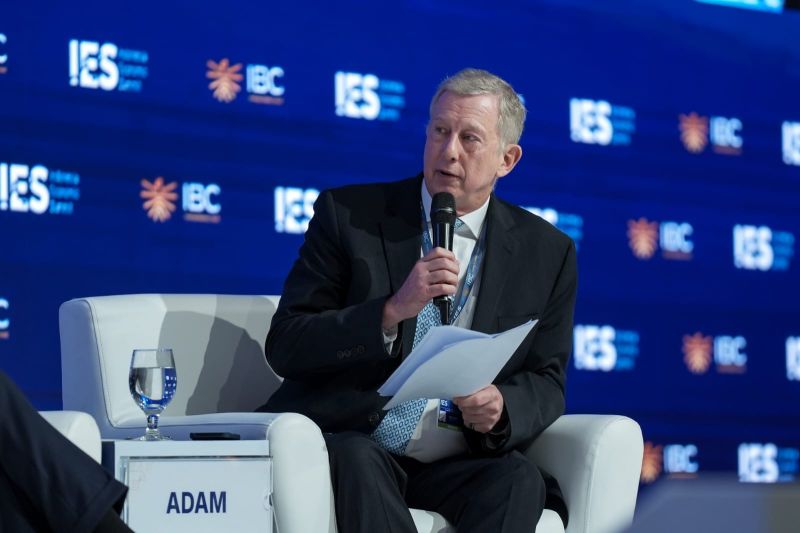
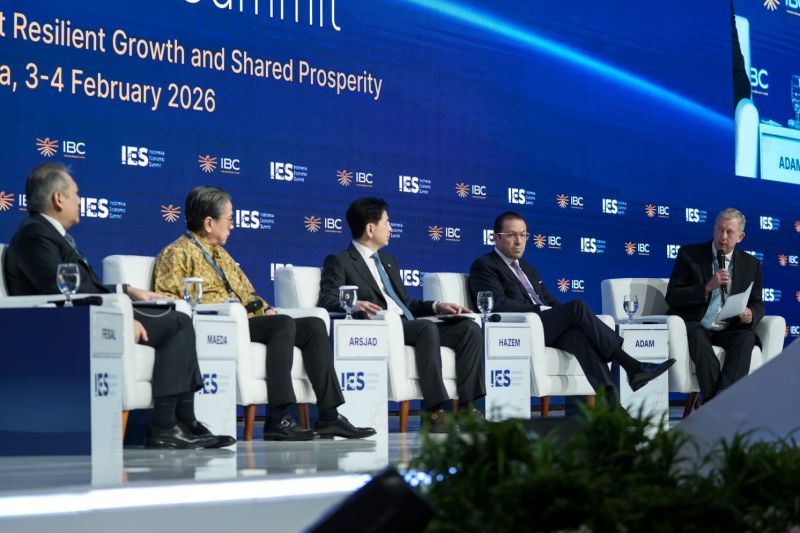
At the Indonesia Economic Summit in Jakarta in February 2026, Schwarz moderated an investment discussion with business and finance leaders including Arsjad Rasjid, Feisal Zahir, Hazem Ben-Gacem and Tadashi Maeda. His recap acknowledged Indonesia’s opportunities while returning to regulatory certainty, licensing complexity, governance and human capital. The promise of investment was accompanied by questions about the conditions needed to sustain it.
“But turning potential into capital at scale will depend on one thing: execution,” he wrote. It is a compact statement from someone whose professional life has repeatedly met the complications hidden inside that last word. The newspaper placement, the Indonesian history, the reconstruction assignment and the advisory firm all lead back to decisions and the institutions responsible for them.
There is no need to make his different jobs look identical. Reporting, writing a book and running a consultancy ask different things of a person. Taken together, however, they explain why Schwarz’s current work has a long view. He has spent years examining the place where economic confidence meets political responsibility. For the executive hoping to invest, that is often where the interesting conversation finally begins.