Mario Harik’s early XPO story takes place in a living room. He and Brad Jacobs were discussing how technology could change transportation and logistics. Harik would later recall that conversation as an early expression of their plan for a technology-enabled transportation business. There was an idea about an old business, and a software engineer who would have to help make it work.
Harik was Jacobs’s third hire. He joined as chief information officer in November 2011, when the company was beginning the acquisition campaign that would make the XPO name familiar on highways. Before the trucks could work together, the systems had to. A purchase agreement could bring businesses under one owner. It could hardly persuade their software to become acquainted.
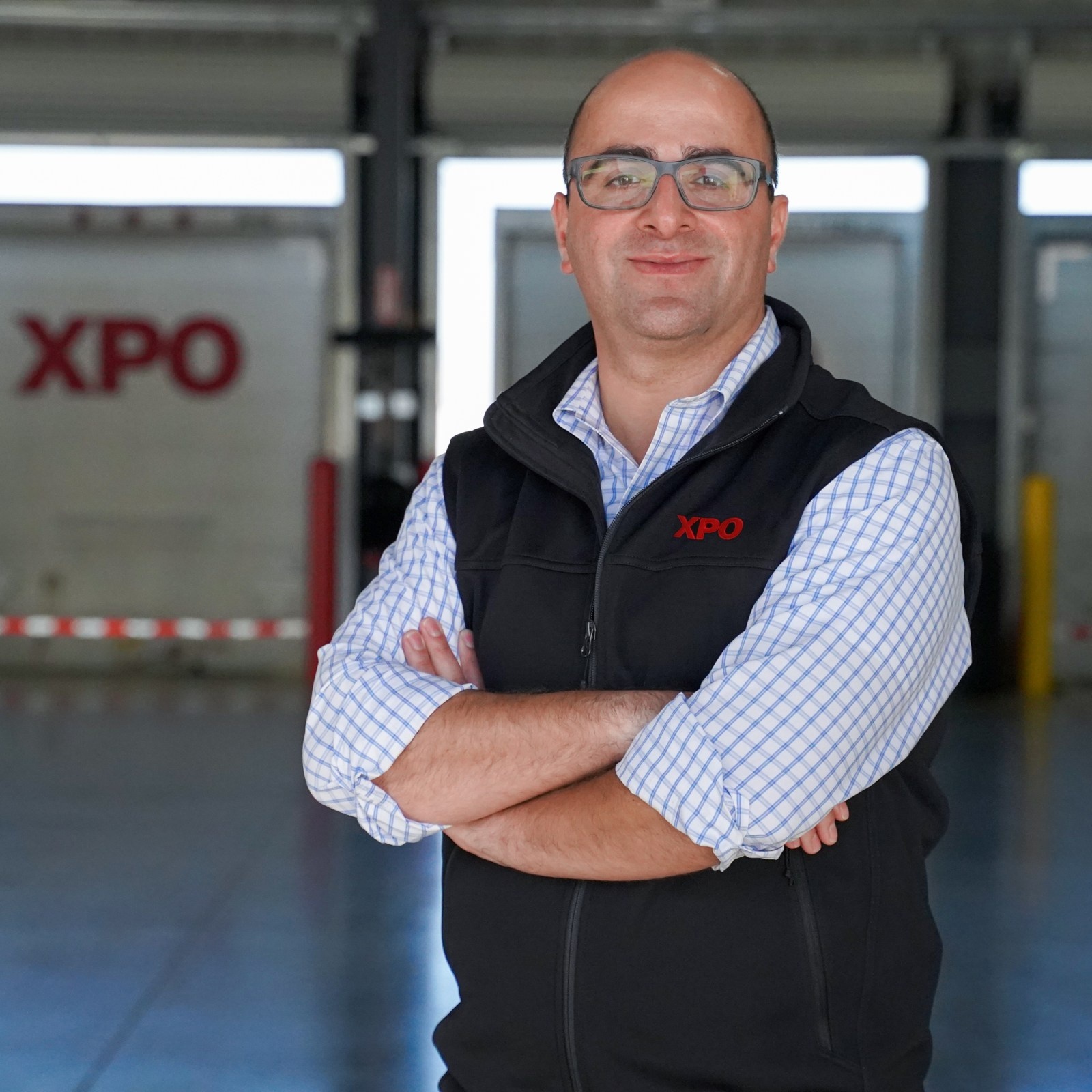
Today Harik is XPO’s chairman and chief executive, having taken the CEO job in November 2022 and the chairmanship in January 2026. The interesting part is the distance between those two kinds of responsibility. He first helped build the machinery that made decisions possible. Now he answers for the decisions, the people carrying them out, and the freight arriving at the other end.
Before the corner office, the connections
His formal training crossed two campuses: computer and communications engineering at the American University of Beirut, followed by a master’s degree in engineering, information technology, at the Massachusetts Institute of Technology. That combination put networks, computation and practical problem solving near the beginning of his professional life.
Before XPO, Harik co-founded G3 Analyst, working as chief architect of web and voice applications. He also served as chief technology officer at Tallan and as chief information officer and senior vice president of research and development at Oakleaf Waste Management. Logistics was therefore an extension of earlier work connecting information with physical services. The waste industry, too, has customers, vehicles and schedules that decline to organize themselves.
There is a homely version of his engineering outlook. With his young children, Harik explains the profession through things that need making or mending. “They build things and they fix things.” It is an appealingly short job description. It also leaves room for a lifetime of complications between identifying something broken and getting it to work.
The promotion began outside IT
Harik’s route to the top widened before it rose. In February 2021 he became chief customer officer, adding responsibility for global sales. That October he took charge of North American less-than-truckload operations. For a period, he carried those responsibilities alongside his technology role. Customers, revenue and daily operations became part of his brief before the CEO title arrived.
The transition coincided with a company becoming more focused. XPO spun off its warehousing business as GXO in August 2021. Its brokerage and other asset-light transportation operations became RXO in November 2022. Harik succeeded Jacobs as CEO when the RXO separation was completed. North America’s remaining XPO business centered on less-than-truckload freight, while the company retained transportation operations in Europe.
Jacobs had given senior executives exposure to responsibilities beyond their own departments. His account of succession emphasizes a bench of people learning how other leaders ran their businesses. Harik’s changing titles show that approach in practice. The engineer had opportunities to understand what happened when a commercial promise encountered a loading dock. By the time he became CEO, that encounter was already his business.
A truck is also a scheduling problem
Less-than-truckload, usually shortened to LTL, lets several customers share a trailer. A customer with a few pallets can buy the space needed without paying for an entire vehicle. The apparent simplicity conceals a coordination problem: collections, terminal transfers, longer highway journeys and local deliveries have to fit together.
This is fertile ground for Harik’s background. XPO’s technology work has included machine-learning models for deciding how freight should move through its terminal network. Its SMART platform forecasts dock volume and supports staffing decisions. Digital connections let customers obtain quotes, book shipments and follow their progress. Each application addresses a particular piece of work rather than an abstract ambition to become more digital.
A late departure can matter well beyond the terminal where it happened. A badly timed arrival can meet a dock staffed for a different workload. Those are ordinary consequences of a connected operation, and they help explain why a technologist would be interested in trucking. The network is a daily test of whether a plan can accommodate the world outside the plan.
Harik’s advice to aspiring chief executives has been commercially direct: “Be very commercially focused.” For him, a technology proposal needs a connection to customer service, market share or the economics of operating the business. An elegant system still has to earn its keep. Freight provides plenty of opportunities to discover whether it does.
Smaller shipments.
Coordinate the network.
Keep each promise.
The dock gets a vote
The software background does not remove the need for people who know the freight. In April 2023, XPO appointed Dave Bates chief operating officer for North American LTL. Bates arrived after 27 years at Old Dominion Freight Line, including 12 years overseeing its day-to-day North American operations. Harik was adding an operator with a long apprenticeship in the work itself.
That hire gives the leadership story some texture. A CEO’s experience can help frame the questions; it cannot supply every answer. Bates’s remit covers service, the customer experience, network operations, productivity and sales. These are places where an idea has to become a repeatable practice across many locations, shifts and employees.
Harik has also described time in terminals with drivers, dockworkers and frontline supervisors as a central education. The value is a different vantage point from the one available through metrics and executive conversations. A worker can describe the awkward step in a process. A customer can explain which delay actually hurts. Those details give management something specific to change.
His stated aspiration for customers is correspondingly plain: freight picked up on time, delivered on time and delivered without damage. At a 2025 industry conference, he extended that ambition to conversations with salespeople and customer service representatives. The business has to be pleasant to deal with as well as competent at moving a pallet. Logistics leaves room for manners.
One customer buys part of a trailer. The carrier has to make the whole journey work.
The LTL proposition
Buying room to grow
In December 2023, XPO acquired 28 service centers previously operated by Yellow. Its filings put the gross addition at about 2,900 dock doors, with some of that space intended to replace existing facilities. The distinction matters. A network can improve by moving from a cramped building to a better one, even when the map gains no new city.
By October 2024, Harik reported that 21 of the acquired centers had opened. Eight were additions and 13 were relocations to larger sites. He linked the larger properties to more efficient pickup and delivery operations. The acquisition was a real-estate decision with consequences for everyday work, a reminder that a technology strategy may eventually require a considerable amount of concrete.
The investment was also a bet on future demand. Extra capacity costs money before every door is busy. But waiting until a location is overwhelmed creates its own difficulties. For Harik, the question was where additional space could help the entire network, including markets where existing constraints limited the company’s options.
XPO’s later results show the scale of the integration effort. By the end of 2024, it had brought 25 new service centers into its network that year. Its North American LTL business reported a 260-basis-point improvement in adjusted operating ratio for the full year. Buildings alone do not explain that result; their usefulness depends on how people, equipment and shipments move through them.
The numbers, with their labels attached
In the second quarter of 2026, XPO reported companywide revenue of $2.36 billion and net income of $162 million. Within North American LTL, adjusted operating ratio reached 79.9%. Harik also reported a damage claims ratio below 0.2%, describing it as a company record.
Operating ratio compares operating expenses with revenue, so a lower percentage generally indicates more revenue remaining after operating costs. The adjusted measure removes specified items; it deserves its full label. Damage claims measure another part of the experience. Reading both together keeps the financial story connected to what the shipper actually receives.
These results belong to a company and its workforce. They are also a useful test of the strategy its chief executive has chosen: improve service, make the network more productive and invest in capacity. No quarterly report can settle the future. It can show whether those choices are beginning to appear in the accounts.
The physical expansion continues. XPO’s latest announcement of facilities in Mesa, Arizona, and Cameron, Missouri, brings its North American network to 300 service centers. The company says those openings help it serve demand around Phoenix and Kansas City. Another set of doors becomes another set of decisions about where freight should go next.
North American LTL
Reported by XPO
Leave room for the better answer
Harik’s public discussion of leadership contains a useful complication for anyone expecting an engineer to demand agreement. He favors meetings in which senior people speak after more junior colleagues, and he is wary of unanimous answers arriving too easily. “It’s okay to have some friction.” That makes disagreement part of the work rather than an interruption to it.
The same habit helps explain the arc of his career. He moved through technology, customer responsibility and operations before taking the whole company. Since June 2024, he has also served on QXO’s board. The responsibilities have expanded, but the recurring question remains practical: what needs to happen, and what is preventing it?
Back in Jacobs’s living room, transportation enabled by technology was a proposition. Fifteen years later, Harik’s job is full of particulars: a terminal with more space, an employee with useful feedback, a shipment that must arrive intact. A plan becomes persuasive when it survives those particulars. Somewhere in the network, another trailer is being loaded. That is where the next answer begins.
Follow the next shipment
Conversations, company updates and Harik’s public profile.
Mario Harik on LinkedIn ↗XPO ↗Watch: The Knowledge Project, 2026 ↗Watch: Technovation, 2022 ↗Read: Harik on moving from CIO to CEO ↗Latest XPO news ↗Explore: second-quarter 2026 results ↗