The trouble with free software is that the applause arrives long before the invoice. MariaDB has plenty of applause. The relational database began as a 2009 fork of MySQL, built by Michael “Monty” Widenius and a crew that included veterans of the original MySQL team. Today the company says MariaDB has passed three billion downloads and reaches more than 2.5 billion users through Linux distributions. Yet in March 2024, the commercial business disclosed a cash balance of just $1.8 million and warned that it might not remain a going concern.
That contradiction is the company in one frame: a database everywhere, and a business briefly cornered. K1 Investment Management took MariaDB private in September 2024 at $0.55 a share and appointed Rohit de Souza chief executive. The reset that followed has been unusually literal. MariaDB acquired the high-availability technology Galera Cluster, bought back the SkySQL cloud service it had spun out, partnered with Exasol for analytics, and then acquired in-memory computing company GridGain in March 2026.
The fork was the first product decision
MariaDB's origin story is not a brainstorm in a coworking space. On April 20, 2009, Oracle announced it would buy Sun Microsystems, which owned MySQL. Widenius and roughly 20 former MySQL engineers started the MariaDB project that day because they feared Oracle would not be a trustworthy steward. The first release arrived that October. The name continued a family tradition: MySQL was named for Widenius's daughter My; MariaDB for his daughter Maria.
The technical move was canny. MariaDB did not ask developers to abandon familiar SQL, connectors and operational habits. It offered a highly compatible alternative that could arrive through the same Linux distributions. Compatibility was distribution. Open governance was the emotional hook. The commercial company, founded as SkySQL Corporation in 2010 and renamed MariaDB Corporation in 2014, could then sell support and enterprise capability around a product developers already knew.
What it actually sells
Community Server is the free front door: a GPLv2 relational database, developed in public and widely packaged. MariaDB plc makes money one floor up. Enterprise Platform combines a hardened server with MaxScale, a proxy that routes traffic, splits reads and writes, manages failover and adds security controls. Galera supplies synchronous clustering. Enterprise Backup, technical support, consulting, training and remote database administration cover the unglamorous work that determines whether an application survives Monday morning.
MariaDB Cloud adds managed, provisioned and serverless service across AWS, Microsoft Azure and Google Cloud. The reacquired SkySQL technology gives the company an answer for teams that like MariaDB but do not want to run it. Bring-your-own-account deployment on supported clouds is aimed at buyers who want MariaDB to manage the database inside an existing cloud account, where credits, controls and procurement are already settled.
Developers download Community Server and use familiar MySQL skills.
The database moves into production, where failure becomes expensive.
Teams buy support, hardening, cloud operations and fewer 2 a.m. mysteries.
The model is visible in MariaDB's last full public year. Fiscal 2023 revenue was $53.1 million, up 21.6 percent. Subscriptions contributed $47.2 million, or nearly 89 percent; services supplied the rest. The company counted 665 customers at year-end and 690 by March 2024. Its current site says more than 700. Deutsche Bank, DBS, Nokia, Red Hat, Samsung, ServiceNow, Telefónica and Virgin Media O2 are among the names it promotes. Samsung SDS has said a move from Oracle cut its database costs in half.
Growth on top, danger underneath
What failed first
The open source product did not fail first. The capital structure did. MariaDB entered the NYSE through a 2022 combination that had implied a $672 million enterprise value. But roughly 99 percent of the SPAC's public shares were redeemed, draining most of the cash that might have reached the business. By early 2024, growth had slowed sharply: quarterly revenue was up only 0.8 percent year over year. MariaDB had a $26.5 million secured note due, an accumulated deficit of $261.7 million and too little cash for the next 12 months.
Management had already cut headcount, discontinued products and reduced operating burn. Those moves improved quarterly gross margin to 79.8 percent and shrank adjusted EBITDA loss to $378,000 from $12.6 million a year earlier. They did not erase the debt clock. Progress Software briefly proposed $0.60 a share, but withdrew. K1, which had acquired the secured note, completed its $0.55 offer and took 100 percent of the issued shares. The purchase price was roughly $37 million of equity using the last disclosed share count; the broader economic cost also included MariaDB's debt and the capital needed to stabilize it.
What changed their mind was not a sudden affection for private equity. It was arithmetic. Public-company independence had become less valuable than certainty of funding and freedom from a quarterly survival drama. Under K1, MariaDB says it became profitable, though as a private company it no longer publishes the statements that would let outsiders test that claim.
The bundle becomes the strategy
MariaDB's product response is to make one database do more jobs. Enterprise Platform 2025 put vector types and vector search inside the database engine, allowing developers to keep embeddings beside relational data rather than operate a separate vector store. Platform 2026 added built-in RAG-oriented tools and Model Context Protocol support. MariaDB Exa, powered by Exasol, tackles large analytical queries over operational data. GridGain contributes in-memory speed and a path toward distributed, real-time processing.
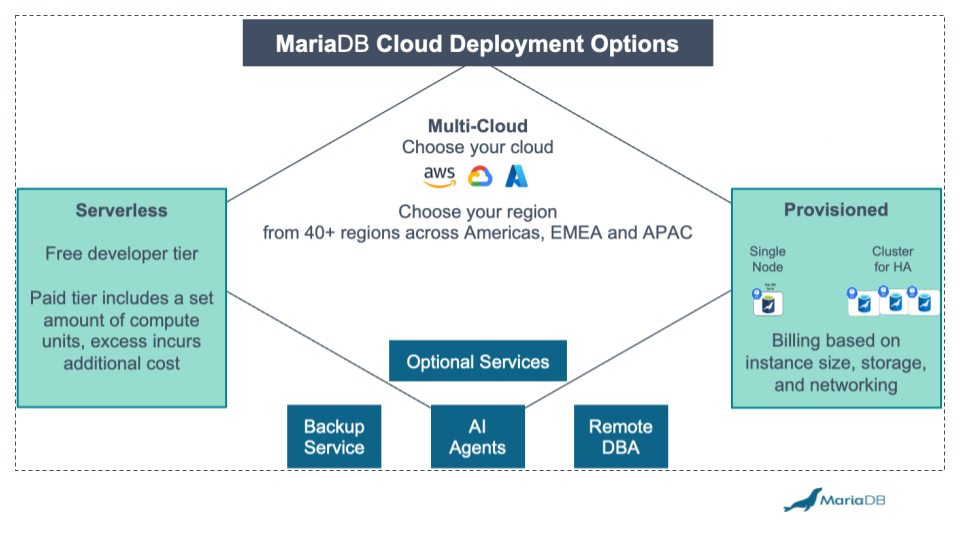
The differentiation is not that MariaDB invented every component. It is that a DBA can use familiar SQL, deploy on premises or across the major clouds, and call one vendor when routing, clustering, backup or vector queries misbehave. Oracle and Microsoft sell deep proprietary stacks. AWS, Azure and Google sell convenient native services. PostgreSQL has a huge ecosystem. Snowflake and Databricks dominate many analytical conversations. Specialist vector and distributed databases can win a benchmark. MariaDB's counteroffer is portability plus consolidation at a lower claimed cost.
What readers can copy
For an open source founder, MariaDB's reusable move is to sell the consequence, not the code. The free database creates familiarity. The paid layer addresses what happens when that database becomes important: guaranteed fixes, tested releases, migration help, high availability, security and a named party accountable for production. Downloads belong at the top of the funnel; renewal dollars belong in the board deck.
The second move is to buy proven adjacency. Galera had shipped with MariaDB for years, and more than a third of enterprise customers used it before the acquisition. SkySQL already ran MariaDB in the cloud. Those deals turned dependencies and prior experiments into owned capabilities. A smaller company can copy the sequence without buying anything: watch what customers repeatedly bolt onto the product, integrate that workflow, then charge for reduced operational friction.
The third move is restraint. MariaDB's platform only wins if each new box removes more complexity than it introduces. The tidy sales diagram hides integration work across four acquired or partnered technologies. Buyers should ask for workload-specific benchmarks, upgrade procedures, failure-mode drills and a full three-year cost model. “One platform” is useful only when the seams stay invisible during an incident.
When the MariaDB playbook does not work
- Your application relies on Oracle- or MySQL-specific behavior that compatibility testing cannot reproduce safely.
- A hyperscaler's native managed database is good enough and operational convenience matters more than portability.
- A specialist warehouse, vector engine or distributed database has a decisive performance advantage for the main workload.
- Your team lacks the migration budget, DBA expertise or tolerance for running a less common enterprise stack.
- The promised consolidation becomes a bundle of loosely integrated products with separate failure modes.
MariaDB has already proved that a principled fork can become infrastructure used around the world. Its harder proof is still underway: that the company behind the free database can turn breadth into a durable, comprehensible business. The rescue bought time. The acquisitions bought pieces. Now MariaDB has to make the pieces feel like one product - and keep the invoice easier to understand than the alternative.