A bus sends its location. Ten seconds later, it sends another. Nothing about either message is especially impressive. The trouble begins when the messages refuse to stop. In the Philippines, Bonito Tech’s transportation platform was handling GPS reports from 50,000 vehicles at that cadence. The company’s account describes a PostgreSQL system struggling with queries and archiving. Deleting old data could lock the database. Yesterday had become an obstacle to today.
- The bet: extend PostgreSQL so developers can keep SQL and their existing tools.
- The product: TimescaleDB for time-series workloads, with managed cloud and enterprise deployment options.
- The change: Timescale became Tiger Data in 2025; the database extension kept its name.
Yesterday is the first problem
Bonito Tech adopted TimescaleDB and its automated retention policies. The instructive detail is almost embarrassingly mundane: a transit application needs an orderly way to forget. Collecting a location is easy to understand. Deciding how long to keep billions of locations, while answering passengers’ questions, is where the engineering bill arrives.
Other customers arrive through different doors. Conserv monitors temperature, humidity and light for museums, libraries and archives. Its case describes ingest and query delays in a system previously using Elasticsearch. Load-testing company k6 needed to correlate measurements, group results and join them with metadata. Each case gives time-series data a second requirement: the readings must remain connected to what they mean.
GPS reports per day, if all 50,000 vehicles report every 10 seconds around the clock.
The product hiding in the plumbing
Ajay Kulkarni and Mike Freedman began with an IoT platform called iobeam. In Kulkarni’s published account, the database they needed became the opportunity: other developers were wrestling with the same problem. The founders shifted to a database company and publicly launched TimescaleDB in April 2017.
That decision could have sent them toward a database written from scratch. Instead, they built an extension for PostgreSQL. Their early funding announcement explains the calculation: reuse established database layers and solve the specialized problem sooner. PostgreSQL supplied a mature foundation; Timescale concentrated on timestamped data. It also left customers with skills they could bring to work on Monday.


“The data retention policies are very handy”
Wilhansen Li · CTO, Bonito Tech
Keep the language, change the storage
The central device is the hypertable. To the developer, it behaves like a table. Underneath, data is partitioned into chunks by time. A question about last Tuesday can avoid rummaging through unrelated months. Retention can remove old chunks, and the storage engine can use columnar organization for analytical work.
Continuous aggregates address another expensive habit: asking a dashboard to recalculate the past. They maintain summaries incrementally. An hourly view need not repeatedly count every individual reading from the beginning. These features turn recurring housekeeping into database policies rather than an ever-growing collection of application scripts.
This explains its place in a crowded market. Plain PostgreSQL remains a reasonable starting point. InfluxDB and QuestDB are alternatives for time-series work; ClickHouse is another candidate for analytics. Timescale’s appeal is the combination of specialized storage and relational flexibility. The choice depends on the queries and operating environment, not the animal on the logo.
The bill has two columns
TimescaleDB can be self-hosted without a software fee, but its editions deserve attention. The project has an Apache 2 core and additional Community features under the Timescale License. “Open source” is convenient shorthand that can obscure which features carry which terms. Extension availability also matters when choosing a managed PostgreSQL provider.
The commercial cloud service, now Tiger Cloud, charges for configured compute and storage. At the published rates checked in October 2026, Performance compute starts at $30 a month, with storage priced separately at $0.177 per gigabyte-month. That opening price is a component of the bill. Larger configurations and additional resources change the total.
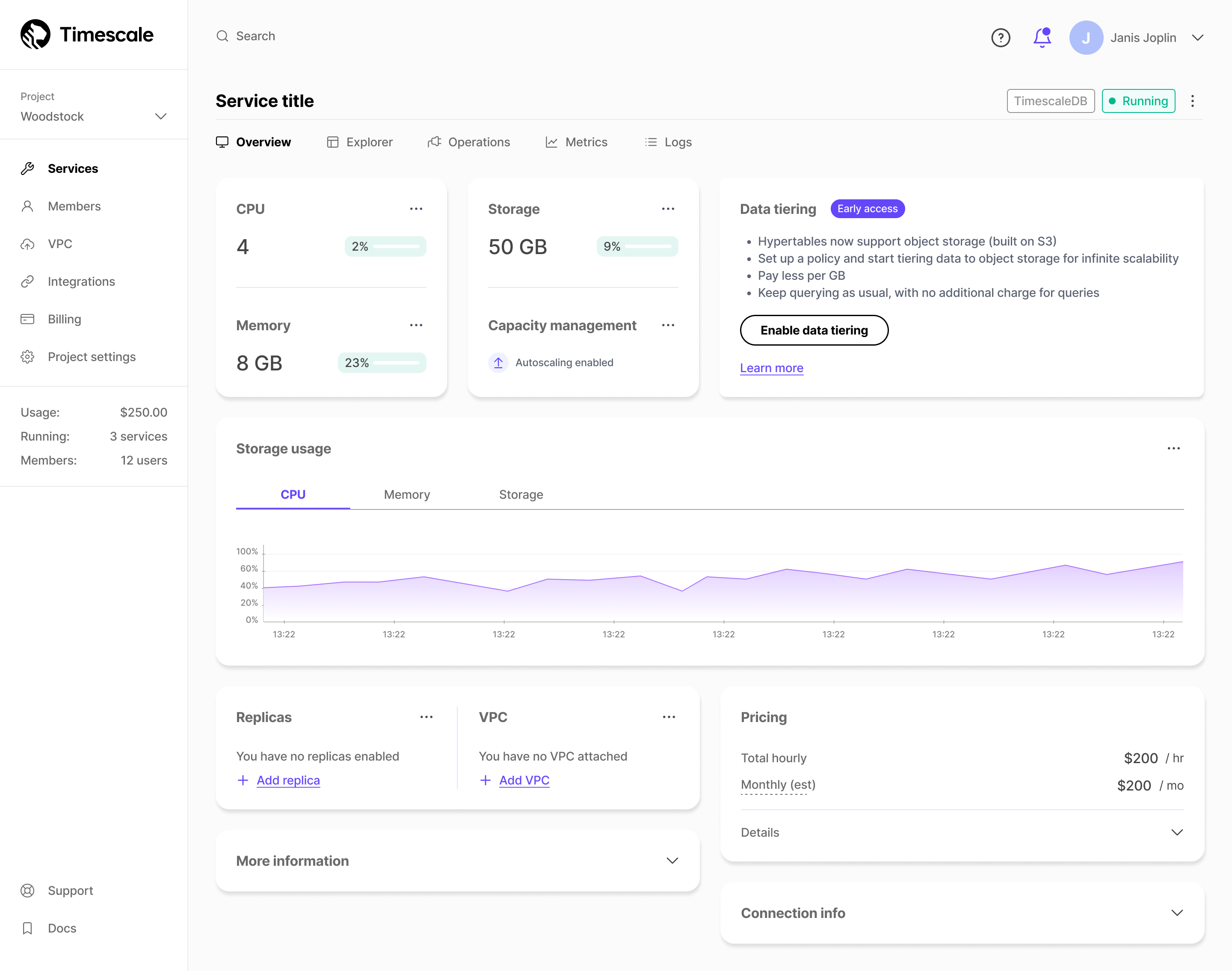
Self-hosting moves those operational responsibilities to the customer. Managed hosting sells relief from them. The company made that trade central to its business, describing a move toward cloud monetization in 2021. In 2023, the founders wrote: “We used to be a database company with a cloud product.” The managed experience had become the commercial center.
A tiger with a longer territory
Investors financed the expansion. A $40 million Series B in 2021 was followed by a $110 million Series C led by Tiger Global in February 2022, at a valuation above $1 billion. Those are historical financing figures. They describe the resources available for development, rather than what a customer should expect to save.
The broader product family includes pgai for embedding workflows and pgvectorscale for vector search alongside pgvector. In June 2025, the company adopted the Tiger Data name. Today its industrial work includes an Inductive Automation alliance and a commercially licensed TimescaleDB Enterprise for local deployments. A plant that needs control on site has different requirements from a developer buying managed cloud.
The useful thing to steal
The company describes a remote-first, engineering-led culture. Its product suggests a transferable engineering discipline: identify the actual bottleneck before replacing the system around it. Test representative ingestion, joins, late data and retention. Compare the cost of operating the database as well as the invoice. A small relational application may have little reason to add this machinery; a demanding workload still needs careful design.
The founders found a business in the part of their original business that other people also needed. Customers found value in keeping a familiar language while changing how data was managed. For anyone receiving another sensor reading every ten seconds, that is a pleasantly practical ambition.
Follow the data
Explore Tiger Data, cloud pricing, the engineering blog and the name-change announcement. Read Bonito Tech’s story or browse TimescaleDB on GitHub.
Watch Ajay Kulkarni’s WorkOS interview and find demos on the company’s YouTube channel. Follow LinkedIn, X or Facebook.