The trouble with a database usually arrives disguised as a perfectly reasonable question. Which customers are leaving? Which advert should this person see? Has that transaction become suspicious? The data may already exist. The answer may still be waiting behind a queue, a batch job, or a second system that has not caught up. SingleStore has built its business around that interval.
- The product: a distributed SQL database for transactions, analytics and search.
- The opening: applications whose users need fresh answers while new data keeps arriving.
- The economics: cloud consumption or self-managed software; architecture matters as much as the hourly rate.
- The next wager: give AI the same live data, with business definitions and permissions attached.
A database is an odd place to look for drama. It is supposed to be the quiet member of the household. But when software cannot answer quickly enough, the database begins making business decisions of its own. A feature becomes too expensive. An analysis becomes tomorrow’s task. A customer tries another product. The interesting question about SingleStore is which of those decisions it can return to the people making the software.
01The event that refused to be finished
In a published engineering account, GoGuardian described browser-event data from five million students. Records could change after their first appearance, while more than 94% of reads involved aggregation or ranking. Its SQL shards wrote well but struggled with those reads; its then-current Druid setup complicated updates. A conversation at AWS re:Invent 2017 led to a different arrangement.
GoGuardian used SingleStore row tables for changing events, then moved settled data into column tables, querying a view across both. That was a specific design for a specific workload. The team reported some queries below 30 milliseconds with suitable indexes and partition keys. Its small proof-of-concept cluster also slowed sharply under heavier read load; production needed a larger, better-tuned setup.
The transferable idea is to test the data’s awkward behavior. A benchmark filled with tidy, finished records can miss the reason your existing system is struggling. Ask what changes after arrival, what the reader wants to aggregate, and how those two activities collide. The troublesome corner often contains the buying decision.
inserts + updates
Conceptual architecture. Performance depends on the workload, data layout and resources.
02When the name became a souvenir
Founded in 2011 by Eric Frenkiel, Nikita Shamgunov and Adam Prout, the company began as MemSQL. It belonged to Y Combinator’s Winter 2011 batch. In October 2020, it became SingleStore: its product had already moved beyond the in-memory identity that its original name advertised.
The technical argument is called hybrid transactional and analytical processing, or HTAP. Transactions record what happened: a purchase, an update, a payment. Analytics asks what those events mean together. Putting both in one engine reduces the need to shuttle records between separate systems before an application can ask a useful question.
Universal Storage brought operational capabilities to columnstore tables. Later releases added multi-column unique keys and upserts, reducing the need to maintain separate hot row tables and archival column tables for some workloads. Today’s documentation distinguishes disk-backed columnstores from in-memory rowstores; choosing between them remains a matter of access patterns. There is considerable engineering hidden inside the agreeable word “single.”
This is SingleStore’s area of expertise: distributed execution, storage layouts, ingestion and mixed workloads. Its appeal is strongest when a product needs to accept changes and analyze them promptly. A team with a modest database and leisurely reporting requirements may have little reason to pay for that combination. Speed earns its keep when something valuable happens before the answer expires.
03The feature that never reached the invoice
Heap offers a sharper commercial illustration. In SingleStore’s customer account, its PostgreSQL/Citus architecture had become costly to maintain and restrictive for new analyses. Heap evaluated a dozen databases and selected SingleStore Self-Managed on Azure. It reports $2 million in annual savings, 60 times faster ingestion and a 25% reduction in cost of goods sold.
Heap’s reported results in a vendor-published case study. They describe its implementation, not a forecast for yours.
“Developer experience was essential”
Molly Shelestak, Heap principal product manager
That short sentence explains more than a league table of database speeds. The cost of infrastructure includes the analyses developers cannot express conveniently and the features they postpone. A cheaper query is welcome. A system that lets a company sell a capability previously out of reach can change a different part of the income statement.
The results deserve to be read with their conditions attached. They are customer reports published by the supplier, rather than an independent comparison across identical environments. Copy the evaluation discipline: use representative data, include difficult joins and updates, and watch response times as concurrency rises. An average can be charming while the slowest customers are having a dreadful afternoon.
04Buy the engine, rent the running room
SingleStore sells two principal ways to operate its database. Helios is the managed cloud service, available on AWS, Microsoft Azure and Google Cloud. Self-Managed gives customers responsibility for running the software on their own infrastructure. Support, training and professional services sit around that choice. This is enterprise software for data teams and application builders, not a consumer subscription.
Helios bills compute and storage separately. Its public Standard starting compute price is $0.99 an hour; a larger deployment, a different region, Enterprise features or multiple availability zones changes the bill. Optional data movement adds another component. The business model connects revenue to customers’ use of the platform, with commitments available for buyers ready to reserve spending.
Arithmetic for the starting Standard configuration running continuously for 730 hours. Add storage and applicable services; this is not a production sizing recommendation.
The sensible purchase starts with a response-time target and a load profile. Work backward to capacity, then price that capacity. Otherwise, the entry rate becomes an attractive number attached to an unspecified job. Include migration effort, temporary duplicate systems and operating time in the comparison. The database invoice is only one participant in the meeting.
05The competitor inside the partnership
SingleStore occupies a crowded neighborhood. Transactional databases, analytical warehouses and specialized search systems all approach parts of its workload. PostgreSQL, SQL Server and Oracle are familiar alternatives; Snowflake, ClickHouse, Druid and Databricks enter different analytical conversations. Choosing among them means deciding which operations dominate, how fresh answers must be and who operates the system.
A useful complication arrived in September 2024: SingleStore announced a Snowflake Native App and Iceberg integration. The proposed arrangement lets customers run SingleStore workloads within their Snowflake accounts and pay for compute with Snowflake credits. A rival can also be the place where the customer’s data already lives.
Then SingleStore acquired Australian integration company BryteFlow. The resulting Flow product addresses the route into the database, with no-code transfer and change data capture from supported sources. Its September 2025 account lists MySQL, PostgreSQL, Oracle and SQL Server among those sources, while distinguishing Snowflake’s one-time parallel loads from continuous CDC.
The lesson for buyers is pleasantly practical: keep a working system of record if the problem is the layer answering questions about it. Augmenting a warehouse or replicating selected operational data can be more sensible than replacing the entire estate. The decision should follow the bottleneck, rather than a taste for tidy diagrams.
06AI asks the old question in a new accent
SingleStore now places Aura Intelligence around its database: natural-language analysis, a Context Engine, AI Functions and connections for developer tools. Its IBM partnership also brings an integration with watsonx.ai. Vectors can sit alongside related records, allowing SQL to combine similarity search with ordinary business attributes.
September 2026’s Analyst announcement describes curated Domains that select tables, attach business meaning and restrict access. The important work is specifying what the business means by a measure, which relationships are valid and which records a person can see. An eloquent answer built on the wrong definition of revenue is an expensive form of creative writing.
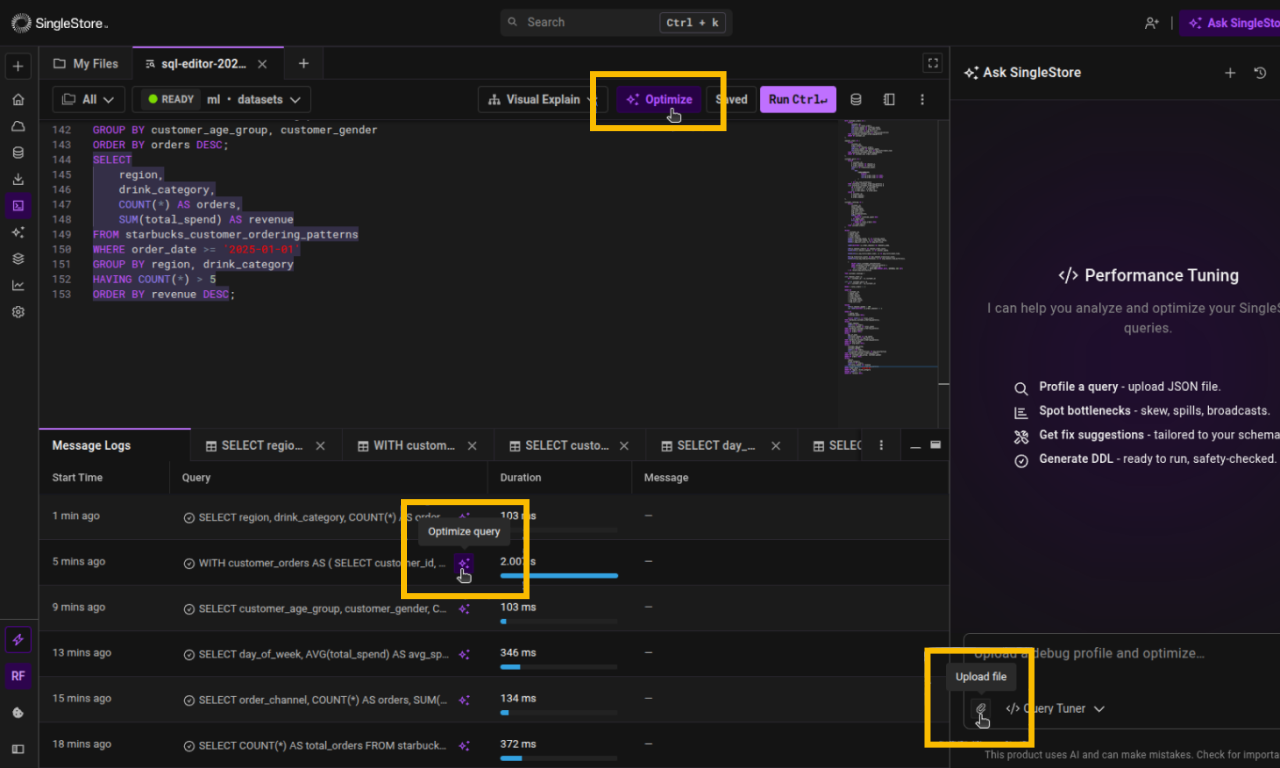
On September 30, SingleStore announced a Query Tuning Agent preview. It uses execution profiles and schema to suggest changes, such as addressing data skew or costly distributed joins. Recommendations go to a person for review and testing. It is a telling product choice: the company is trying to make its database expertise available at the moment a developer encounters a slow query.
07A new owner, the same waiting customer
The financing history supplies scale without settling the product argument. SingleStore announced a $116 million financing led by Goldman Sachs Asset Management in July 2022. In October 2025, CEO Raj Verma announced that Vector Capital’s majority growth buyout had closed. Selected earlier investors remained shareholders, and the existing management team continued to lead the business.
Vector describes a company serving nearly 50 Fortune 500 businesses. SingleStore names customers including Adobe, Goldman Sachs, Siemens and Comcast. Its careers page emphasizes measurable performance, customer attention and open communication. Those are declared values; the customer engineering stories offer a more tangible view of the work: understanding an awkward workload, testing it and helping someone run it.
The useful thing to copy is the order of inquiry. Measure freshness, query latency and simultaneous demand. Identify the work your application actually performs. Reproduce its unpleasant moments in a trial. Then count the whole cost. SingleStore makes a persuasive case where those requirements meet. The customer at the other end of the screen supplies the final test: whether the answer arrives while it can still help.