At Blue Owl’s 2022 investor day, the spreadsheets briefly lost the stage. During an intermission, Marc Lipschultz performed a Grateful Dead song. When chief financial officer Alan Kirshenbaum resumed the presentation, he thanked his colleague for the performance, then returned to permanent capital. Finance had acquired a house band, if only for the break.
The detail is useful because Lipschultz’s résumé otherwise offers few pauses. Stanford. Harvard. Goldman Sachs. More than two decades at KKR. Then a new firm, a stock-market listing and a larger institution assembled around private capital. The song belongs to the same person who helped build that machinery. Even an investor day needs an intermission.
His career turns on a decision made in 2016. After years inside an established private-equity partnership, he went out to build one of his own. Ten years later, the consequences reach well beyond the founding team. Blue Owl manages money for institutions, individuals and insurers. Its co-CEO must now answer to several audiences, each keeping a different clock.
Twenty-one years, then a new door
Lipschultz graduated from Stanford in 1991 with an economics degree, honors and distinction, and membership in Phi Beta Kappa. His undergraduate research shared a Firestone Medal. Harvard Business School followed, with an MBA in 1995 and Baker Scholar recognition. There was academic substance behind the familiar university names.
Before KKR, he worked at Goldman Sachs on mergers, acquisitions and principal investments. In 1995 he joined KKR, where he eventually served on the management committee and became global head of energy and infrastructure. Those assignments required understanding businesses whose assets and obligations could last for decades. A power network does not become a different investment because somebody refreshes a screen.
Leaving in 2016 meant changing his relationship to the institution itself. At KKR, he had been a senior investor within a partnership. At Owl Rock, he would help determine what the partnership should be. The founding group included Doug Ostrover, a co-founder of GSO, and Craig Packer, formerly a senior leveraged-finance executive at Goldman Sachs. Each arrived with an established career and relationships.
Calling it a start-up is accurate, though the term can conceal the preparation. The business was new; the professional histories were long. Lipschultz’s move was an entrepreneurial second act built with people who already knew the customers, the competitors and the vocabulary. They still had to persuade investors to entrust a new organization with capital.
The borrowers needed a different conversation
Owl Rock concentrated on direct lending to middle-market companies. In ordinary language, a business needed financing and an investment firm could negotiate the loan directly. For borrowers, a substantial commitment from a lender could offer certainty. For investors, the attraction was income. For the lender, the difficult work was deciding which promises deserved its money.
The founding team also approached an investment vehicle with an established retail audience from an institutional direction. Before Owl Rock Capital Corporation’s July 2019 public debut, it had raised $5.5 billion, more than 80 percent from institutions. Investors included New Jersey’s state pension fund, Brown University and Michael Dell’s family office. The shareholder register gave the venture an early institutional footing.
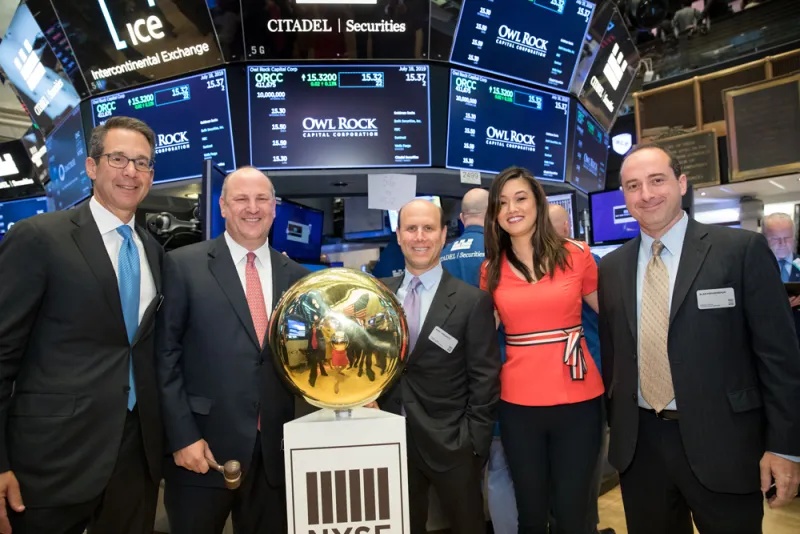
The photograph from the exchange debut places Lipschultz between his fellow founders and the ceremony’s other participants. It captures a particular stage of the project: Owl Rock had moved from a new lending business to a vehicle public investors could own. The public listing belonged to Owl Rock Capital Corporation, the business development company. Blue Owl’s own arrival on the exchange would come later.
That distinction matters. A manager, a fund and a borrower occupy different places in the transaction. Their risks overlap without becoming identical. Much of Lipschultz’s later public work involves explaining those relationships, often to audiences that encounter private credit first through a headline or a share price.
Three ways to stay in the room
In May 2021, Owl Rock combined with Dyal Capital Partners to form publicly traded Blue Owl. Dyal brought a business investing in the managers of private-capital firms. By the end of the year, Blue Owl had also acquired Oak Street, adding a real-estate operation. A lender was becoming a broader provider of capital.
The resulting structure placed several relationships under one roof. A private-equity firm might need financing for a company it owned. Its management business might want a long-term minority investor. A corporate tenant might want capital tied to its property. Blue Owl could participate at several points, with separate teams and strategies addressing different needs.
Financing for businesses, including direct lending and asset-based finance.
Capital tied to property and infrastructure, with an emphasis on income.
Minority stakes and financing for private-capital managers themselves.
Lipschultz became co-CEO alongside Ostrover in May 2023. He also serves as co-chief investment officer for the Blue Owl credit advisers. The titles describe two connected responsibilities: helping run the asset manager and helping oversee the investment work. Building the institution does not make the individual credit decisions disappear.
Blue Owl reported $319 billion in assets under management at June 30, 2026. That is a measure of assets managed across the firm, rather than money owned personally by its executives. It also covers multiple strategies. The scale explains why Lipschultz’s decisions now attract attention well beyond the circle that backed Owl Rock at its beginning.
The future has a rent bill
His infrastructure background offers a thread through Blue Owl’s expansion into data centers. In October 2024, the firm announced an agreement to buy digital infrastructure manager IPI Partners for approximately $1 billion. IPI then managed about $10.5 billion and had a portfolio of 82 data centers across several regions. The transaction connected Blue Owl’s property-financing experience with demand for computing capacity.
The distinction between financing a building and backing a technology winner is central to Lipschultz’s public explanation of the strategy. A data center has a tenant, a contract and payment obligations. Those details allow an investor to examine a recognizable financial relationship inside an industry whose products change quickly. Artificial intelligence still needs somewhere to put the machines.
The logic has an older financial shape: evaluate the counterparty and the agreement before celebrating the growth forecast. It fits Blue Owl’s description of a credit-first approach to real assets, focused on current income and limiting downside risk. The ambition may be technological. Much of the diligence remains contractual.
That framing leaves substantial questions to answer. A long contract still depends on the parties honoring it. Large investments still require judgment about demand and financing. The broader economic importance of computing does not settle the value of every building constructed to house it. Lipschultz’s task is to turn an expansive theme into particular investments that withstand those questions.
A different kind of team sheet
Professional sports provide another setting for his interest in organizations. Lipschultz is a limited partner in the Washington Commanders ownership group. In late 2024, he also announced that he had joined the Tampa Bay Lightning ownership group, working alongside Jeff Vinik. These are ownership interests, distinct from the day-to-day work of running a team.
In his March 2025 conversation with Michael Sidgmore on Alt Goes Mainstream, the discussion reached the Commanders, the Lightning and the role of culture in organizations. It also covered the practical problem of building an investment firm to serve individual investors at scale. Teams, customers and internal habits sit alongside capital in that account of institution building.
Stanford supplies a longer-running relationship. Lipschultz was elected to its board of trustees in 2021, thirty years after graduating. He had helped establish and chair an investing and finance alumni group, served in alumni leadership, and co-chaired several undergraduate reunions. The university recognized his volunteer service with its Governor’s Award.
Those commitments add a second calendar to the career. Fundraising years and market cycles run alongside reunion years and trustee service. The student who won recognition for economics research became an alumnus organizing other alumni, then a trustee. The connection persisted through changes of employer and the creation of his own business.
Patience meets a share price
By October 2026, Lipschultz faced a less ceremonial public appearance. He and Ostrover sat together for an interview as private credit confronted redemption requests and investor skepticism. They defended the underlying business and rejected the suggestion that Blue Owl should leave the public market. Lipschultz reaffirmed the rationale for the public listing.
“We went public for a reason and that reason stands.”Marc Lipschultz · October 2026
That position creates a demanding assignment. Private assets take time to finance and realize. A listed manager receives a fresh market verdict every trading day. Investors in funds have their own expectations about access to their capital. Growth can bring those constituencies together; pressure reveals where their expectations differ.
Lipschultz’s next chapter therefore includes explaining the institution he helped assemble. The lender, the property investor and the partner to asset managers must make sense as individual businesses and as parts of Blue Owl. His confidence is public. The results will have to arrive over time, through investments, cash flows and the experience of clients.
The path from KKR to Owl Rock gave him the chance to design a firm around long relationships. Blue Owl’s scale has enlarged that experiment and the audience watching it. The intermission is over. The co-CEO is back at the microphone, with rather more to explain than the next song.