By July 2019, Craig Packer had helped raise $5.5 billion for a business with a rather unfashionable ambition: lend money and get it back. More than 80 percent of that initial equity came from institutions. The investors included a state pension fund, Brown University and Michael Dell’s family office. Owl Rock Capital Corporation was going public, and Packer was explaining why his young firm had started with such a large pot.
The size was part of the design. With borrowing added to its equity, Owl Rock could finance larger companies immediately. It could avoid spending its early years making smaller loans while waiting to accumulate capital. A financing business had applied a financing solution to its own beginnings. There is a pleasing economy to that.
Packer had spent years inside banks arranging debt for companies. At Owl Rock, he helped build the institution that would hold the loans. That change in position explains much of his career since: the attention to information, the preference for choosing transactions, and the persistent business of explaining what investors actually own.
A banker changes sides of the table
Before the founder came the capital-markets specialist. Packer earned a bachelor’s degree at the University of Virginia and an MBA at Harvard Business School. His career included Donaldson, Lufkin & Jenrette and Credit Suisse First Boston, where he became global head of high yield capital markets. These were jobs in the machinery that connects companies needing money with investors prepared to supply it.
In 2006 he joined Goldman Sachs as a managing director and head of high yield capital markets. He became a partner in 2008, the year when the financial system supplied an unusually severe examination of everyone’s assumptions. He later served as co-head of leveraged finance in the Americas. His responsibilities also extended to committees overseeing capital, risk and business standards.
The sequence matters because Owl Rock was an experienced banker’s new business. Packer arrived with years of exposure to borrowers, financing structures and the institutions buying debt. A founder can start with an idea; this one also brought a working knowledge of the paperwork.
Three résumés, one lending business
Owl Rock brought Packer together with Doug Ostrover and Marc Lipschultz. Ostrover had co-founded GSO, the credit business acquired by Blackstone. Lipschultz had run energy and infrastructure investing at KKR. Packer supplied the Goldman leveraged-finance background. Ostrover and Packer had also been colleagues at DLJ, giving their partnership a history that preceded the new name on the door.
The firm launched in 2016 into a market shaped by companies’ need for financing and investors’ appetite for income. Direct lending offered borrowers a route to capital outside the traditional bank-led distribution process. For the lender, it meant building a business around sourcing opportunities, examining companies and negotiating terms.
Starting at scale was a deliberate choice. Packer’s explanation in 2019 was practical: a small initial capital base would have pushed the firm toward smaller transactions. Raising institutional money first gave the team access to larger borrowers from the beginning. The founders were making a choice about the companies they wanted to finance before making their first public-market introduction.
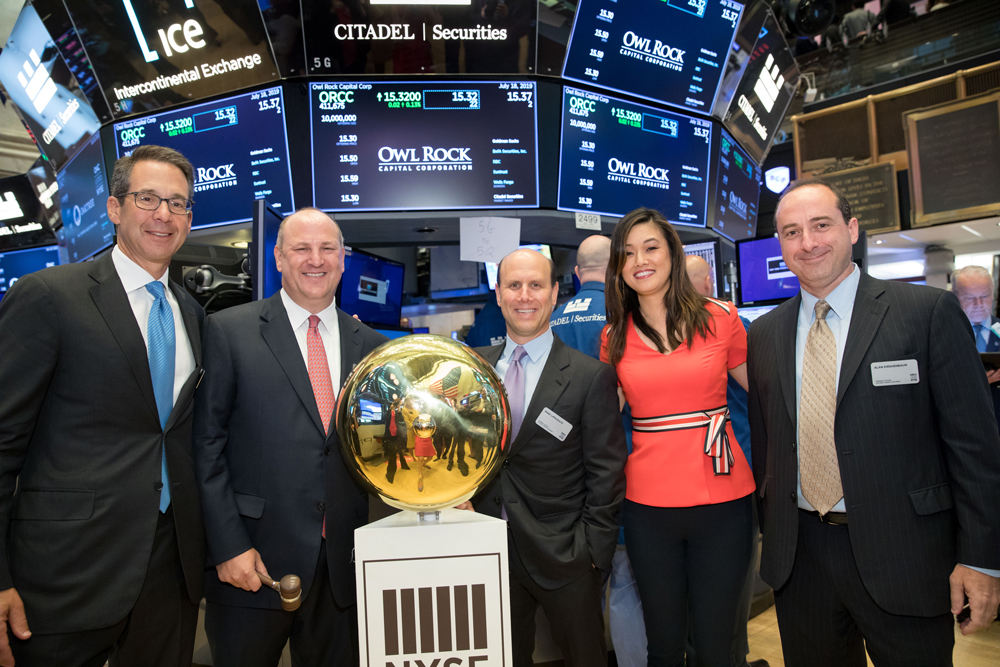
The July 18, 2019 listing of Owl Rock Capital Corporation gave public shareholders access to that loan portfolio. The business development company, usually shortened to BDC, was central to the design. It put a portfolio of privately negotiated corporate loans inside a vehicle whose shares could trade on an exchange. The loans remained private even when the ownership became public.
The attraction of staying put
Patient capital became a recurring subject in Packer’s public conversations. In a 2022 interview, he discussed the benefits of permanent capital vehicles, the measures investors should use to evaluate a BDC, the use of leverage and how a portfolio might behave in a downturn. These are less glamorous subjects than predicting the next fashionable industry. They are also closer to the daily work of a lender.
The distinction between a portfolio and the capital supporting it can sound technical until the two operate on different clocks. A company may need a multiyear loan. An investor may want an exit much sooner. Vehicle structure determines how those wishes can coexist, and who bears the consequences when they cannot.
Needs financing that can remain in place over the life of a loan.
Owns an interest in a vehicle. Exit options depend on that vehicle’s structure.
Listed BDC shares can trade. Non-traded vehicles have their own liquidity arrangements. Neither arrangement makes the underlying loans instantly saleable.
Packer’s 2023 podcast conversation with private-credit editor David Brooke returned to deals, documentation, retail investors and lending standards. The subjects fit together. Inviting a broader set of investors into private credit increases the importance of explaining both the loans and the wrapper around them. An acronym is a compact label; it is a poor substitute for an explanation.
Writing the loan, reading the company
At a Greenwich Economic Forum panel, Packer described direct lenders as the “architects of these transactions.” His point was about agency. A lender can concentrate its people and time on the companies it wants to finance, negotiate the financing and pass on other opportunities. In his account, selection, diligence and structuring were substantial parts of the work.
He also acknowledged the limit of that effort: understanding a transaction does not prevent the borrower from having problems later. The distinction is useful. Better information improves a decision; it cannot turn the future into a completed spreadsheet. For someone selling the attractions of a lending model, the qualification deserves as much attention as the sales pitch.
“We are actually the architects of these transactions.”
Craig Packer, Greenwich Economic Forum panel
The practical questions are absorbing even without the industry vocabulary. What does the company sell? How dependable are its customers? What can go wrong before the loan is repaid? What protection does the agreement provide? Packer’s public discussions repeatedly return to the work that happens before money moves, and the information needed afterward.
A larger company, a smaller screen
In May 2021, Owl Rock combined with Dyal Capital Partners through a transaction involving Altimar Acquisition Corporation. The resulting company, Blue Owl Capital, began trading on the New York Stock Exchange under OWL on May 20. At March 31 that year, the combined businesses had $52.5 billion in assets under management, with 91 percent classified as permanent capital.
The combination put direct lending alongside a business investing in alternative asset managers. It widened the company around Packer’s credit activities. A person buying shares in the asset manager was buying something different from a person buying shares in one of its BDCs. The similar names could conceal very different economic interests.
Packer’s operating instincts appeared in a modest request he described in 2024. After Blue Owl hired a chief technology officer, he wanted an app that would give him access to portfolio information on his phone, replacing reliance on Excel spreadsheets. A growing investment business still needed a convenient way to answer a basic question: what is happening in the loans?
He also discussed expansion into adjacent strategies and overseas markets. His stated preference for originating assets reflected a desire to choose the portfolio directly. Growth, in this telling, carried an administrative obligation: the systems had to keep pace with the money.
The capital has a clock after all
In February 2026, the relationship between private loans and investor liquidity became a very public test. Blue Owl announced a $1.4 billion asset sale across three credit funds. It also permanently halted redemptions at Blue Owl Capital Corporation II, moving toward returning capital through distributions rather than the previous redemption process.
The distinction mattered to investors who wanted control over their exit. Packer defended the sale price as evidence about the loans’ value. In a February 20 television appearance, he emphasized the accelerated return of capital for OBDC II investors. Buyers’ willingness to purchase assets supported one part of his argument. Investors’ access to cash remained a separate issue.
A transaction value, not Packer’s personal wealth or the size of the entire credit platform.
On OBDC’s February earnings call, he also addressed a more ordinary pressure: lower base interest rates and tighter lending spreads could affect future earnings. He described rate sensitivity as a familiar feature of managing the fund across different environments. Even when borrowers keep paying, the income generated by a portfolio can change.
The episode brings his career’s central problem into focus. Building a lender requires choosing companies and financing them. Running that lender requires managing the expectations of the people supplying the money. Those responsibilities meet in the same portfolio, but they do not always produce the same conversation.
Beyond the credit committee
Packer’s public life includes a continuing connection to education and Connecticut organizations. He serves on the McIntire School of Commerce Foundation board and the University of Virginia Athletics Foundation board. He is also co-chair of the honorary board of Kids in Crisis. These are institutional commitments alongside his investment roles.
His public posts show another part of the working week: welcoming interns, bringing portfolio finance executives together and meeting colleagues outside the office. He has described Blue Owl’s annual CFO forum as a way to provide a peer network as well as capital. He has also written about the pleasure of a company pickleball tournament. Even private credit occasionally puts down the documents and picks up a paddle.
Today he is Blue Owl’s co-president, head of credit, a director and CEO of its BDCs. The titles describe a large organization. The through-line is smaller and more concrete: decide whom to lend to, understand the terms, keep watching, and account for the result. Packer helped build a business around those decisions. Its next chapter will be written in the loans and in the confidence of the people who finance them.