At Blue Owl’s 2022 investor day, Sean Connor began with a small domestic revelation. A colleague had apparently been dreaming about meetings with Doug. Connor joked that this was something he and his wife discussed, too. Finance had followed him home, acquired a speaking part, and made itself comfortable. Then he got down to the business of bringing private investments to a much larger audience.
The joke was brief. The assignment has occupied years. Connor, now Blue Owl Capital’s CEO of Global Private Wealth, works where investments meet the people expected to understand them. He helps oversee the funds, their structures, the raising of capital, and the relationships that continue after a subscription document is signed. It is an unusually revealing place from which to watch finance change: the machinery matters, and so does the explanation.
His career runs through corporate lending, an early seat at Owl Rock, and the construction of a global private wealth business. Yet one of its clearest expressions is a learning platform called The Nest. In a profession that enjoys putting Greek letters into presentations, Connor has spent considerable effort on a more ordinary question: how does somebody actually use this?
A Philadelphia beginning, a New York education
Connor is a Philadelphia native who studied economics at Columbia University. His professional life took him into the business of financing companies, including a long spell at CION Investment Management. There he became a managing director and served on its investment committee, working across the decisions that determine which companies receive capital and on what terms.
That background matters to the work he does now. Originating a transaction, assessing a borrower, and negotiating financing put an executive close to the underlying business. An investment product eventually arrives in an advisor’s office with a name and a presentation. Earlier in its life, it consists of companies, obligations, cash flows, and judgments about what could go wrong.
Connor subsequently became one of Owl Rock’s first employees, with responsibility for building its private wealth business. Blue Owl’s later scale can make that beginning easy to overlook. The wealth operation had to be assembled. Someone had to work out how an investment strategy would reach advisors, how a fund would function for their clients, and how those clients would be served afterward.
The paperwork is part of the product
Consider the distance between a promising investment and an investment somebody can hold. Connor’s responsibilities span fund formation, product design, capital raising, servicing, marketing, and operations. Those words can sound like the agenda for a very long Monday. Together, they describe the route from an investment team’s strategy to a client’s portfolio.
In January 2023, Blue Owl announced a distribution arrangement with iCapital and Allfunds. Eligible Allfunds clients could access its software direct lending strategy through an iCapital-powered feeder fund. The investment proposition involved financing software and technology businesses. The distribution proposition involved making an existing strategy available through infrastructure wealth platforms could use.
Connor described private wealth as central to Blue Owl’s longer-term growth plans. The announcement gives that ambition a concrete shape: a manager, a technology provider, a distribution platform, and a fund connecting them. Access depends on all four working together. An elegant thesis has limited usefulness when the intended investor cannot get through the front door.
It also helps explain why his job extends beyond raising money. A fund’s structure determines how participation works. Client servicing determines what happens once the excitement of investing has passed. These are durable responsibilities, especially when the assets themselves require a patient owner.
A nest with homework
On September 12, 2024, Blue Owl launched The Nest, a digital platform for financial advisors and their clients. Its three organizing verbs were Learn, Implement, and Engage. The wording had a welcome lack of mystery. Before putting an unfamiliar investment into a portfolio, an advisor needs to understand it, determine whether it belongs, and have somewhere to take the next question.
Connor identified limited advisor education and engagement as an obstacle to broader adoption. The platform brought together educational material, continuing education webcasts, portfolio resources, implementation guides, and contact with Blue Owl specialists. It addressed the space between hearing about an asset class and taking responsibility for recommending it.
“A lack of advisor-focused educational and engagement opportunities around private markets is a major roadblock”Sean Connor, announcing The Nest, September 2024
There is a commercial interest here, plainly. A manager benefits when more advisors understand its investments. The useful question is whether understanding reaches the inconvenient details, too. The Nest’s implementation material includes assessing client fit and understanding fund operations. Those subjects are less glamorous than a new opportunity. They are also closer to the work an advisor must perform.
Understand the assets and their attributes.
Assess client fit and portfolio use.
Keep the conversation going with specialists.
The conversation crosses an ocean
By May 2024, Blue Owl described a private wealth team of more than 100 professionals serving 100,000 clients globally. These were figures for that moment, rather than a permanent description of the business. They show how far the operation had travelled from its early construction at Owl Rock.
That month, Johann Santer joined as head of Asia-Pacific private wealth, based in Hong Kong and reporting to Connor. Blue Owl had established its regional wealth presence in 2021. Connor emphasized products and solutions suited to the needs of the Asia-Pacific market. The ambition came with a local executive and an existing regional operation.
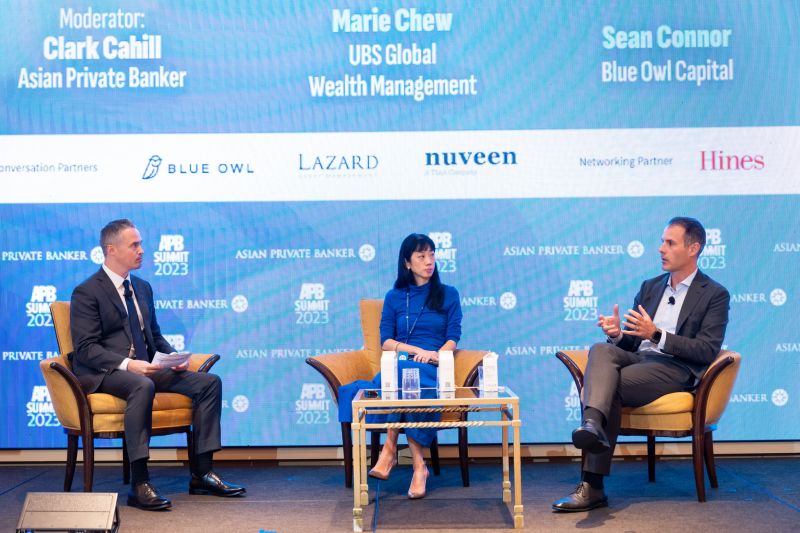
In January 2025, Blue Owl added Yoichi Nakamura to lead private wealth in Japan, reporting to Santer. The appointment emphasized relationships with Japanese securities companies and local operating experience. Global expansion, in this instance, has a very particular geography: people in Hong Kong and Tokyo, working with the institutions through which local investors actually invest.
The summit photograph captures a less numerical version of the same effort. Connor sits in conversation, alongside a wealth management professional and a moderator. A global business still requires someone to take a seat, listen to a question, and answer it in terms that make sense to the room.
The question behind the exit
By May 2026, the discussion had acquired a sharper edge. Speaking with Julie Cooling at iCapital Connect, Connor addressed education around evergreen products, including interval and tender offer funds. The central issue was liquidity: what happens when investors want their money back?
He explained the purpose of restricted repurchase features in funds holding longer-term investments. Such arrangements typically offer limited periodic liquidity; he discussed a common quarterly level of 5% of net asset value. The actual terms depend on the fund. A periodic opportunity to request a repurchase does not give every investor an unconditional exit.
Connor discussed a typical quarterly repurchase level of 5% of fund net asset value. Fund terms vary. Limited periodic liquidity can leave investors waiting.
This is where the education argument earns its keep. Connor’s explanation linked the funding arrangement to the time needed by the underlying investments. His contention was that limits help protect the integrity of the long-term portfolio. For the client, the consequence is equally concrete: the investment must fit a period during which money may be unavailable.
Artificial intelligence, with buildings attached
Connor’s public conversations also reach digital infrastructure. In December 2025, he appeared on CNBC’s Squawk Box to discuss private credit and investment in the AI data center boom. In a separate conversation with Blue Owl digital infrastructure head Matt A’Hearn, he asked about the market gaps that had prompted the founding of IPI Partners in 2016.
A’Hearn described technology companies needing partners able to meet their expanding data requirements. Connor’s questions moved through the history of the business and its ability to execute. It is an instructive change of perspective. AI may arrive in a user’s life as a box into which they type a question. The investment conversation extends to the physical capacity behind it.
For Connor, this adds another subject to explain to the wealth audience. Private credit, real assets, and stakes in asset managers involve different economic exposures. Presenting them under one firm’s name does not remove those differences. The practical work is helping advisors understand what they would own, how it might generate returns, and which risks travel with it.
Back to the students
In January 2025, Connor welcomed first- and second-year Columbia students to Blue Owl’s office through Lionsbridge. He wrote about their curiosity and the importance of mentorship. The visit provides a small, useful counterweight to the fund structures and distribution agreements: an alumnus making time for people still trying to understand how a career begins.
His public appearances suggest a recurring professional habit: returning to explanation. A student asks about finance. An advisor asks how to implement an allocation. A client asks about liquidity. The audiences differ, but each requires more than a confident prediction about the future.
That is the thread running from early Owl Rock to The Nest and the 2026 interviews. Connor’s work concerns the invitation into private markets and the obligations that come with extending it. A new investor needs an entrance, a working knowledge of the room, and a clear understanding of the exits. The last part deserves at least as much attention as the welcome.