In March 2004, Deva Mishra had a project in Cornell’s student computing showcase called “The Secular TLS Method with Kronecker Products.” It is a title with little interest in charming a stranger. There would be no mistaking it for a beach read. More than twenty years later, Mishra’s work still concerns complicated systems, though the systems now hold the investments behind insurance promises.
He leads Blue Owl Insurance Solutions, a business that connects an alternative asset manager’s investment capabilities with the requirements of insurers. His career has passed through Goldman Sachs, Global Atlantic and Prosperity. Those names give the itinerary. The more interesting question is how a computer science graduate came to spend his working life thinking about what an insurance company owns, what it owes, and how the two fit together.
A programmer before the portfolio
Mishra attended Cornell from 2000 to 2004, studying computer science and economics. The combination placed mathematical machinery beside the behavior of markets. His university activities included the Cornell Concert Commission, Alpha Phi Omega and Ultimate Frisbee. The student record allows for a reasonably rounded undergraduate: technical work, collective work, and at least one activity in which the object was to throw something accurately.
The BOOM showcase, short for Bits On Our Minds, brought student projects into Upson Hall. Mishra’s entry sat among demonstrations of artificial intelligence, computer animation and other applications of digital technology. There is no reason to read his later career backward and pretend an insurance executive was already inevitable. What the entry establishes is simpler: before the investment titles, there was a student working through a technical problem.
His route to that campus began in Webster, outside Rochester, New York, where both parents worked at Xerox. His early paid work involved landscaping and planting trees with friends. After university, finance offered an opening. Goldman Sachs put him in the mortgage business, a consequential place to learn during the financial crisis.
The promises on the other side
He subsequently moved into Goldman’s reinsurance operation, the predecessor of Global Atlantic. Eventually he became Global Atlantic’s deputy chief investment officer. His responsibilities included an insurance general account exceeding $50 billion. An investment job at that scale sits inside a business whose obligations extend well beyond the next market close.
An insurer’s assets and liabilities are often discussed as if they occupy separate rooms. In a set of accounts, they have their own columns. Inside the business, however, a decision in one column changes the questions asked of the other. Investments produce cash. Contracts establish obligations. The timing of each matters. A pleasing investment return can tell only part of the story.
That is the appeal of Mishra’s career as a subject: the movement between disciplines becomes practical. Insurance investing requires choices about assets, but also an understanding of the organization holding them. The portfolio has a purpose beyond winning a comparison with another portfolio. It must help the insurer keep its commitments.
Two sides. One balance sheet.
The unglamorous advantage
Consider the difference between buying a bond backed by mortgages and owning mortgage loans directly. The second route brings an investor closer to the underlying assets. It also brings paperwork, data and servicing arrangements. Financial ingenuity occasionally arrives carrying a file cabinet.
In July 2024, Mishra described the considerable effort required to hold those loans. “It takes so much work to be able to own these loans directly,” he said. The remark was almost comically plain beside the elaborate language that surrounds private markets. It also identified a real constraint: an investment strategy needs an organization capable of carrying it out.
An asset on a screen depends on an organization off it.
The operating question
Direct ownership can involve gathering information from different formats, handling loan documents and arranging for payments to be collected. Each task creates a demand on the institution. An asset may appear as one line in a portfolio report while depending on several businesses and processes outside it.
This is where the operating side of investment management becomes visible. Finding something attractive is one task. Establishing the capacity to own it over time is another. The distinction helps explain why a firm’s systems, staff and partners belong in any serious account of its investment work. They are part of what makes the investment possible.
Building with other builders
Mishra joined Prosperity in 2019 and led Prosperity Asset Management, alongside his investment responsibilities for the wider group. One partnership offers a concrete view of that work. Evergreen Residential, founded in 2021, developed a business spanning equity investment, lending and property management. A Prosperity affiliate became an early strategic investor.
In November 2024, Evergreen announced approximately $1 billion in capital commitments from investors, together with strategic backing from the Prosperity affiliate and Kuvare. Prosperity clients had also invested in Evergreen’s strategies. The relationship connected an operating real estate platform with institutions seeking suitable investments.
Mishra’s explanation centered on the people running the business and the suitability of its assets for insurance investors. Those judgments have to coexist. A capable team can build a business that does not fit a particular insurer. An attractive category of assets still needs people who can acquire and manage them. A partnership puts both propositions to work.
The example gives some texture to a career otherwise expressed in very large asset totals. There is an actual residential business on the other end of the capital, with responsibilities extending from investment selection to property management. Behind the abstraction of an asset class are organizations doing ordinary, necessary work.
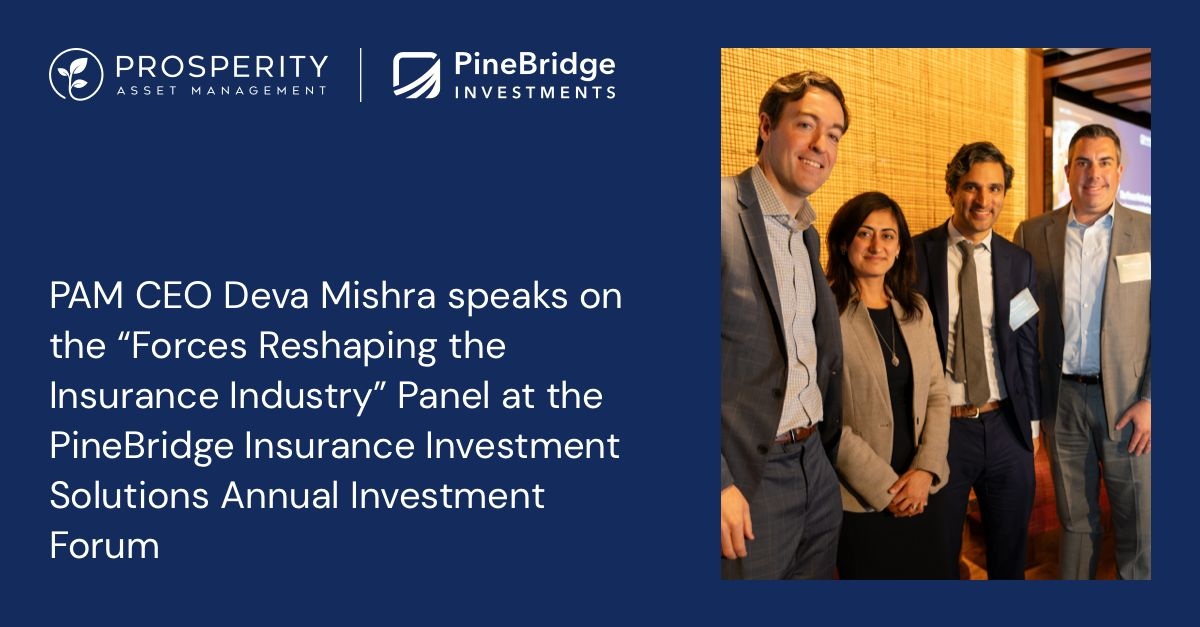
His public appearances have covered related questions. At PineBridge’s insurance investment forum, he joined a discussion of consolidation, regulation and reinsurance. These subjects can sound remote until an acquisition, a capital decision or an investment allocation makes them immediate. They shape the conditions under which an insurance business can grow.
Growth, with obligations attached
In February 2025, JAB announced an agreement to acquire Prosperity Life Group, including its insurance companies and asset manager. Prosperity then had more than $25 billion in assets and supported approximately one million policies. The announcement put the scale of the enterprise beside the number of contracts it served.
That pairing matters. Assets are often the headline number in an investment business. Policies give a different measure of its reach. Each represents an obligation carried by an institution, and a reason the institution needs its investment work to function over time.
Mishra described Prosperity’s approach in terms of policyholders and balance sheet management. In the acquisition context, that emphasis connected the asset manager with the insurer it served. The business being bought contained both investment capabilities and contractual responsibilities. Its growth had to be understood through both.
A larger table at Blue Owl
Blue Owl announced Mishra’s appointment in May 2026, with a July 6 start. His remit is to expand Insurance Solutions, an initiative launched in 2024. He reports to co-chief executives Doug Ostrover and Marc Lipschultz, drawing on teams across Credit, Real Assets and GP Strategic Capital.
The appointment brought experience of building insurance investment operations into an established alternative asset manager. Blue Owl described Prosperity’s expansion during his tenure from $3 billion to approximately $30 billion in assets. Those figures measure the growth of a business. They also explain why experience with acquisitions, origination and insurance balance sheets figured in the hiring decision.
The new role brings a familiar problem to a different setting: how to connect investment capabilities with an insurer’s requirements. The assets available across a manager’s platform do not arrive with identical uses for every client. Choosing, structuring and managing them requires knowledge of the institution on the other side of the relationship.
The people in the system
There is a human network behind that professional sequence. In discussing his move, Mishra credited leaders at Global Atlantic, Elliott and Prosperity, including Allan Levine, Gilles Dellaert, Nicholas von Moltke, Mark Cicirelli and Steve Kasoff. His enthusiasm for working with Ostrover and Lipschultz came with gratitude for earlier colleagues. “How lucky am I?” he wrote.
His connection with Cornell has continued too. His public profile describes an advisory board role beginning in 2017 and fundraising for the computing college and students through the Shobhana Mishra scholarship. That work brings the story back to the institution where the technical education began, with a different responsibility toward the people coming through it.
His board work reaches beyond investment management. He serves on the board of CYCLE Kids, the cycling education organization founded by Julianne Idlet, and is a director of OceanWell. The latter develops subsea systems for producing fresh water, using ocean pressure in reverse osmosis. These roles place him alongside educators, engineers and business builders working on problems with physical consequences. Bicycles and water equipment give the professional biography some welcome objects you can actually point to.
Asked to choose a lunch companion, he picked Alexander Hamilton, drawn to the origins of the financial system. His career advice was closer to the office floor: take responsibility for problems you notice. The two answers belong comfortably together. One concerns how institutions were constructed. The other concerns what a person can do when a piece needs fixing.
The Cornell project title has little obvious resemblance to the title on his door today. The career between them contains changes of subject, colleagues and scale. What makes it worth following is the work that job titles compress: understanding how an institution functions, learning what its promises require, and helping build the capacity to keep them.