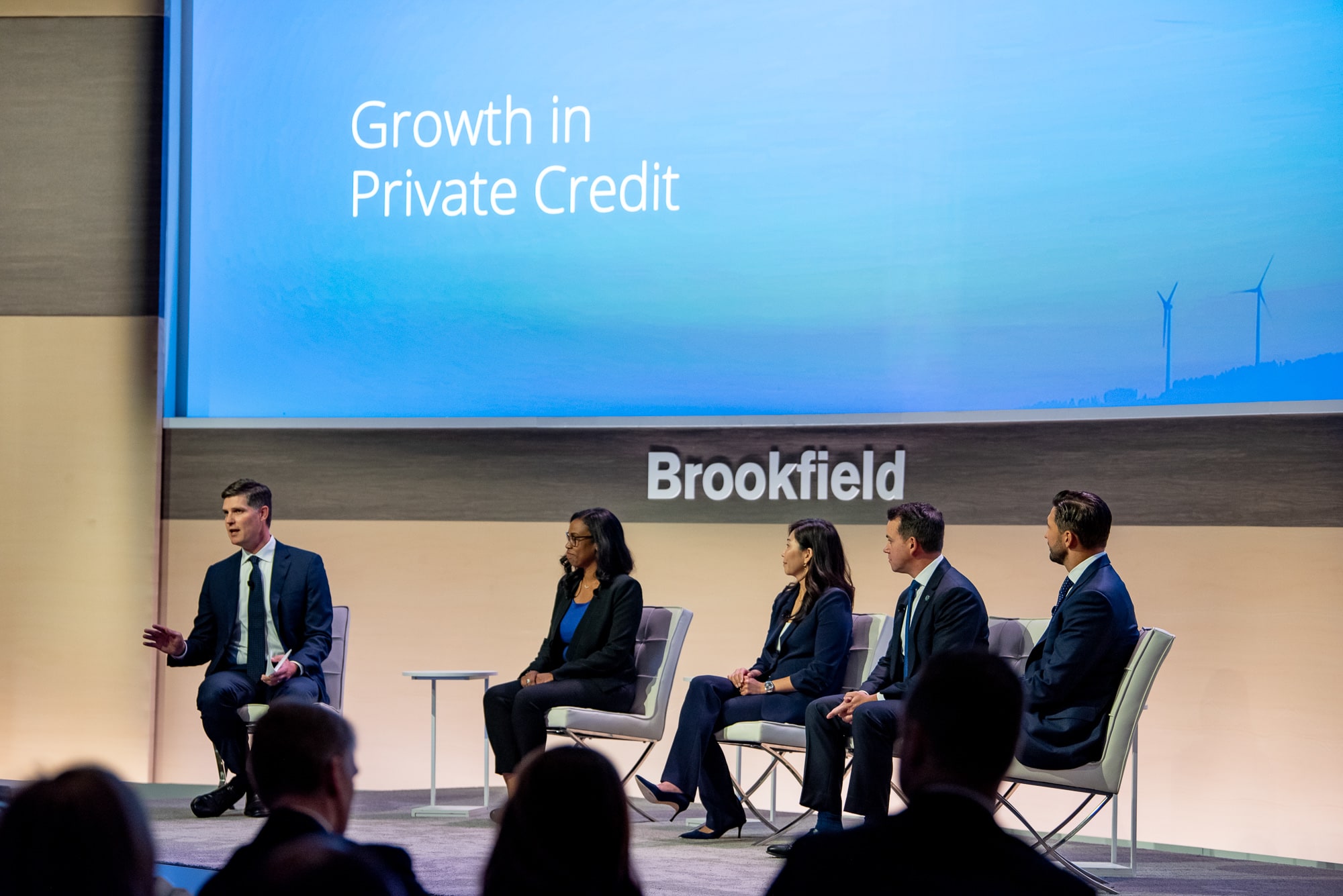
At Brookfield’s 2024 Investor Day in New York, Craig Noble had a question for his fellow panelists. They had discussed private credit, investment strategies and insurance capital. Now he wanted to know their favourite artists from the catalogue of Primary Wave, Brookfield’s music rights partner. The answers ran from Whitney Houston to Boyz II Men, Counting Crows and Prince. For a moment, an investment presentation acquired a soundtrack.
The detour had a business purpose. Music royalties were another example of the cash flows that could find a home within Brookfield’s investment universe. Noble was asking people from different corners of that universe to describe something familiar. A song was rather easier to picture than a capital structure. The discussion ended with a joke about a purple tie. Finance had briefly loosened its collar.
Noble’s work has often involved making connections of a less audible sort: between an investment team and a larger institution, between an asset and its financing, between a specialist manager and clients it might otherwise struggle to reach. His current position, Executive Chair of Brookfield’s Credit Group, gives him strategic oversight across credit strategies and affiliated managers. He also sits on Brookfield’s Executive Committee.
That remit followed years as a portfolio manager, investment chief and chief executive. The career makes more sense as a sequence of expanding responsibilities than as a succession of titles. Before he was explaining how the pieces fitted together, he had spent years working inside them.
A portfolio manager gets a larger desk
Noble studied commerce at Mount Allison University and earned an MBA at York University’s Schulich School of Business. His education also includes the CFA designation. Before Brookfield, he spent five years at Bank of Montreal, working in credit analysis, corporate lending and corporate finance. The early tasks concerned the practical questions of lending: understanding a business, examining its finances and judging its capacity to meet obligations.
He joined Brookfield in 2004. His subsequent experience included direct infrastructure investing and work with a long-short credit opportunity fund. In 2008, he began leading the firm’s global infrastructure securities business from its inception. Infrastructure could be approached through ownership of an asset or through the securities of the company behind it. His career came to span both perspectives.
By 2012, he was co-chief investment officer. In July 2013, Brookfield Investment Management appointed him chief executive. He was based in Chicago and retained his infrastructure portfolio responsibilities. The appointment put an investor in charge of the investment business without immediately taking the portfolios off his desk. There was still money to manage while the organisation was being managed.
His work continued across different kinds of securities. In September 2018, he and Larry Antonatos were jointly responsible for day-to-day management of Brookfield Real Assets Income Fund, including strategic allocation among corporate credit, securitized credit and equities. That combination demanded decisions across categories that are often described in separate conversations. An allocation decision had to bring them back together.
In March 2019, a fund announcement set out another change. Noble would step back from co-managing the Global Listed Infrastructure Income Fund by the end of the third quarter as he assumed additional responsibilities at Brookfield Asset Management. He would retain involvement in real-assets solutions and certain investment committees. His responsibilities were widening beyond a single portfolio.
- 2004Joins Brookfield
- 2008Leads global infrastructure securities
- 2013CEO, Investment Management
- 2024Leads the dedicated Credit Group
An umbrella with room for specialists
By early 2024, Brookfield had grouped its credit strategies into a dedicated credit business led by Noble. He described the decision as a way to give the activities more focus and room to grow. Much of the underlying investment work already existed. The organisational change created a common place for it, including businesses with their own histories and methods.
One of those businesses was Oaktree. Others brought narrower expertise. LCM Partners worked in European consumer and small-business loans. Castlelake specialised in asset-based private credit, including aviation and specialty finance. These were different practices with different information requirements. A large parent could supply reach and resources; the specialist still needed to understand the loans.
The Castlelake transaction closed in September 2024. Brookfield acquired a 51 percent interest in its fee-related earnings, while Brookfield Wealth Solutions committed capital to its strategies and funds. Together, the arrangements amounted to $1.5 billion. The distinction matters: this was a partnership involving both the management business and investment capital, giving the specialist a connection to a broader pool of money.
Asked in February 2025 about lessons from bringing the credit activities together, Noble emphasised what the businesses could accomplish together. He also described the independence of businesses such as Oaktree. Coordination and autonomy had to coexist. The commercial proposition depended on what the teams could do together while preserving the expertise clients had come for.
Why a mortgage belongs in this story
Angel Oak brought the partnership approach into residential mortgage credit. Brookfield announced an agreement to acquire a majority stake in April 2025 and completed the transaction that October. At closing, Brookfield described its credit platform as having $332 billion in assets. The number belongs to that date and that platform; it measures neither Noble’s personal wealth nor an individual fund.
For Noble, the attraction included Angel Oak’s ability to originate mortgages as well as invest in them. Origination puts a business closer to the beginning of a loan: the borrower, the documentation and the decision to extend credit. In his public explanation of the partnership, those capabilities complemented the wider credit offering and could be connected to more institutional investors.
The progression from infrastructure securities to mortgage origination may look like a change of subject. There is a common problem underneath: how to connect knowledge of an underlying asset with the capital willing to finance it. The necessary knowledge varies. A property loan, an aircraft financing and a corporate loan require different work. Bringing the managers together does not make those differences disappear.
In a June 2025 conversation with Private Debt Investor, Noble identified real estate debt, infrastructure and asset-based finance as areas of attention. He also described investors seeking broader relationships with fewer managers. Those two observations explain the appeal of the structure he was helping build: clients could have a wider conversation with Brookfield while individual teams continued to work on particular markets.
“The learning is the power of putting it together.”
Craig Noble · February 2025
The caution inside the growth story
Growth is a recurring subject in Noble’s public appearances, including his June 2025 Brookfield Perspectives conversation with Hadley Peer Marshall. Their discussion covered the formation of the credit arm and opportunities ahead. The pairing also reflected the connection between credit, infrastructure financing and the wider asset-management business. The organisational chart was becoming a conversation between colleagues.
His published outlook for 2026 put underwriting discipline alongside that growth. He highlighted differences among borrowers, sectors, collateral and deal structures as factors that could produce increasingly different results. It was a reminder that the size of a market cannot settle the merits of a particular loan. The close examination still has to happen after the growth presentation ends.
The outlook also pointed toward lending across infrastructure, real estate and asset-based finance. Selectivity remained central to his argument. In an expanding market, there can be more opportunities to examine and more reasons to distinguish carefully among them. A plentiful supply of capital does little to simplify the underlying judgement about an asset or a borrower.
In August 2026, Noble co-authored a paper with Robert O’Leary and Armen Panossian on the next stage of private credit. Their argument centred on specialisation: as the market becomes more varied, expertise in the assets, structures and servicing behind a loan becomes more consequential. They examined areas including real estate debt, infrastructure debt, opportunistic credit and asset-backed finance.
The paper also addressed risks such as concentrated sector exposure and mismatches between long-term assets and investor liquidity expectations. Its emphasis was granular. Knowing the broad label attached to an investment was insufficient. This was an extension of the problem that runs through Noble’s career: how to retain detailed investment knowledge while operating across a wider field.
Back to the people in the chairs
Today, Brookfield lists Robert O’Leary and Armen Panossian as co-CEOs of Credit and Noble as Executive Chair. His biography describes a role overseeing strategy and relationships with affiliated managers. The distinction keeps the present picture clear: Noble previously ran the credit business as CEO, and his current responsibility sits at the level of strategic oversight.
The people beside him at the 2024 panel made that network visible. Real estate, infrastructure, Oaktree and Castlelake each had a seat. Their work involved different borrowers and assets, but they could discuss the advantages and complications of belonging to a larger organisation. Noble’s job as moderator was to give the separate accounts a common thread.
Then came the music question. There is no need to turn the exchange into a claim about his own musical taste; the choices belonged to his colleagues. What it showed was his willingness, in a formal setting, to invite a more personal answer. For a few minutes, the specialists became people who knew the words to songs.
Across more than twenty years at Brookfield, Noble’s responsibilities have moved from analysing and managing investments to connecting the businesses that make them. The work still depends on individual judgement, even when the numbers become very large. A platform can contain many teams. Getting them into a useful conversation is a separate task. On that New York stage, he found room for both the financing and the playlist.
Continue the conversation
- Craig Noble at Brookfield
- Craig Noble on LinkedIn
- Watch: Growth and Opportunity in Private Credit
- 2024 Investor Day conversation
- 2013 leadership announcement
- 2014 investment-management biography
- 2018 fund responsibilities
- 2019 portfolio transition
- The formation of Brookfield Credit
- Castlelake partnership announcement
- February 2025 credit interview
- The partnership approach
- Angel Oak partnership completion
- Credit outlook for 2026
- Accessing the next layer of private credit