Before Marc Freed-Finnegan was selling the value of a millisecond, he was arranging for people to show up. At Montclair High School in New Jersey, he created Kids for Kids, a student program organizing activities for children at a homeless shelter in Newark. By March 1999, it had more than 100 active student members. He was recognized as one of New Jersey’s two leading student volunteers in that year’s Prudential Spirit of the Community Awards.
There is a temptation, with founders, to turn every early accomplishment into a business-school parable. Resist it. A school volunteer program deserves to be understood on its own terms. Still, it gives this particular career a useful starting point: a teenager setting up something that required other people to participate, and enough organization to keep it going.
Today, Freed-Finnegan is co-founder and CEO of Chalk, a San Francisco company building infrastructure for machine learning and AI. Its work happens in the interval between someone doing something online and a system deciding how to respond. A purchase. A signup. A newly opened feed. The technical problem is elaborate; the human expectation is almost rude in its simplicity. Please make it work now.
A tenor with a second job
At Yale, Freed-Finnegan studied political science. His extracurricular résumé had rather more theatrical punctuation. He sang with the Spizzwinks(?), whose question mark is part of the name, and later with the Whiffenpoofs of 2004. The Spizzwinks list him as a first tenor, with solo credits including “Build Me Up Buttercup” and “Sylvie.”
The administrative credits are equally revealing. World tour manager. Business manager. Webmeister. Graphic design and business credits on an album. These are the jobs that sit behind the performance: the travel has to happen, the record has to be produced, and someone has to deal with the website. In a singing group, even the infrastructure gets a slightly absurd title.
The Whiffenpoofs’ alumni library credits him with a solo on “Too Darn Hot.” His career would eventually become concerned with keeping computation fast, but there is no need to manufacture a prophecy from the song selection. The useful detail is the range: a political science student who could take the solo and take responsibility for the business.
Both sides of the checkout
His early professional work included sell-side mergers and acquisitions at a small investment bank. He joined Google in 2007, initially working on global infrastructure, including European data-center site selection and network expansion into emerging markets. He subsequently worked in new business development and became product lead for Google Wallet.
Wallet put him close to a stubborn gap in commerce. Online businesses could observe a customer browsing and buying within the same system. Physical shops had their own information, payment equipment and routines. Putting a phone in a customer’s hand did not automatically connect all those pieces.
In 2012, Freed-Finnegan and Google Wallet colleague Jonathan Wall left to start Index. Their attention turned to retailers: how could a physical store use customer information to offer a more relevant experience? The ambition included personalization and better service, alongside the practical business of accepting a payment.
Consider the grocery example Freed-Finnegan used in a 2015 interview. If a customer already bought a particular yogurt, discounting it could mean giving away margin on a purchase that would have happened anyway. A retailer with a clearer view of the basket could instead offer a reason to try another category. A coupon looks trivial until you ask whether anyone needed to receive it.
Payments brought an even more immediate test. Index worked on speeding up chip-card transactions and promoted a product called “1-Second EMV.” Anyone who has stood at a checkout, uncertain whether to remove the card, can appreciate a product brief measured in seconds. The waiting customer is a demanding benchmark.
Stripe acquired Index in 2018. The acquisition brought the team’s physical-commerce capabilities into a company known for online payments; Chalk’s account of Freed-Finnegan’s career connects that work to Stripe Terminal. He subsequently worked at Stripe. The path to AI infrastructure passed through the ordinary business of paying for things.

The problem that kept returning
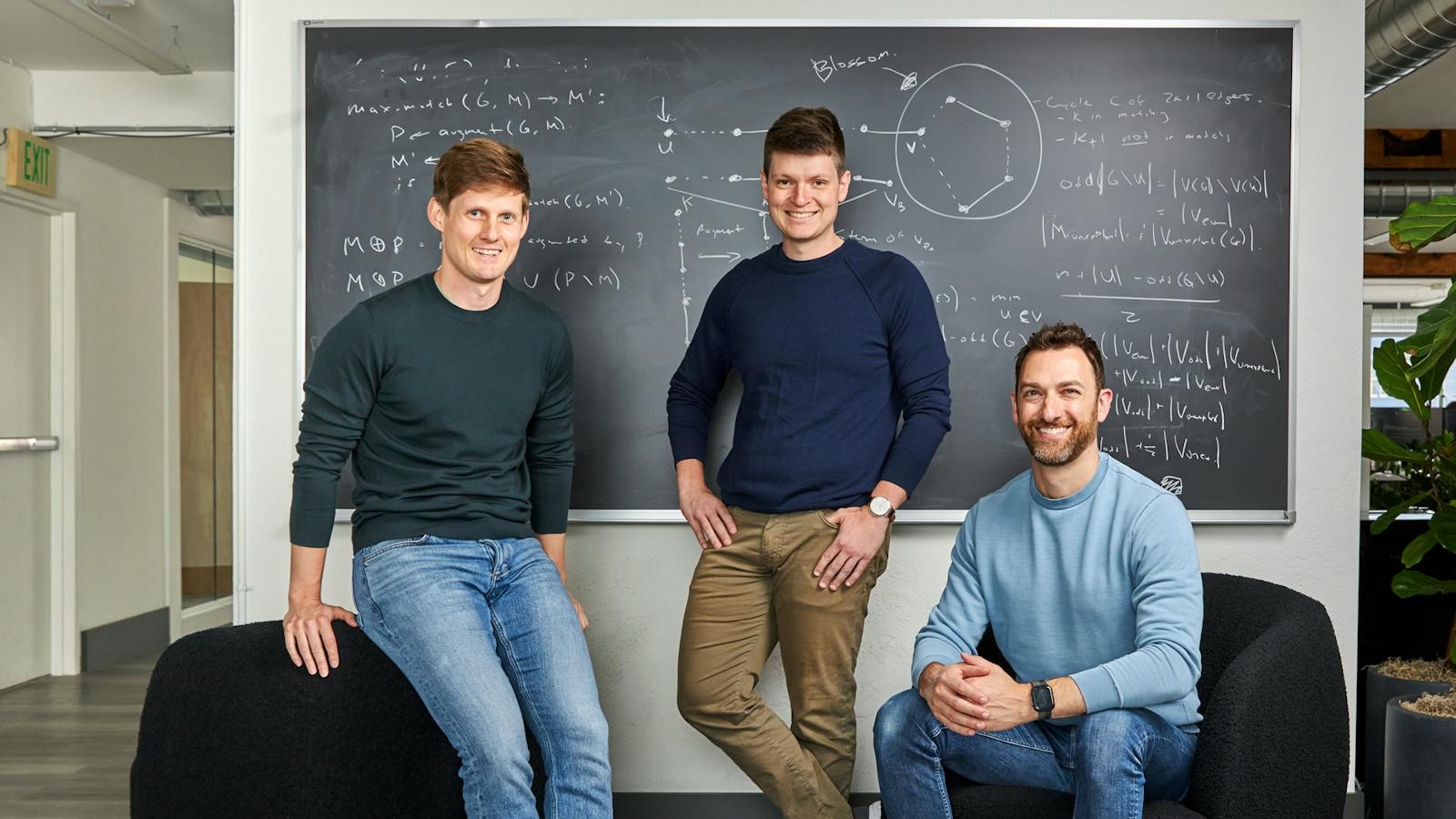
Chalk, founded in 2022, brought Freed-Finnegan together with Elliot Marx and Andrew Moreland. The three arrived with different views of related problems. Freed-Finnegan had worked on payments and merchants. Marx had built early risk and credit data infrastructure at Affirm. Moreland had worked on large government data projects at Palantir.
Marx and Moreland also co-founded Haven Money, which Credit Karma acquired. Across Affirm, Haven and Credit Karma, Marx repeatedly encountered the need to build infrastructure for decisions using fresh data. Freed-Finnegan has described that repetition as central to Chalk’s origin. The same class of work was being done again, inside another company.
Recruiting Freed-Finnegan required its own sales effort. Marx later recalled driving to Los Angeles and arriving at his house with a pitch to start a company together. They had occasionally met for dinner, and Freed-Finnegan had given him advice while he was building Haven. Asked how long he planned to stay, Marx said he would remain until the answer was yes. Freed-Finnegan shared the account with an amused response about how he could refuse his two future co-founders. Chalk’s first conversion apparently required a house call.
In December 2023, Freed-Finnegan announced a $10 million seed round led by General Catalyst, Unusual Ventures and Xfund. His explanation put developer workflows near the center: adding features, backtesting changes, and getting machine learning into production. The recurring frustration had become a product with customers.
The age of an answer
Freed-Finnegan’s explanation of Chalk begins with a distinction that is easy to miss from outside the industry. Training creates a model. Inference uses it. The second activity happens repeatedly, as customers use a product, and it needs information suited to the particular moment.
A precomputed answer can arrive quickly while describing a world that has already changed. Computing everything on demand introduces another difficulty: getting the necessary data and calculations finished before the person loses patience. Chalk concentrates on that combination of freshness, complexity and speed.
He carries a concise lesson from Google: “Speed is a feature.” It describes a product experience, as well as a computer’s performance. The delay affects what someone does next. Engineers see the timing in a trace; customers experience it as a page that feels responsive, or a transaction that leaves them waiting.
“Speed is a feature.”
Marc Freed-Finnegan, on a lesson from Google
Chalk’s technical approach includes taking feature logic written in Python and compiling it into faster execution pipelines. Its 2025 materials describe C++ and Rust. For the teams using it, the point is practical: data scientists can work in a familiar language while reducing the need for separate production rewrites.
Whatnot gives the argument a concrete setting. The live-shopping platform’s earlier system generated more than 10 billion predictions nightly. New sellers and changing browsing behavior made that schedule awkward. A live marketplace has very little respect for yesterday’s plan.
After moving to real-time inference, Chalk reports that personalized feeds reached 99.9% of users, compared with roughly 90% before. Those figures describe the results for this particular customer. They explain why Freed-Finnegan talks about a faster data layer in terms of something a shopper can actually notice.
Personalization before and after real-time inference. Figures reported by Chalk for Whatnot.
Capital, with a customer attached
In May 2025, Chalk announced a $50 million Series A at a $500 million valuation. Felicis led the round, with Triatomic Capital and existing investors participating. Felicis founder Aydin Senkut joined the board. Freed-Finnegan said the funding would support a more general compute framework and expansion of the team.
A large financing round is easy to make the climax of a founder profile. His own description of progress offers a more demanding measure: a customer starts with one application, then trusts the platform with another. That expansion requires the software to keep doing its job after the announcement has stopped attracting attention.
Chalk had already opened a New York office in July 2024, adding an East Coast base to its Bay Area operations. The business was growing geographically while Freed-Finnegan kept explaining an unusually compact proposition. Somewhere inside a larger company, an engineer needs data to arrive in time for a decision. There are many such somewheres.
Now the clock runs backward, too
By June 2026, the discussion had expanded to agents. Chalk introduced Compute, a runtime for workloads inside a customer’s cloud, connected to its Context Engine. One purpose is historical evaluation: testing how an agent would have behaved using the information available at a particular point in time.
The distinction matters. Give a test access to facts that arrived afterward and the result becomes suspiciously clever. Chalk describes enforcing a shared historical cutoff across the agent’s data and tool calls. The system is meant to let developers replay a situation without quietly handing their software tomorrow’s newspaper.
Freed-Finnegan’s June essay about Snowflake Summit focused on the question of trusting agents in production. He described appearing on stage with Grindr chief product officer AJ Balance, while Marx demonstrated the historical-data approach. In October, Chalk added Model Gateway, covering model routing, fallbacks and spending controls within a customer’s existing deployment.
The ambition has widened, but the thread through Freed-Finnegan’s work remains recognizable: useful information has to meet the situation in which someone can act on it. The shop counter, the payment terminal and the live feed each supplied a version of that problem. Agents add another complication: proving the decision made sense with what was known then. A former tour manager might appreciate the scheduling difficulty. Everyone needs to arrive on time. Now the software has to remember which time.