Tom Hamer’s first iPhone app had a pleasingly circular purpose: it taught other people how to build iPhone apps. He was 14. The pupil had opened a school, and the school fitted in a pocket. More than 40,000 users came along. Before the university degrees, the Amazon job and the venture funding, there was already a useful problem to solve: someone wanted to make something, and the machinery was getting in the way.
Years later, the machinery would become considerably more sophisticated. Hamer would co-found Marqo with Jesse Clark, build search infrastructure, raise money and move across the Pacific to sell it. The recurring question, though, would remain recognisable. How much technical work should a person have to do before a computer understands the task?
A search box makes that question look deceptively small. There is a rectangle, a blinking cursor and an implicit promise: tell us what you want. Then comes the negotiation. A shopper uses one word; the catalogue uses another. A photograph contains something that nobody has bothered to describe. The computer has plenty of information and surprisingly little tact.
The teenager with a teaching app
Hamer studied computer science at the Australian National University and later took a master’s at Cambridge specialising in machine learning. He also worked as a software engineer on Amazon Web Services’ Relational Database Service. That combination put him close to two different concerns: what a model could understand, and what infrastructure needed to do reliably once people depended on it.
During his Cambridge studies, he began working on vector search in his spare time. In February 2024, he described a gap between what the technology could demonstrate and the tools developers had available to put it into production. A demonstration could show the possibility. Delivering it inside somebody else’s business was another assignment.
The educational app and the later search company belong to different eras of software. Still, the resemblance is hard to miss. Both put a useful capability within reach of someone who might otherwise spend their time wrestling with the prerequisites. The app explained how to build. Marqo would attempt to absorb some of the building work itself.
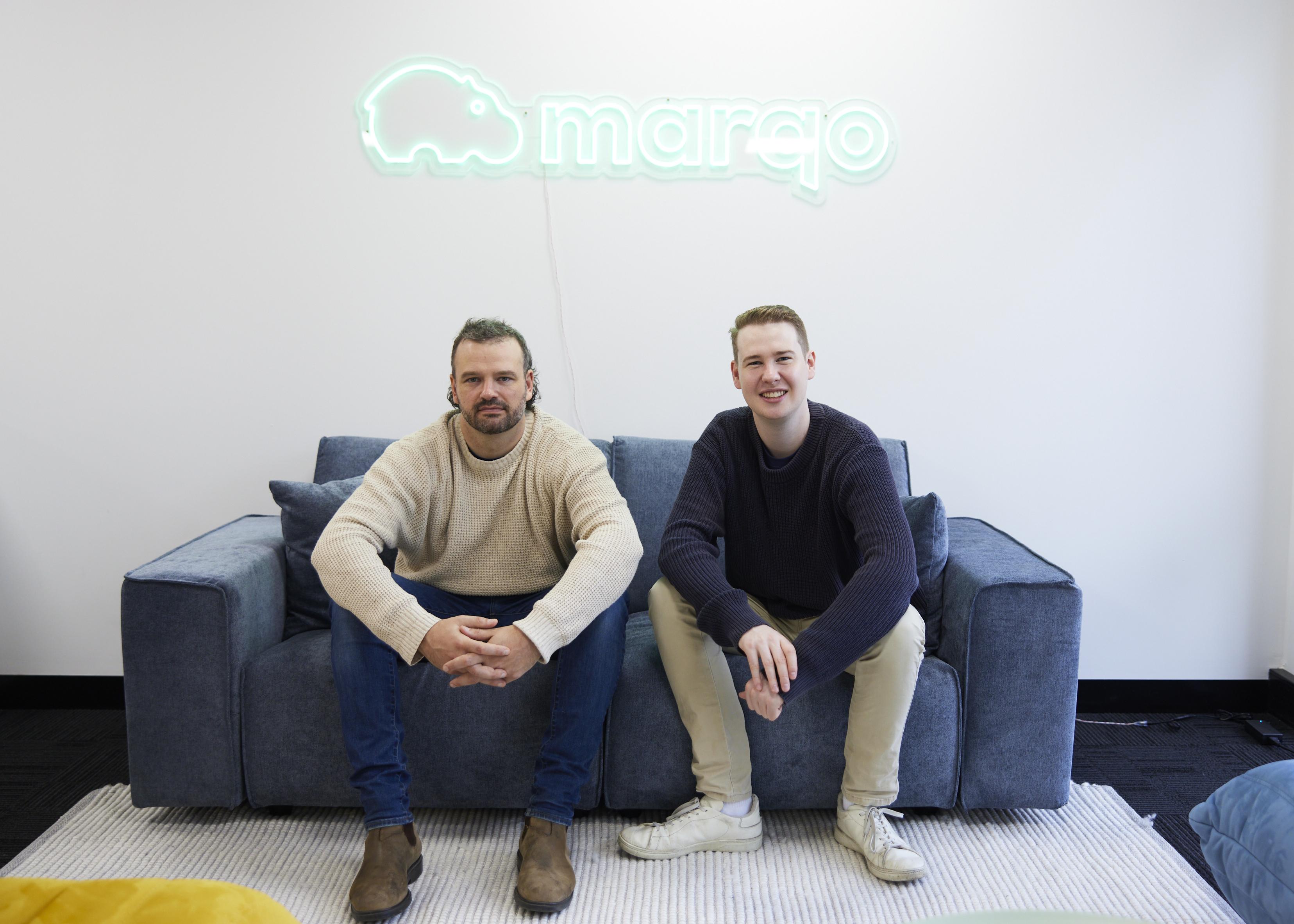
A database engineer meets a physicist
Clark brought a different route into the same problem. His background included physics research at University College London and Stanford, machine learning at Stitch Fix and work leading machine learning in Amazon’s robotics division. Hamer had worked on databases. Together, they combined experience of organising information with experience of teaching machines to recognise patterns within it.
Hamer initially incorporated Marqo in London in April 2022. The founders subsequently established an office in Melbourne and returned to Australia to build the company. Blackbird first invested in May that year. By September, Hamer was publishing an introduction to an open-source tensor search framework, explaining why ordinary search could struggle when people used synonyms, made spelling mistakes or asked questions.
His example was a blue shirt. A conventional lexical search could look for the words “blue” and “shirt”. Human requests are less obedient. We describe things approximately, reach for associations and expect a little interpretation. The ambition was to let software cope with that untidiness without requiring every developer to assemble an entire search system from separate parts.
Marqo brought these stages together behind one developer interface.
In vector search, models turn material such as text and pictures into numerical representations that can be compared. That permits connections across formats: words can be used to find images, for example. The mathematical machinery is elaborate. The customer’s requirement is often beautifully ordinary: please find the thing I meant.
The search engine leaves the workshop
Marqo’s early identity was closely tied to developers. January Capital’s August 2023 investment announcement described an open-source product with more than 3,000 GitHub stars and paying customers, alongside the general availability of Marqo Cloud. The hosted offering gave the company a commercial product while the code gave developers something they could inspect and try.
That relationship mattered to Hamer’s account of the business. In a May 2024 podcast conversation, he discussed the community’s role in attracting users and talent, building trust and generating commercial interest. Open source supplied a practical meeting place: a developer could encounter the product through use, rather than beginning with a sales conversation.
There was a concrete customer test, too. Temple & Webster described going from signing up to production A/B testing in five days, then rolling a new feature across all its traffic the following week after improvements in key metrics. The attraction was the short distance between trying the technology and seeing whether it helped.
For a founder, that distance has consequences. An elegant system can occupy an engineer indefinitely. A retailer needs to know what happened to the shopping experience. The ability to run a live experiment moves the discussion from the appeal of an architecture to the behaviour of actual customers.
- 2022
- Marqo takes shape between London and Melbourne.
- 2023
- Marqo Cloud reaches general availability.
- 2024
- A US$12.5m Series A accompanies the move to San Francisco.
- 2026
- Hamer and Clark introduce Celeris alongside Marqo.
A different job, across the Pacific
In February 2024, Marqo announced a US$12.5 million Series A led by Lightspeed, with Blackbird, January Capital and Chronosphere co-founder Rob Skillington participating. Total financing reached US$17.8 million. The round came with a geographic decision: move the headquarters to San Francisco. Hamer would relocate; Clark would remain in Melbourne with the engineering team.
That division of labour made the change in Hamer’s own work visible. He had built database infrastructure and explored search technology. Now he was to expand the commercial side of the company in California, hiring and working closer to the people who could bring the product into businesses. Marqo retained its Australian and London presence.
In his May 2026 appearance on The First podcast, the founder discussed learning to frame Marqo around business results rather than its description as a developer tool. Revenue and conversion became central to the explanation. He also addressed hiring for culture, the move to the Bay Area and the difficulties of early product development.
“Action produces information.”
A principle discussed in Hamer’s conversation on The First, May 2026
The phrase is a useful way into this part of his career. Put a product in front of developers and discover what they need. Put a feature in front of shoppers and measure what changes. Move into a new market and learn what the commercial job demands. Each step exposes a question that a tidy plan can leave comfortably unanswered.
Even the search box needs rethinking
Hamer’s technical work also reached the interface itself. In September 2024, he co-authored Designing Interfaces for Multimodal Vector Search Applications with Owen Pendrigh Elliott and Clark. The paper examined how people could express information needs through interfaces designed for multimodal search, rather than simply transplanting the familiar text box.
It is an unusually revealing detail in a search founder’s record. Improving the engine leaves another question on the table: how should a person ask it for something? If software can compare pictures and language, the old interaction may use only a fraction of that ability. A better engine creates work for the dashboard designer.
By October 2026, Marqo presented itself as a product discovery platform for enterprise retailers, combining product understanding with shopper behaviour. Its original open-source search repository carried a deprecation notice and said it would receive no further updates. The company that began by inviting developers into a general search framework had made retail its commercial focus.
That change belongs in Hamer’s story as much as the funding does. Building a company entails deciding which version of an early idea to keep pursuing. The public record now contains both the original invitation to experiment with tensor search and the later choice to concentrate on a particular customer’s needs.
Now, about that pause
In 2026, Hamer and Clark launched Celeris Labs alongside Marqo. Their new research venture addressed inference speed: how quickly a language model can return useful intelligence. Its stated applications included interactive coding, voice systems, agents and robotics. The focus moved from finding the relevant material to delivering an answer quickly enough for a live interaction.
Celeris described work on hybrid approaches combining sequential and parallel generation, as well as automated exploration of model architectures. Its July research statement framed latency as a problem to tackle through training and model design. Speed would be part of the research agenda from the beginning, rather than solely an optimisation after training.
The work was still advancing that autumn. On October 8, Hamer published the introduction to Celeris-1-decision, a hosted model for defined questions about text, structured data or images. It returns probabilities and can supply a short explanation. Celeris reported a 67-millisecond median response for a single question in its own end-to-end tests.
That is a company measurement for a specified workload, rather than a universal stopwatch result. Its relevance to Hamer’s trajectory is the specificity of the objective. A decision arrives, carries a probability and can be checked by a person or acted on by software. The wait becomes another part of the machinery to examine.
The teenager’s teaching app made a technical task easier to approach. Marqo set out to make search understand a less tidy request. Celeris asks how much can happen before an answer arrives too late to be useful. Across those projects, Hamer keeps returning to the encounter between a person’s intention and a computer’s response. There is plenty of engineering in that space. There is also a customer, still waiting for the thing they meant.
Read, watch & follow
Hamer’s work, conversations and public profiles.
- Marqo · Celeris Labs
- LinkedIn · X / Twitter · GitHub · Hugging Face · Medium
- Watch: The First podcast, May 2026
- Watch: Voices in AI interview, December 2024
- Listen: The SaaS CFO, May 2024
- The 2024 move to San Francisco
- The early app and Marqo’s founding team · Marqo’s 2023 cloud launch
- Hamer’s introduction to Marqo, September 2022 · London incorporation and Temple & Webster’s rollout
- Read: Designing Interfaces for Multimodal Vector Search Applications
- The original Marqo repository · Marqo today
- Celeris’s research direction, July 2026 · Hamer’s October 2026 decision-model announcement