Every piece of artificial intelligence eventually runs into something embarrassingly physical. A chip is unavailable. A training job stalls. A cloud region gets expensive. A deployment that behaved beautifully in a notebook meets real traffic and develops a personality. The future may arrive as a chatbot, a robot or an autonomous vehicle, but backstage it still resembles a crowded machine room with invoices.
Jaeman An has spent much of his working life backstage. Before he co-founded VESSL AI, he was a software engineer for roughly seven to eight years. One of his projects was a mobile game that reached 10 million users. That scale required global traffic management, cloud architecture and the sort of operational discipline that users notice only when it disappears. Success, in infrastructure, is an absence: the page loads, the game continues, nobody opens an incident channel.
His next chapter brought the same instincts into machine learning. At an AI startup, An worked on a production deep-learning application. The work exposed an awkward gap. Conventional software had spent years developing DevOps practices for continuously building, shipping and monitoring code. Machine learning had powerful models, eager researchers and a far less mature operating system around them. Training and deployment still involved fragile handoffs and repeated setup. An saw room for a DevOps-like layer built for models.
“It's just one YAML interface for everything.”Jaeman An, describing VESSL AI
The company hidden inside the recurring headache
VESSL AI began in 2020 with a practical assignment: group and orchestrate GPU resources scattered across cloud providers and on-premise systems. The product would let developers run training and deployment without becoming amateur cartographers of every cloud. A simple configuration could stand in front of a complicated estate. Monitoring, autoscaling and reliability tools would sit nearby.
This is a recognizable species of founder insight. It does not begin with a grand theory of civilization. It begins with a problem that has wasted enough of your own Tuesdays. An had watched global software infrastructure strain under traffic, then watched machine-learning teams rediscover similar operational pain. VESSL AI turned the repetition into a product.
The market moved quickly around that premise. Early customers were often training vision models and image classifiers. Then large language models changed the center of gravity. Teams wanted to fine-tune open models, keep proprietary data in controlled environments and move workloads among their own hardware and specialist GPU clouds. The specific model changed; the orchestration problem grew.
The organization grew around people accustomed to those unlovely details. In late 2024, An described a 30-person team split between Seoul and San Francisco, including 20 engineers. He pointed to experience from Google, Sendbird and HyperConnect, companies where global traffic is less a slide-deck aspiration than an ordinary Tuesday. The hiring logic followed the product logic: recruit people who have already discovered that distributed systems possess both a sense of humor and terrible timing.
An's own technical education had an unusually social fringe. His public profile places him at KAIST from 2009 to 2016 and lists activities that included SPARCS and GoN alongside CSBand and EEBand. Computing clubs and actual bands make an apt prelude to an orchestration company. Both disciplines require specialists to listen across boundaries, keep time and recover gracefully when somebody enters a bar early.
An's preferred description is almost comic in its restraint: one YAML interface for everything. YAML is not the sort of object one frames in a museum. Developers use it to describe how systems should behave. The point is precisely its ordinariness. VESSL AI's machinery can be elaborate while the customer's instruction remains compact.
Models became celebrities. GPUs became landlords.
By 2024, the industry's attention had expanded from MLOps toward LLMOps, agent workflows and a newly urgent shortage of AI compute. A clever model was no longer enough. Teams needed the right GPU, in the right quantity, for the right span of time, at a price that did not make the finance department blanch. The supposedly weightless software business had acquired a taste for expensive metal.
That October, VESSL AI announced a $12 million Series A led by A Ventures, bringing the total amount it reported raising to $16.8 million. The company said the money would support stronger LLMOps capabilities and global expansion, including a dedicated Silicon Valley team. An had relocated from South Korea to the United States as that push gathered pace. VESSL AI already operated across Seoul and the San Francisco Bay Area, a geographic echo of its multi-cloud product: important systems rarely live in only one place.
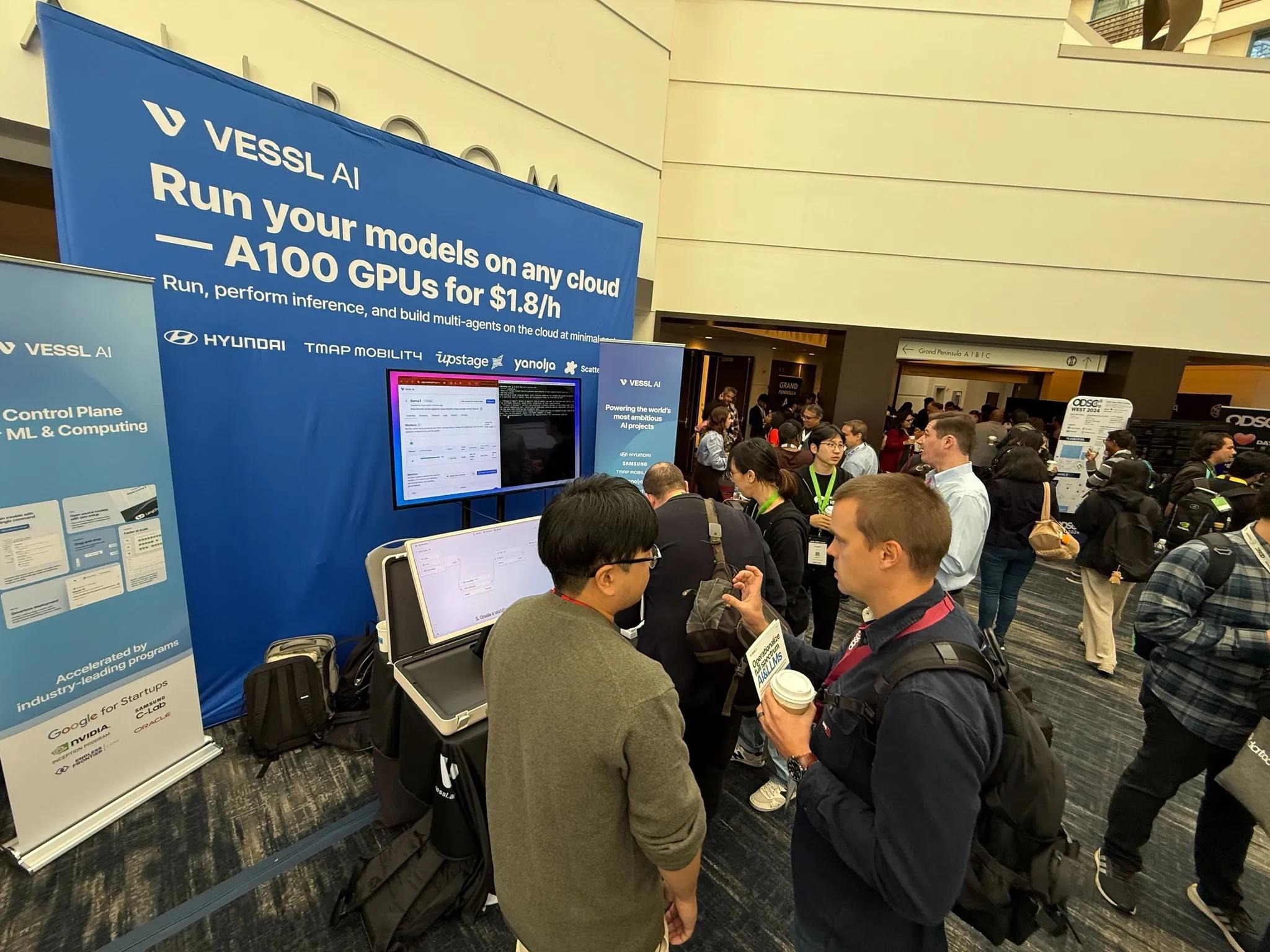
The company's language evolved with the constraint. It moved from an end-to-end MLOps platform toward VESSL Cloud and a broader GPU infrastructure proposition. The continuity matters more than the vocabulary. An's original concern was coordination: make disparate compute behave like a usable system. The current GPU race makes the same concern larger and more capital-intensive.
An ambition measured in machines
An's public manner remains that of an engineer explaining a system. In talks, he walks through private models, cloud choices and the tradeoffs between fine-tuning and retrieval. He names the layers. He shows the path. His GitHub profile, under the handle kuss, carries older traces of the same appetite: public repositories involving QUIC networking and a continuous pytest runner. Speed, feedback and the behavior of systems under load were interests before AI infrastructure made them fashionable.
He also has a taste for scale stated plainly. In 2026, An published a goal for the following year: 50,000 NVIDIA Vera Rubin GPUs, expanded with partners across South Korea. It is an ambition that sounds abstract until one imagines the racks, cooling, power, networking and contracts. Five digits of compute turn orchestration from software convenience into industrial policy with cables.
KAIST, with student activities spanning computing groups and two bands.
Software engineering, global traffic and a mobile game that reached 10 million users.
VESSL AI is founded around the missing operational layer for machine learning.
A move to the United States and a $12 million Series A support the next stage.
VESSL Cloud leans into GPU access, routing and infrastructure at a larger scale.
There is a social layer to his thinking too. At a 2023 entrepreneurship program for KAIST students, the lesson participants remembered was his emphasis on connections. A company is a network long before it becomes an org chart: collaborators, customers, mentors, investors and the person willing to answer a question when the obvious route fails. For an infrastructure founder, relationships are another dependency to maintain.
“AI compute shouldn't slow down research.”Jaeman An
The glamour is upstream. The leverage is underneath.
An describes VESSL AI as an execution layer. The phrase is useful because it refuses to predict which model or agent will win. Instead, it asks what every winner will require. Researchers need compute. Enterprises need control. Production teams need monitoring and predictable deployment. Finance teams need utilization rather than idle hardware performing a costly impression of sculpture.
The orchestration metaphor appeared more explicitly as the product broadened. GPUs, language models and agents are different instruments. Each may be impressive alone. A working service requires timing, allocation and a shared score. An has argued that this coordination will become central as businesses adopt multiple specialized agents rather than a single universal model.
The risk in such a broad vision is familiar: infrastructure companies can promise a universal layer and discover that every customer's environment is universally peculiar. VESSL AI's answer has been to keep the developer surface recognizable while adding integrations beneath it. The product has to accommodate proprietary data, multiple vendors and workloads that range from training to live inference. The elegance is judged at the boundary, where a customer's messy reality meets a small configuration file.
That boundary is where An's career has been pointing. The game with 10 million users taught him that scale eventually audits every shortcut. Production machine learning taught him that model quality cannot rescue weak operations. Building across Seoul and San Francisco taught him that technical systems and companies both depend on good connections.
AI's public story is full of astonishing outputs. An's work concerns the inputs we prefer to forget: hardware, capacity, reliability, deployment and cost. Plumbing is an unromantic metaphor until the taps stop working. Then it becomes the entire day.
The wager behind VESSL AI is that the next phase of artificial intelligence will need less improvisation and more infrastructure that behaves. If An succeeds, much of the achievement will be invisible. A researcher will request compute, a model will train, a service will scale, and nobody will think about the layers in between. For an infrastructure engineer, obscurity can be a standing ovation.