A graphics processor can be scarce and idle at the same time. Scarce to the developer trying to rent one; idle to the owner whose last job has finished. Put those people in different places, with different software and different expectations, and an apparently simple exchange becomes an infrastructure problem. This is the space io.net occupies. Its wager is that some of AI’s shortage can be addressed by making existing machines easier to find and use.
- IO Cloud rents GPU infrastructure; IO Intelligence offers models and agents.
- Independent suppliers provide the hardware. io.net coordinates access.
- Judge the finished workload, not merely the advertised hourly rate.
The nuisance that became the business
io.net’s own history begins with quantitative trading. Before June 2022, the team says, it was developing systems for stock and cryptocurrency markets. Trading was the intended business. Compute was the troublesome supporting actor who kept demanding a larger dressing room.
That history describes a search for distributed computing and a useful discovery: Ray, the framework for coordinating work across machines. io.net credits Ray with cutting backend development from a projected six months to 60 days. Then GPU costs became an obstacle. The company’s attention shifted toward the infrastructure itself. The lesson is modest and portable: watch the bottleneck your own team repeatedly encounters. Other teams may be paying to endure it too.
Founder Ahmad Shadid and co-founder Tory Green became public faces of the venture. In March 2024, its developer, IO Research, announced a $30 million Series A led by Hack VC, with investors including Multicoin Capital and 6th Man Ventures. The Block reported a $1 billion fully diluted token valuation for the final tranche. That describes the token financing, rather than a clean statement of the company’s equity value.
A cloud with borrowed furniture
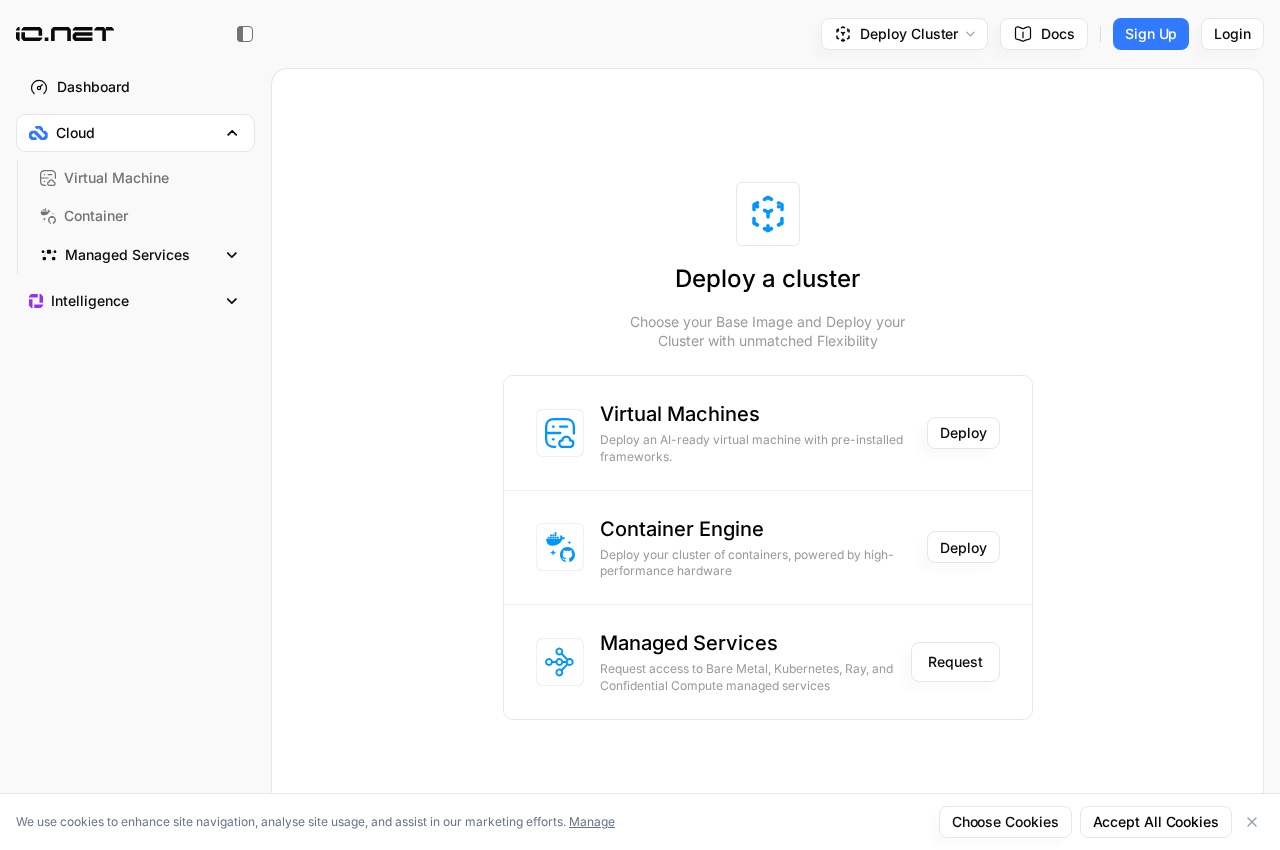
The product makes more sense when you follow a job. An AI team needs a GPU with enough memory, an appropriate environment and somewhere to put its data. IO Cloud offers virtual machines and containers, plus managed services available by request, including bare metal, Kubernetes and Ray. The machinery comes from distributed suppliers. io.net’s work is to present that supply as something a developer can deploy.
Conceptual flow. Actual configurations depend on the service and available hardware.
This places it between conventional clouds and compute marketplaces. AWS, Azure and Google Cloud are alternatives when buyers want their broader service ecosystems. Specialist GPU providers and marketplaces are alternatives when the immediate need is accelerated compute. io.net’s distinction is the combination of distributed supply, cluster orchestration and a crypto-based incentive system. Owning fewer machines does not excuse it from making them useful.
Customers include developers, machine-learning engineers and enterprise teams running training, fine-tuning or inference. Company materials name Krea and Wondera. A particularly concrete announcement involved Leonardo.Ai: an initial agreement specified 24 A100 GPUs for May through August 2024. A named allocation is more informative than a fog of partnership logos. It tells you what someone actually intended to rent.
The inventory developed an imagination
In April 2024, the network’s supply figures came under scrutiny. Shadid’s explanation, reported by The Block, was that attackers had spoofed GPU availability to pursue rewards. He described approximately 1.8 million fake GPUs attempting to connect. The company worked to distinguish real devices from invented ones, and genuine supply was temporarily affected as partners rejoined.
“a painful lesson”Ahmad Shadid on the 2024 incident, reported by The Block
The early failure was in establishing which advertised resources were real. A marketplace that pays people for showing up gives dishonest people a reason to show up repeatedly. For another founder, the copyable lesson is blunt: tie incentives to verifiable service, and design the verification before celebrating the inventory. A large supply number can otherwise become an expensive work of fiction.
Leadership changed too. Shadid stepped down in June 2024; Green took over. In April 2025, former CTO Gaurav Sharma became CEO, while Green moved to chair the foundation. Those transitions belong in the story because a distributed network still has people responsible for its product and its promises.
Some developers would prefer an answer
IO Intelligence, released in February 2025, moves up a level. Instead of provisioning a machine and serving a model yourself, you access models and agents through a web interface or API. The documentation shows calls using the OpenAI SDK with io.net’s endpoint. Familiar client code lowers the effort of trying an alternative, although model behavior still needs testing.
The business therefore has two related routes to payment: compute rentals and AI usage. Intelligence documentation describes shared credits across models, subscription allowances and pay-as-you-go continuation. Models consume credits at different rates. A useful comparison follows the actual task through the system, including quota limits and failed requests. The glamorous number is the hourly discount; the useful number is what a satisfactory result costs. For scale, a homepage price table dated July 30, 2025 listed an RTX 4090 virtual machine at $0.49 per hour. That is a dated advertised rate, not a promise about today’s inventory or every deployment mode.
The electricity bill prefers dollars
Suppliers have a different calculation. A volatile token payment can make ordinary operating costs difficult to plan. io.net’s tokenomics materials identify that exposure as a reason for changing its incentives. In June 2026, it announced the launch of its Incentive Dynamic Engine, with supplier payouts pegged to dollar value and token burns linked to network revenue. The redesign acknowledges that participating in infrastructure should not require a matching appetite for price speculation.
Enterprise contract value announced by io.net. Contract value is not annual company revenue.
The same announcement reported an $8 million enterprise agreement and up to four billion inference tokens processed daily. These are company-reported figures. Inference tokens measure model traffic; IO tokens belong to the crypto economy. Confusing them would give the story rather more money than arithmetic permits.
For a prospective customer, the next step is an experiment: run a representative job, measure completion time and failures, then compare the total bill. Tight latency, data-location rules or demanding communication between GPUs can change the answer. Distributed supply alone settles none of those questions. io.net’s proposition is attractive when available hardware becomes dependable work. The proof arrives when the job finishes.