- Index connected old point-of-sale systems to modern payment terminals, cloud routing and customer analytics.
- Its software served named grocers, restaurants and apparel chains including Fairway, The Fresh Market, Cava and American Apparel.
- The company raised $26 million; its public price list and Stripe's 2018 acquisition price were never disclosed.
- The product worked best where checkout volume was high and the existing retail stack was too expensive to replace.
There is a moment at a supermarket checkout when the entire store seems to be waiting on a two-inch piece of plastic. The cashier has stopped. The shopper has stopped. The little screen says DO NOT REMOVE CARD, which naturally makes everybody stare at the card. In the middle of the 2010s, this became an American ritual. Chip cards were safer than magnetic stripes, but safety arrived with eight, ten, sometimes sixteen seconds of public stillness.
Index saw those seconds differently. To a shopper they were annoying. To a busy grocer they were throughput, abandoned baskets and labor. To the founders of Index they were proof that the least glamorous layer in retail - the handoff among register, PIN pad and processor - could determine whether a much grander idea lived or died.
The company that was not a wallet
Marc Freed-Finnegan and Jonathan Wall left the Google Wallet team in 2012. The obvious guess was that they would build another mobile wallet. Instead, their startup, first called Tappmo and then Index, wanted to give physical stores the memory of a website. Amazon could recognize a returning shopper, recall purchases and test whether a recommendation worked. A cash register at a national chain often knew only that somebody had bought something.
The early pitch was appealingly specific. With permission, Index could turn a payment card into a secure token, connect later purchases to that anonymous history, remember that a customer preferred an email receipt and help the retailer send a relevant offer. It could measure whether the offer ended in another purchase. The system was opt-in, a distinction that mattered because the same feature could feel either helpful or creepy depending on whether the shopper understood the bargain.

Index's clever choice was to avoid demanding a renovation. Square's clean hardware-and-software stack made sense for many small merchants. A large retailer had registers, processors, apps and websites accumulated over years. Index offered to integrate with all of it. Freed-Finnegan called the approach "loosely federated." In plainer language: keep the expensive things you already own; let us improve the seam.
“When we talk to Target, we're not expecting them to swap out their point-of-sale system. We integrate with it.”Marc Freed-Finnegan, co-founder and CEO
Then the plumbing became the product
Personalization depended on access to the moment of purchase. That pulled Index deeper into payments. In 2015 it launched semi-integrated payments for Verifone and Ingenico terminals and a hosted gateway connected to First Data, Vantiv, Chase Paymentech and Worldpay. The architecture moved sensitive card data directly from the PIN pad toward the processor. The register received a simple approval instead of handling the raw card details.
The quieter route through checkout
The useful absence: raw payment data did not need to pass through the point-of-sale machine.
That separation did three jobs. It reduced the register's PCI compliance exposure. It let a retailer change processors without rebuilding every checkout device. And it made future upgrades - EMV, contactless payments, loyalty prompts - less like surgery on a live store. Index was no longer merely reading the purchase event for marketers. It was responsible for making the event happen.
The old knot
Payment data ran through the POS, tying security, certification, hardware and processor choices together.
Index's seam
The register named the price. The terminal handled the card. The cloud routed the payment. Each part could change with less disturbance.
Why one second mattered
The first thing to fail was not the personalization thesis. It was the checkout experience around it. America's October 2015 EMV liability shift pushed merchants toward chip cards, and the new ritual was conspicuously slow. Index adopted the card networks' faster specifications, built an EMVCo Level 2-certified kernel, removed steps unnecessary for the online-only U.S. authorization model and let shoppers insert a card before the cashier finished scanning.
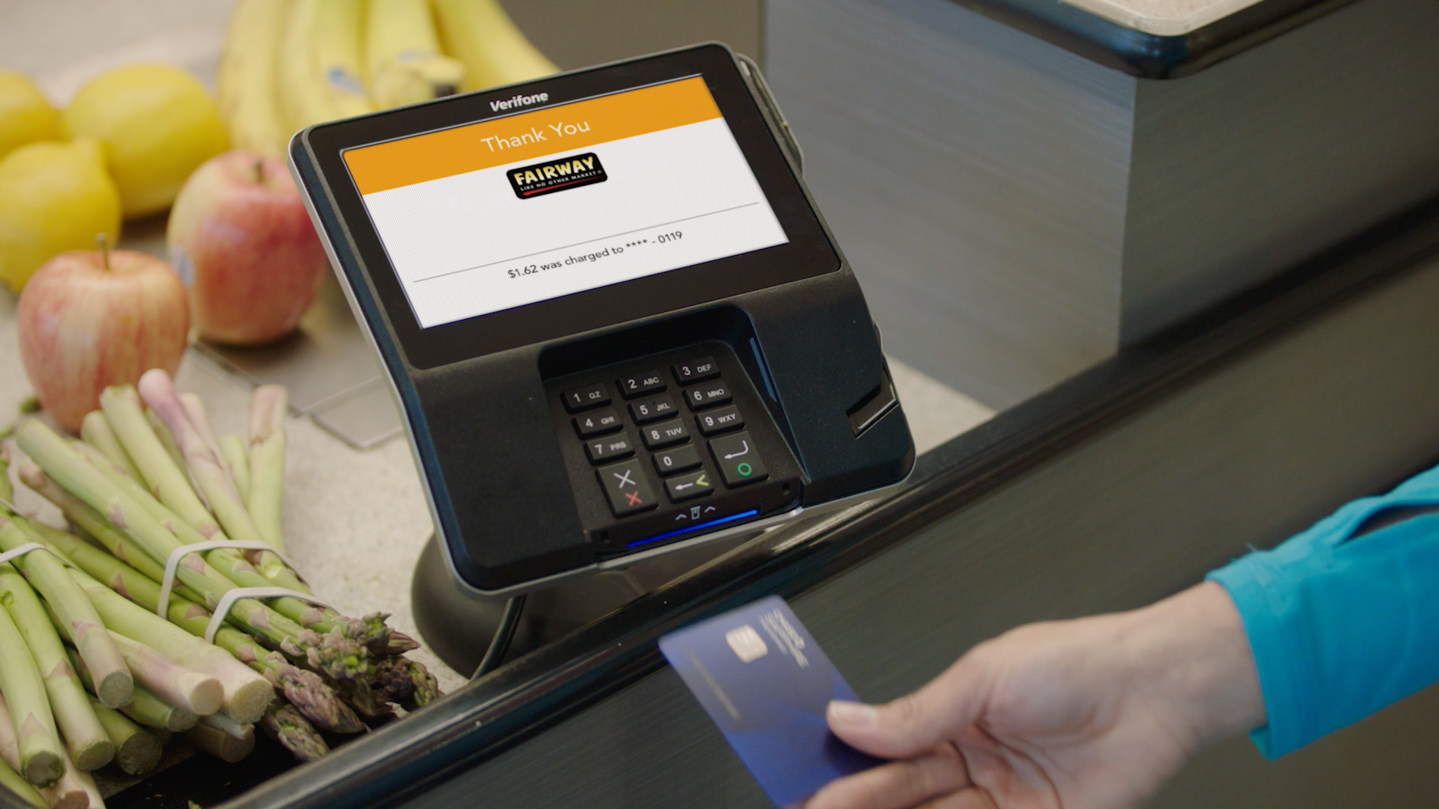
In May 2017, Index announced that the customer's card interaction could take about one second. Fairway Market, New Seasons Market and New Leaf Community Markets deployed it. More than half of shoppers in Index's installations chose to dip before the total appeared. The product was not magic: authorization still had to occur. Index had shortened the human part by changing the sequence.
The second number is less theatrical but more revealing. Fairway's chief information officer said Index reduced the chain's gateway cost by 35 percent while securely transmitting data. Index never published standard pricing. In 2014, it described a mix of service fees and performance fees when recommendations led to purchases; the agreement was separate from payment processing and did not change the processing rate. For an enterprise buyer, the relevant cost was a negotiated contract plus integration and rollout work. The counterweight was measurable savings, smaller compliance scope and a checkout line that moved.
The idea that changed shape
What changed the founders' emphasis was evidence from retailers. Customer recognition remained the ambition, but the urgent budget and operational pain sat lower in the stack. Security deadlines, processor complexity and slow EMV affected every transaction. Solve those first, and the terminal became a place to ask for an email, deliver a receipt, enroll a loyalty member or connect the purchase to a customer profile.
This explains Index's unusual product bundle: gateway, encryption, device management, analytics, loyalty and marketing. Competitors tended to arrive from one side. A payments company could process the card. A marketing platform could segment customers. A modern POS could offer an elegant replacement. Index sat in between, most attractive to large retailers that wanted new capabilities without surrendering their existing hardware, app or processor.
The model also had boundaries. It needed transaction volume high enough for seconds and gateway savings to matter. It needed a cooperative POS, supported terminals and processor certifications. Its personalized layer needed clean line-item data and genuine shopper consent. A small shop wanting an out-of-the-box register would be better served by an integrated POS. A retailer unwilling to explain how it used purchase history risked converting relevance into surveillance.
Stripe buys the difficult years
Index raised $7 million in 2013 from Innovation Endeavors and Khosla Ventures, then $19 million in 2016 in a round led by General Catalyst with Datalogix founder Rob Gierkink. Its customer list grew to include American Apparel, The Fresh Market, Fairway, New Seasons, New Leaf, Tender Greens, Cava Grill and Dig Inn. This was progress, but enterprise retail remained slow, integration-heavy work.
By December 2017, the founders were debating the company's direction. Three months later, Index announced it had joined Stripe. The price was not disclosed. Reports put total capital raised at $26 million and said most employees were offered roles. The sale was not presented as a rescue or a victory lap. It looked like a recognition that Index's most valuable asset was the accumulated knowledge required to make old retail systems, modern cloud software and regulated card networks cooperate.
Six months after the acquisition, Stripe launched Terminal: software development kits, pre-certified readers and cloud device management for in-person payments. It would be too neat to call Terminal simply renamed Index. Stripe had its own platform, partners and product strategy. The lineage is still hard to miss. Both treated the physical checkout as programmable infrastructure and both promised to unify online and offline payment data.
What another builder can copy
- Begin with the customer's installed reality, not your ideal replacement stack.
- Find the universal operational pain that earns access to the more ambitious product.
- Make value legible in seconds, cost or compliance work removed.
- Separate sensitive systems so each component can evolve without recertifying everything.
- Treat consent as product architecture, not language added after launch.
Index began with a glamorous metaphor: make a store know you like Amazon does. It found traction in a much smaller observation: nobody likes waiting for a card reader. The company's lasting lesson lives in that distance. Big visions often enter through narrow seams. Sometimes the seam is exactly one second wide.