Consider the map on a car’s dashboard. It must show where you are, where you should turn, and what deserves your attention. A restaurant matters to a hungry passenger. A charging station matters to a battery running low. The same street contains both. Somebody has to decide which one the driver sees.
Mapbox built a business around handing that decision to the people making the product. Its customers buy the machinery of location: maps, search, routing, and data they can assemble into an experience of their own. You may use its work without ever seeking out its name.
- The product: location infrastructure for developers, from map design to turn-by-turn navigation.
- The appeal: control over appearance, behavior, and the data on screen.
- The bargain: free starting allowances, then product-specific usage charges and engineering work.
01 / A map with the wrong priorities
The early problem was practical. Eric Gundersen’s team worked on maps for international-development organizations. Existing tools left gaps in both geographic coverage and the ability to display useful information. A general-purpose map could tell a traveler where to go while frustrating someone trying to explain what was happening there.
Mapbox emerged in 2010. Co-founder Bonnie Bogle ran operations during its first seven years. The company’s early work involved organizations such as the United Nations and World Bank. That background helps explain its central instinct: let the customer bring the question, then make the geography serve it.

By October 2013, when Foundry Group announced a $10 million Series A, Mapbox already had customers including NPR, Foursquare, and the Financial Times. Foundry described a business built without outside financing up to that point. Paying work preceded the institutional money.
02 / One world. Different instructions.
A weather service needs room for an advancing storm. A delivery app needs an arrival estimate. A hiking app needs terrain. Those priorities can clash with a default map crowded with information meant for somebody else.
Mapbox Studio gives designers controls for colors, typography, road widths, and points of interest. Developers use GL JS for interactive web maps and Maps SDKs for mobile applications. They can add their own layers, so a company’s private information appears in geographic context.
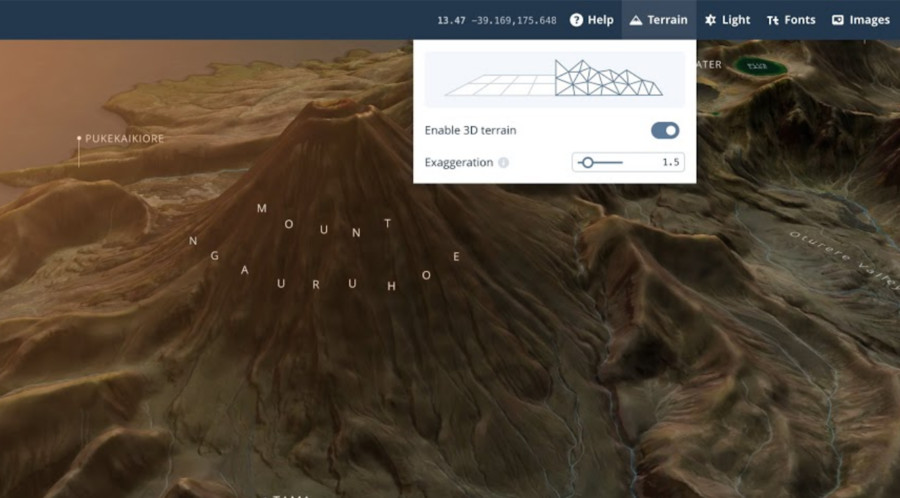
The less visible pieces do equally useful work. Geocoding connects addresses with coordinates. Search helps people find places. Routing calculates journeys; a travel-time matrix compares possible connections. The Tiling Service prepares custom datasets for efficient display. Atlas brings licensed mapping into private infrastructure.
- 01DataRoads, places, boundaries + your layers
- 02ServicesSearch, routes, travel times
- 03ExperienceYour styling, interface, and priorities
03 / The customer keeps the steering wheel
Mapbox occupies a particular place among Google Maps Platform, HERE, TomTom, and other location suppliers: it emphasizes tools for teams that want to shape the experience. A familiar map can be perfectly adequate. Customization earns its keep when location is part of the product’s identity or operations.
Instacart and The Weather Company illustrate that range. In September 2023, Mapbox reported more than four million registered developers and adoption by nearly 40 percent of Fortune 500 companies. Those are company-reported figures from that announcement, rather than a count of today’s active users.
Cars make the argument tangible. On October 14, 2026, Mapbox announced 3D Live Navigation for BMW’s Neue Klasse vehicles. Lane-level guidance and detections from driver-assistance systems appear together in the map. BMW can shape how that information works across its displays. The dashboard becomes a product decision.
04 / Free is a starting point
Control has a bill attached. Mapbox sells metered services, with free allowances, volume discounts, and enterprise agreements. Different products count different things. A web map load, an active mobile user, and a navigation trip are separate units. Confusing them makes a tidy prototype budget unreliable.
Take the standalone Directions API. At the published rates checked in October 2026, the first 100,000 monthly requests are free. The next tier costs $2 per thousand. That makes 150,000 requests approximately $100 for that API alone, before other services or contractual adjustments.
First 100k free; then $2 / 1k through 500k. Illustrative public-rate estimate, checked October 17, 2026. Excludes other products, tax, and negotiated terms.
There is also the cost of maintaining an integration. Teams need to test coverage where their customers actually travel, monitor usage, and decide which features justify the work. A distinctive interface is valuable only if somebody can keep it useful.
05 / An open-source fork in the road
Mapbox’s history comes with a licensing distinction worth understanding. GL JS versions through 1.13 used the permissive BSD license. Version 2 moved to Mapbox’s proprietary terms in December 2020. MapLibre continued the open-source path. Open map data and open-source rendering software have different licenses.
For a team requiring a permissively licensed renderer, MapLibre deserves consideration, alongside a plan for data and hosting. For a team buying an integrated commercial platform, Mapbox may fit. The decision depends on engineering capacity, geographic coverage, contractual requirements, and the value of customization.
06 / The next question is spoken
A $164 million Series C in 2017 backed expansion including automotive work. A $280 million Series E, announced in September 2023 and led by SoftBank, targeted AI location services and a larger automotive presence. These sums describe financing, not a guarantee that every product bet succeeds.
In September 2026, Mapbox announced location infrastructure for AI, including a Places API public preview and tools for agents. The premise is straightforward: a fluent answer still needs dependable geographic information before it can become a useful journey.
“You innovate. You keep listening to the customer.”
Peter Sirota / CEO, speaking to SoftBank Vision Fund
The transferable lesson is specific. Find work that a standard product handles awkwardly. Give customers control over that work. Charge in units they can understand. Mapbox’s published culture stresses customer needs and ownership; its products give those ideas a visible test. Does the person using the map see what matters next?
Take a closer look
Explore the tools, meet the builders, or watch the products at work.