The car did not need to break for Automatic to stop working. It could still start, steer and sit patiently in a parking lot. The little adapter under its dashboard could still be physically present. But at 11:59 p.m. Pacific on May 28, 2020, Automatic’s operations ended, including crash notification. The company told owners to recycle their adapters. A device purchased to explain a car’s problems had acquired a problem the car could not explain.
- The shortcut: plug into the diagnostic port of a compatible older car.
- The usefulness: engine alerts, recorded journeys, parking location and crash assistance.
- The expansion: third-party apps, cellular adapters and dealership services.
- The ending: SiriusXM acquired Automatic in 2017; services closed in 2020.
That ending makes Automatic Labs worth remembering. Here was a sensible answer to an expensive question: why buy another vehicle to get a little more intelligence from the one you already owned? Its history also gives connected-device makers something less comfortable to consider. The buyer takes home the hardware. The seller remains responsible for much of what makes it useful.
01A car that could explain itself
Automatic began in 2011, joined Y Combinator that summer and brought its consumer product to market in 2013. Co-founders Thejo Kote and Jerry Jariyasunant had researched transportation choices at UC Berkeley. Jariyasunant’s work examined feedback about travel, including time and environmental consequences. Automatic carried that interest into the car: collect information, return it to the person making the decisions, and see whether those decisions improve.
The doorway was wonderfully unglamorous. An OBD-II diagnostic port, generally beneath the dashboard, gave the adapter access to vehicle information. Mechanics already used the socket. Automatic paired it with a smartphone app and made the resulting information legible to people who preferred driving their cars to interrogating them.
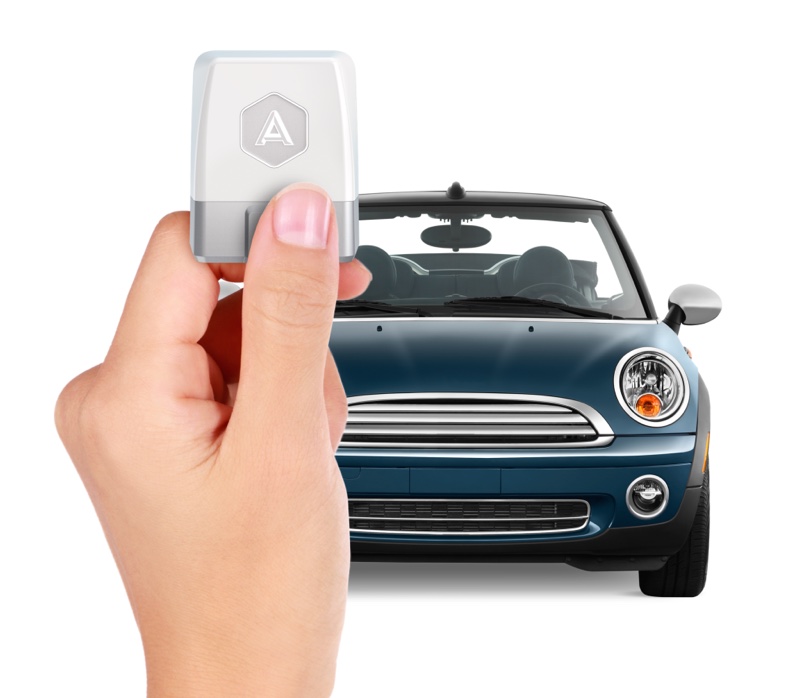
A check-engine light offers suspense with very little exposition. Automatic could report diagnostic information behind it. The app also recorded trips, tracked fuel use and remembered parking locations. Driving feedback drew attention to habits such as hard acceleration and braking. These were small recurring inconveniences, exactly the kind that become expensive through repetition.
The safety proposition went further. An early Crash Alert description used the adapter’s accelerometer to detect a severe collision, allowed a short cancellation period and then contacted an emergency call center. The important product detail was the chain: a sensor’s observation became a service involving people. An alert was only the beginning of the job.
02The app store under the dashboard
By May 2015, Automatic had a second-generation adapter, priced at $99.95, and a developer platform. Built-in GPS and two Bluetooth data streams supported its own app alongside compatible third-party software. Performance apps could receive live vehicle readings. The App Gallery gave customers a way to discover integrations rather than treating the adapter as a closed little appliance.
Expense reporting was an especially persuasive use. Automatic’s Concur integration brought recorded mileage and route information into reimbursement workflows. A journey that would otherwise become a forgotten note or a doubtful estimate could become a usable expense record. The customer did not need to develop a new enthusiasm for telematics; an existing administrative chore supplied the reason to care.
Reading data was one task. Turning it into reimbursement, household automation or emergency assistance required the rest of the chain.
IFTTT and Nest integrations suggested another use: the car could participate in household routines. Vehicle events could become triggers for other software. Automatic’s expertise lay in this translation between automobile information, mobile interfaces and useful actions. A conventional code reader had a narrower assignment; a factory-installed connected system arrived attached to the manufacturer’s vehicle. Automatic pursued a retrofit platform across compatible cars.
There were alternatives, including Zubie, Dash, CarMD and Torque. Automatic’s argument rested on the combination of approachable software, hardware and an app ecosystem. The company’s historical recruiting description emphasized engineering, design and collaboration. The ambition was visible in the product: make a technical interface feel ordinary enough to use without a technical hobby.
03The phone leaves the car
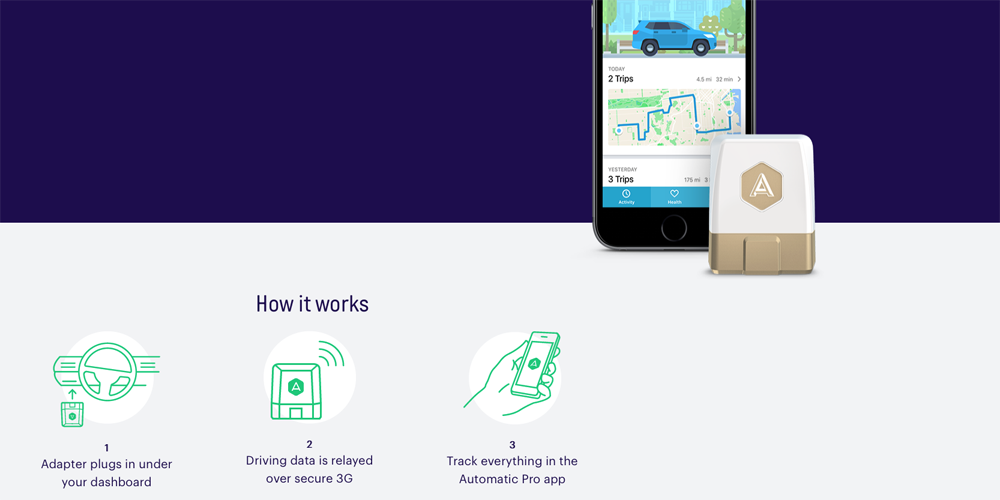
Bluetooth had an obvious dependency: the phone was part of the connection. Automatic Pro, released in 2016, added built-in 3G. Information could travel without relying on a paired phone being in the vehicle. That changed the possibilities for a family monitoring a shared car, and for businesses that needed vehicle information to remain available between different drivers.
“People don’t want another subscription.”
Thejo Kote, on Automatic Pro’s bundled connectivity, 2016
Pro cost $129.95 and included five years of cellular connectivity. Lite offered a $79.95 Bluetooth option. The distinction concerned both features and the continuing machinery behind them. Cellular connectivity makes a device more independent of its owner’s phone while adding reliance on a network and a service operator.
Different hardware and service bundles. These are launch-era prices, not offers available today.
The institutional customers were automotive dealers and insurance carriers. Dealers could use the platform for inventory and customer relationships; insurers could support usage-based savings and teen-driver coaching. Those were different reasons to purchase access to the same category of information. For a driver, location could answer “Where did I park?” For a dealer, it belonged in an operational workflow.
SiriusXM acquired Automatic in April 2017. Its year-end filing reported $107.736 million net of acquired cash and restricted cash. The parent already worked in connected-vehicle services, giving the acquisition a clear stated place in its business. At the time, Automatic’s brand and offerings were to continue.
In 2019, a new Connected Car Assistant arrived at $99.99, using AT&T’s LTE-M network. Its bundle included three years of Select service and six months of Premium. That split made the service clock more visible: different capabilities came with different included periods. The business had moved beyond a simple adapter sale toward tiered services and dealer distribution.
04A socket is not permission
Long before the shutdown, Automatic encountered a limit to its platform ambitions. In a May 2015 statement included in an Electronic Frontier Foundation copyright submission, Kote described legal uncertainty around access to vehicle computers. Customers wanted features such as unlocking doors from a smartphone and broader health checks. He said uncertainty about possible manufacturer lawsuits prevented Automatic from implementing all the features people requested.
That is a revealing distinction. A standardized port can make entry practical without making every operation available. Reading diagnostic information and changing a vehicle’s behavior ask different things of the system. Automatic’s statement documents a constraint on its choices; it does not establish that this constraint caused the company’s eventual closure.
Compatibility imposed further boundaries. Automatic targeted compatible vehicles, generally model year 1996 or later, and Pro’s cellular service worked in the United States. A diagnostic explanation also did not complete a repair. The adapter could help an owner understand an alert; it could not replace the labor, parts and judgment required to fix the cause.
05At 11:59 p.m., the service ends
In May 2020, Automatic attributed its closure to the pandemic’s adverse effect on its business. Its notice described fewer vehicle purchases and leases, and fewer drivers on the road. The public explanation was a loss of a viable path forward under those conditions. It would be tempting to assign a tidy earlier failure to the pricing, the distribution or the technology. The available announcement does not do that.
All Automatic operations ended, including crash notification.
SiriusXM later recorded $24 million in restructuring expenses associated with terminating the service. Customers faced a more domestic calculation: what remained of an adapter after the platform ended? Official guidance directed them to electronics recycling. Eligible customers had a June 15 deadline to request rebates. The shutdown policy also said personalized driving information would be deleted, with limited records retained for corporate obligations.
The five-year inclusion advertised with Pro had depended on a company continuing to supply connectivity and services. Hardware possession and service continuity had different durations. Automatic makes that distinction unusually tangible: the car kept its working life, while the accessory lost the business supporting its connected functions.
06Copy the doorway. Budget for the building.
For founders, Automatic offers a useful method: find an existing interface inside something customers already own, then remove the work involved in using it. The diagnostic socket avoided asking people to replace a costly asset. Mileage reimbursement supplied a concrete task. Developer integrations let the information travel into tools customers already used.
The financial lesson is an inference from the product’s design and ending: a purchase price that includes years of service must support years of obligations. Network access, software maintenance and human assistance continue after the box leaves the shelf. Bundling can make buying pleasant; it also gives the operator a long memory of every sale.
That approach depends on compatible hardware, permitted access, reliable connections and a service business that can keep running. For buyers, the useful questions are equally concrete: which functions work locally, which require the provider, how long is service included, and what happens when it ends? Automatic found an elegant way to let older cars speak. Its last lesson concerns who must remain on the other end of the line.
Follow the remaining trail
Historical profiles, product coverage and a founder conversation.
Original website ↗LinkedIn ↗Twitter / X ↗Instagram ↗Facebook ↗GitHub ↗2015 adapter & App Gallery ↗Watch: Thejo Kote on Automatic ↗