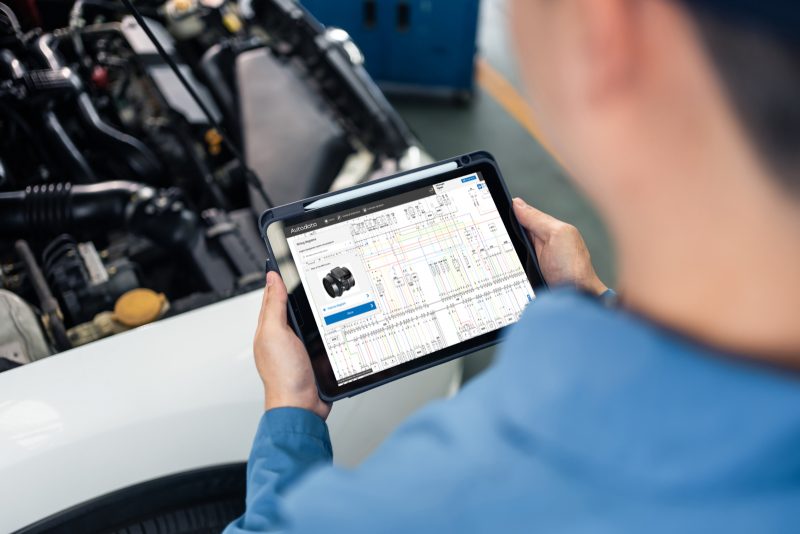
A car arrives with a warning light. Before anyone orders a part, someone has to work out what the car is trying to say. That interval - between a symptom and a defensible repair decision - is where Autodata earns its keep. The screen may show a wiring diagram, a service schedule or a tightening specification. The commercial proposition is wonderfully unglamorous: spend less of the working day hunting for the right information.
Autodata supplies technical information for servicing, maintaining, diagnosing and repairing cars, vans and motorcycles. Its customers include independent garages, workshop groups, mobile mechanics and training institutions. Corporate customers can also license its data for their own products. It occupies a useful position in the automotive aftermarket, turning manufacturers’ information into something a technician can consult beside an open bonnet.
The company’s UK homepage now advertises more than 46,000 car and van models, roughly 826,000 technical repair procedures and 420,000 standardised wiring diagrams. Those are company-reported catalogue counts, not measures of successful repairs. The more interesting number is smaller: a few minutes saved on an ordinary service, repeated through a busy month.
The five-minute problem
In a 2015 Autodata case study, Maurice Donovan, owner of AllAutos Advanced Tuning in Brisbane, described the usefulness of putting technical information inside service schedules. His workshop could print checklists, explain the work to customers and avoid piecing together requirements from a car’s logbook. He estimated that losing access to Autodata could add five or ten minutes to each service.
“It could easily add on five or ten minutes to each service,” Donovan said. At 100 services, that estimate implies about eight to seventeen hours of searching. It is one customer’s historical account, rather than a controlled productivity study, but it makes the buying decision legible. A garage pays for information partly because its technicians’ attention already has a price.
The benefit also reaches the reception desk. Autodata’s repair-time estimator helps staff prepare labour estimates; service schedules help establish what a job includes. A wiring diagram supports fault-finding, while technical service bulletins and known fixes can point to an established problem. Each serves a different moment in the same visit. The repair begins before the first spanner turns.
Where do the minutes go?
Potential monthly time recovered. Services × minutes ÷ 60. An illustration based on the historical customer account, not a performance promise.
The manual outgrew its binding
Autodata dates its establishment to 1972, following a management buyout in Maidenhead. Its early business published manuals for the trade and for motorists working on their own cars. Bowmark Capital’s later acquisition announcement identifies Richard Atherton and Dietmar Otto as the founders. The origin is unusually apt for a data business: the company traces its roots to a translation agency established a decade earlier.
Its delivery formats followed the tools available in the workshop. An electronic product arrived in 1991, the first online product in 2006, and a new web application and API in 2014. In 2015, Autodata says it finished moving all customers worldwide to the new online application, replacing older online and CD versions.
The sequence reveals the constraint the business was addressing. A published edition captures information at a moment in time; a workshop continues meeting unfamiliar vehicles after that moment. Moving online allowed the service to keep changing after a customer subscribed. Autodata’s current UK site reports 62,000 vehicle updates over its preceding twelve months. Keeping the reference current became part of the product itself.
- 1991Disk
- 2006Online
- 2014Web app + API
- 2015Migration complete
One workshop, many manufacturers
Autodata licenses technical information directly from more than 170 manufacturers. Its published process includes additional checks, standardisation and localisation. The company describes a workforce that combines automotive technicians with developers, graphic designers and translators. That mixture explains the product better than the usual software-company vocabulary: somebody must understand the procedure, somebody must organise it, and somebody must make it readable.
A workshop handling several makes benefits from a consistent presentation. On Autodata’s interactive wiring diagrams, technicians can search components and follow colour-coded paths. The interface reduces the need to learn a different visual language every time the badge on the bonnet changes. Accuracy still depends on choosing the relevant vehicle and procedure; a tidy drawing cannot rescue the wrong selection.
The distinction matters in a competitive market. ALLDATA Europe sells access to unedited manufacturer repair information, including mechanical and body repair material. HaynesPro also offers standardised technical data and integration into other businesses’ systems. Autodata therefore competes on the usefulness of its coverage, presentation and workflow. A large diagram count alone cannot establish which service will answer a particular garage’s next question.
THE PRODUCT INSIGHTPut the reference
Editorial analysis
inside the task.
The £143 million reference library
In May 2014, Bowmark Capital and Five Arrows Principal Investments bought Autodata Publishing Group at an enterprise value of £143 million. At the time, Bowmark described a catalogue covering 17,000 vehicle models from 80 manufacturers. The investment case centred on developing the product and expanding geographically as vehicles became more complicated.
By January 2017, the investors had agreed to sell Autodata to Solera for £340 million. Bowmark reported an expanded technology platform, a broader customer base in Europe and Australia, and acquisitions in France, Sweden and Finland. The two transaction figures show how sharply the price of the business changed; they should not be read as a calculation of investment return.
There is a useful twist in the sale adviser’s account. Solera had already tried to buy Autodata in 2014 and lost. It stayed in contact and returned for the later transaction. This was a persistent buyer finding another opening. Within Solera, Autodata joined a larger collection of automotive software and information businesses, with opportunities to combine repair knowledge with other vehicle services.
What a garage actually buys
For a UK buyer, Autodata’s auto-repair software page lists Service & Maintenance from £77 per month and Diagnostic & Repair from £132, excluding VAT. It advertises a £9.99 introductory period of fourteen days, followed automatically by a paid account. These are advertised starting prices checked for this profile; the package, user allowance and terms at checkout determine the purchase.
The distinction between packages deserves attention. Routine servicing and deeper diagnostic work create different information needs. Concurrent access matters too: Autodata offers products for one, two or five devices at the same time. If two technicians need the reference simultaneously, a single-access subscription can become its own small queue.
For an owner weighing the subscription, the useful comparison is the work it supports across a month. A lower monthly fee may be poor value if the needed procedure is absent; a broader package may be unnecessary if the business concentrates on routine maintenance. The trial is an opportunity to examine those differences using familiar vehicles and real questions.
The business also sells training separately. Its UK training purchase page lists £22.50 per user monthly or £238.80 annually. Cars & Vans subscriptions advertise training as included. Beyond garages, the API lets companies incorporate selected information into a parts catalogue, an oil-selection application or workshop equipment. The same technical content can earn revenue through both a finished application and data licensing.
A new battery, a different kind of question
Electrification is pushing Autodata beyond the familiar reference screen. In September 2025, it announced EV & Hybrid Support with HEVRA and the Independent Garage Association. The proposed UK rollout combined searchable vehicle guides with direct expert help by phone, WhatsApp and email, plus qualification verification for garages seeking HEVRA recognition. European expansion was described as a plan.
That combination is revealing. A database can answer a documented question; access to a specialist gives a workshop somewhere to turn when the job needs discussion. Autodata’s UK homepage now advertises HEVRA guides for more than 400 electric and hybrid models. The offer places human support alongside technical documents, acknowledging how much a repair can demand from the person using them.
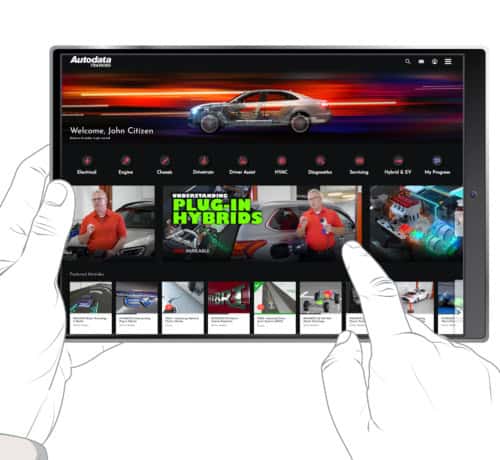
Training provides another route into the same problem. Autodata advertises more than 400 videos, with subjects spanning electrical systems, diagnostics, driver assistance and hybrid and electric vehicles. Technicians can complete knowledge checks and record achievements. Colleges can use video material within their teaching. Watching a module is a useful learning activity; competence on a particular job still requires appropriate practical skills and equipment.
In Australia, Autodata’s Digidentity offering adds identity and qualification verification to access for EV and hybrid repair information. Its current product page dates the introduction to November 2025. The workflow includes garage registration, invitations to technicians and credential checks. Access to specialist information increasingly involves establishing who is opening the document as well as finding the right document.
The part of the business worth copying
For another information business, the lesson is specific: put the reference inside the task. AllAutos valued technical details embedded in service schedules. Corporate customers can embed Autodata information in their own tools. Both approaches reduce the distance between looking something up and doing something useful with it. That is a stronger product argument than asking customers to admire the size of a database.
A workshop can apply a similarly practical test. During a trial, compare the service against jobs the business actually receives: a routine service, a difficult electrical fault and a vehicle that usually sends somebody searching elsewhere. Record lookup time, whether the exact procedure is covered and how easily another technician can follow it. Evaluate the user allowance against the busiest part of the day.
The economics weaken when coverage misses the workshop’s vehicle mix, connectivity is unreliable or the team rarely uses the tool. Recovered minutes also need somewhere productive to go. An empty diary does not turn faster searching into extra sales. Autodata’s proposition is strongest where skilled people have enough work, enough variety and a recurring reason to consult information they cannot reasonably keep in their heads.