Company Profile • Hardware & Training Tech
The Company That Turned Your Trigger Finger Into a Spreadsheet
Austin Allgaier could not figure out why his shooting was not improving. So he strapped a motion sensor to a pistol and started measuring. A decade later, Mantis Tech has graded millions of trigger pulls.
Every shooter has heard the advice, and none of it is measurable. Relax your grip. Smooth the trigger. Follow through. Stop anticipating the recoil. It is the coaching equivalent of "just be confident" - true, useless, and impossible to check against yourself. Austin Allgaier heard all of it, practiced dutifully, and kept getting the same mediocre groups. Somewhere around 2013, at lunch, he asked the obvious question that turned into a company: why is there no device that just tells you what your gun is doing?
That question is the whole of Mantis Tech. The Oswego, Illinois company - it trades publicly as MantisX and simply "Mantis" - builds small sensors and laser kits that clip onto a firearm or a bow, talk to a phone over Bluetooth, and grade what happens in the fraction of a second around a shot. Think of a fitness tracker, except instead of counting steps it watches the muzzle and hands back a number. The pitch is not that the gadget makes you good. The pitch is that it finally shows you, in graph form, exactly how you are bad.
What it actually measuresA coach that speaks in numbers, not vibes
A MantisX sensor mounts on the accessory rail of a pistol, rifle or shotgun. You pair it with the free app, and from there it tracks the movement of the barrel through the trigger pull - the tiny wobble before the break, the jerk at the moment of the press, the way the muzzle settles or does not settle afterward. Each shot gets scored on a 0 to 100 scale based on how far the gun strayed from where it was aimed. It draws a "muzzle trace," a colored squiggle showing the hold, the press and the recoil as three distinct phases. Then it does the part the range buddy never could: it tells you the direction of your error and suggests the mechanical fix.
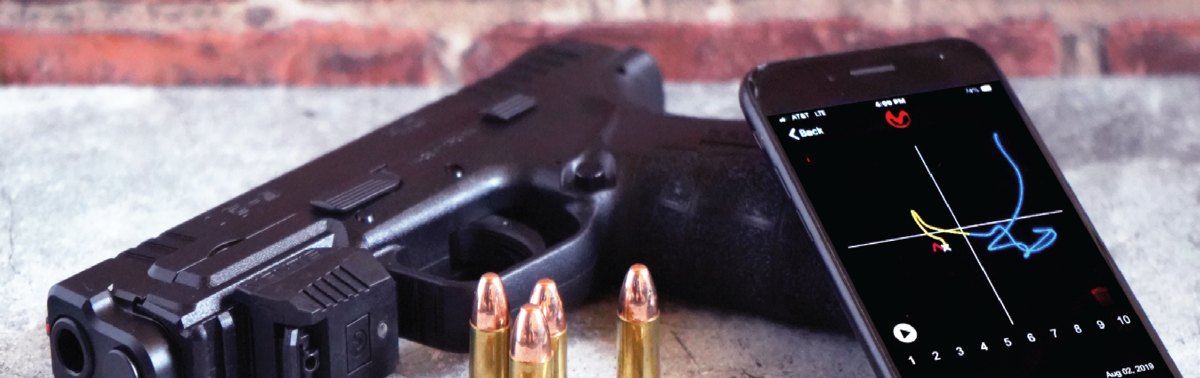
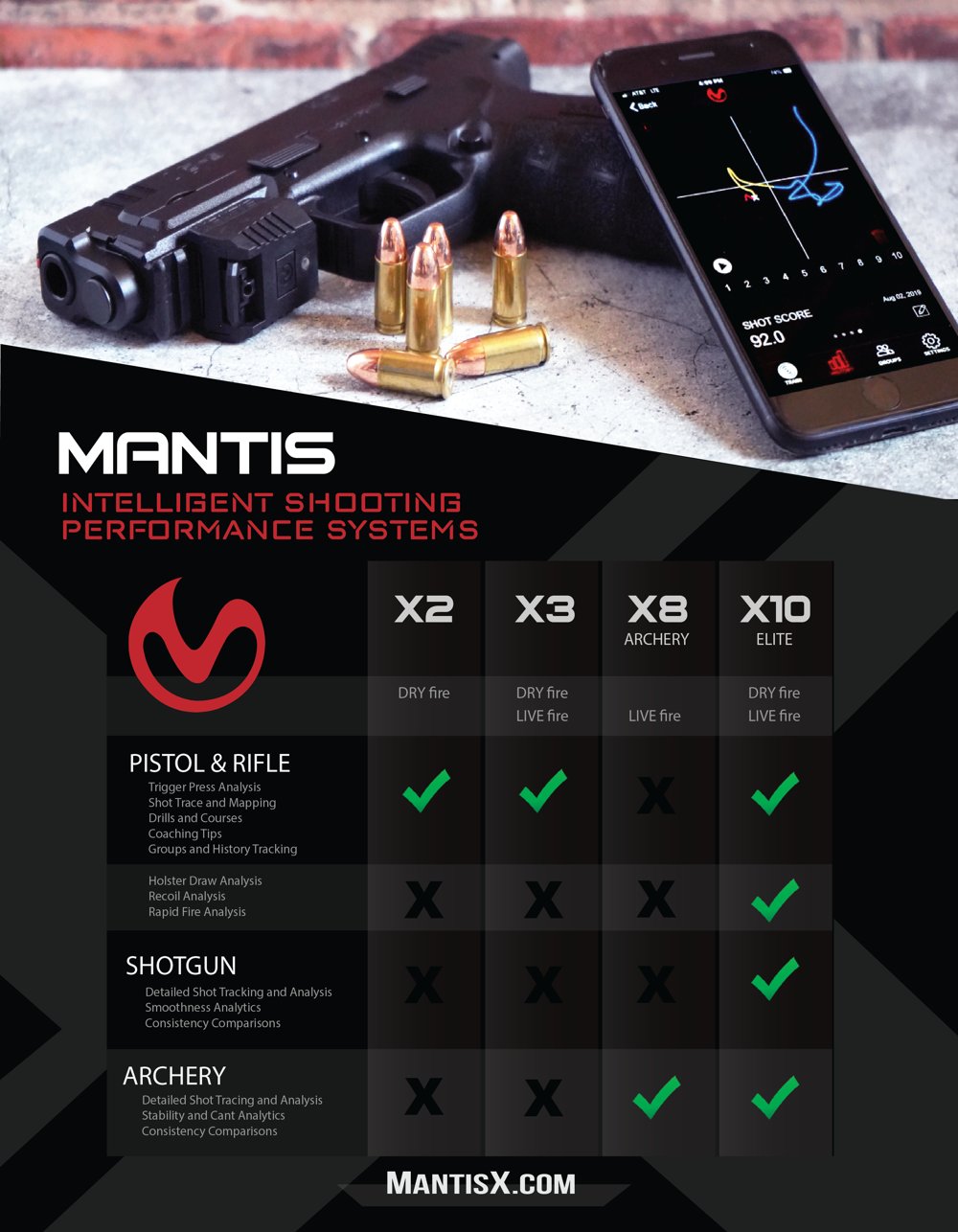
The trick that makes it useful for most people is that it works in dry fire - no ammunition, no range, no muzzle blast. Motion sensors detect whether the trigger broke and analyze the movement without needing to know where a target is. That means the reps can happen in a living room at eleven at night, which is where the vast majority of shooting practice would happen if it were allowed to be cheap and quiet. Live fire works too, and the higher-end X10 Elite adds holster-draw timing, recoil analysis and rapid-fire tracking for people who want to measure the messier stuff.
"The motive behind MantisX is to let the shooter have a coach in their pocket every time they train." The Mantis origin story
From one sensor to a platformOne good idea, applied over and over
The smart part of Mantis is not any single product - it is that the company found one primitive and kept reapplying it. Measure the movement, show the graph, kill the flinch. That works on a pistol. It also works on a rifle, a shotgun, and, once they built the X8, a compound bow, where the sensor grades stability and cant instead of trigger press. The X-series now runs from the dry-fire-only X2, through the X3, up to the do-everything X10 Elite, so the same app grows with a shooter from first pistol to competition.
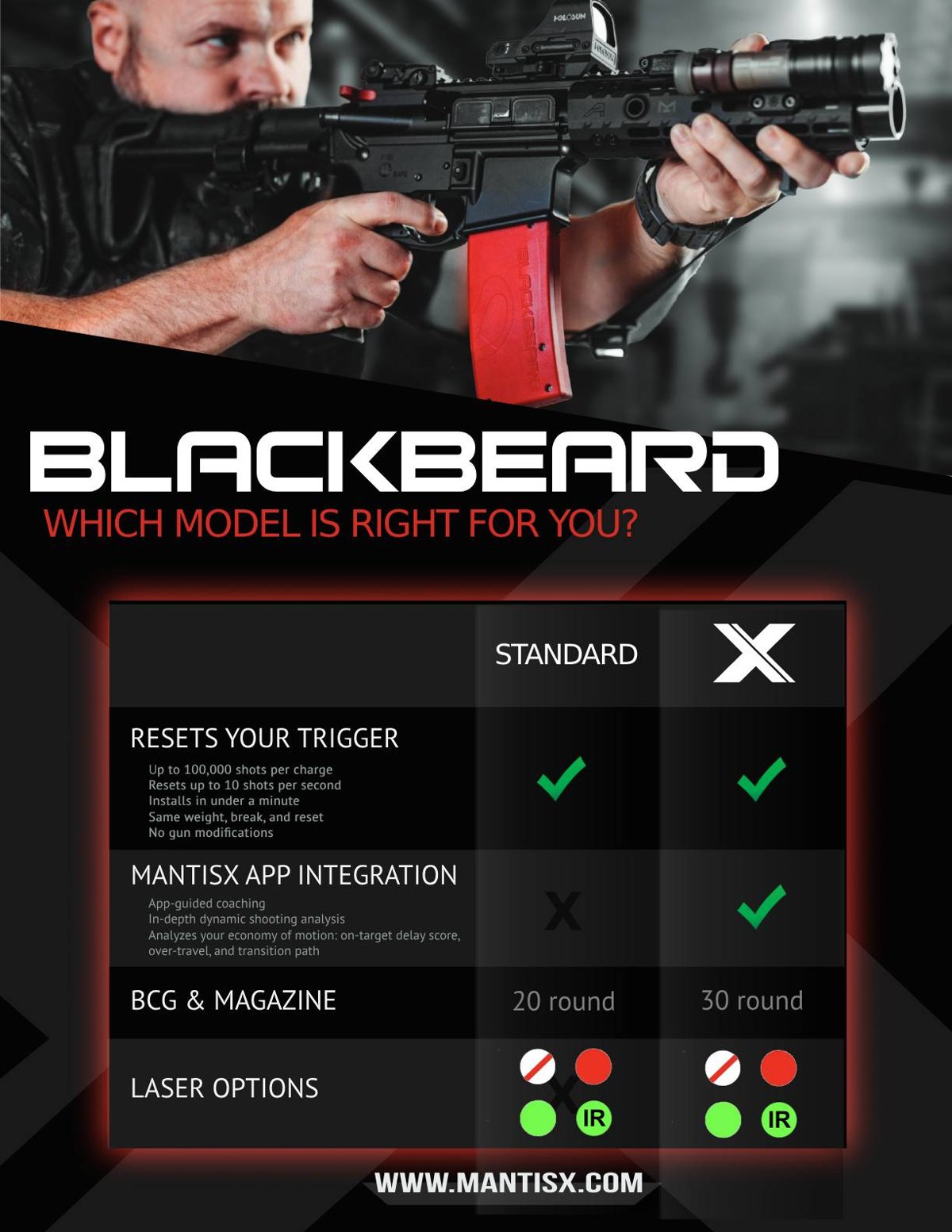
Then there is the Blackbeard, which is the product people point at when they say "why did this not exist before." It drops into an AR-15 in under a minute with no modifications, automatically resets the trigger up to ten times per second, and fires a laser at a target on your wall. Mantis claims up to 100,000 shots on a single charge. The BlackbeardX version adds the full app integration, so your carbine reps get the same dynamic analysis your pistol reps do. Around it sits Laser Academy, a smart-target system that scores hits and times splits, and TitanX, the newest kit in the lineup. The through-line is relentless: turn expensive, far-away, ammo-hungry practice into something you can do at home tonight.
The economics of the living room
Strip away the hardware and Mantis is a fairly clean model: sell an affordable device, give away the app that makes it worth owning, and let the ecosystem pull people back for the next piece. A MantisX X3 runs about $170, the X10 Elite about $250, and a BlackbeardX starts around $299. The app costs nothing, which is the point - it lowers the barrier to the first purchase and quietly makes the second one feel natural. The company sells direct through its own Shopify store and through firearms retailers and distributors, with a separate lane into government, military and law-enforcement buyers.
The insight that makes the whole thing work is almost embarrassingly simple: ammunition is expensive and ranges are inconvenient, so the real constraint on getting better is not talent, it is reps. Anything that makes a rep cheaper and closer to home expands how much people practice. Mantis is essentially a company built to sell cheaper reps - and it turns out a lot of people want them. Third-party estimates put annual revenue in the low millions, which for a lean, engineer-heavy team of around 41 is a healthy place to be.
Who is on the other endSWAT teams and nervous first-timers, same app
The customer base splits in a way most consumer-hardware companies would envy. On one end are civilian gun owners - competitive shooters chasing tenths of a second, and first-time owners who are nervous and want something that will actually teach them rather than just scold them. On the other end are professionals: US military and special-forces units, and law-enforcement agencies across all fifty states, who use the same platform for close-quarters and qualification prep. It is unusual for a $170 consumer gadget to earn a place in a professional training program, and Mantis has done it by making the data legitimate enough that a serious instructor will trust it.
Cops, special forces, competitive shooters and living-room plinkers all train on the same sensor. Same score, same graph, same coach in your pocket.
Where it sits in the marketA crowded category it helped create
Mantis was not the only company to notice that dry fire was ripe for gadgets, and the category is now busy. Next Level Training's SIRT pistol swaps your firearm for a laser trainer entirely; iTarget, LaserLyte, G-Sight and Strikeman run laser-and-target systems; DryFireMag and others make mechanical trigger-reset devices. What separates Mantis is the analytics layer. Most competitors tell you where the shot landed. Mantis tells you why - the movement pattern behind the miss, scored and trended over time, so practice becomes something you can watch improve. In a field full of point-of-impact tools, Mantis sells diagnosis.
The culture questionThe un-hype hype machine
There is a tell in how Mantis talks about itself, and it is worth copying. The team calls itself a bunch of "data heads" who got tired of guesswork, says it spends its money on R&D and customer service instead of flashy trade-show booths, and - most unusual for the industry - refuses to make empty promises. The about page more or less warns you that the device will not fix your shooting unless you put in the work. In a market that runs on tactical bravado, telling customers "this only works if you actually use it" reads as more credible than any superlative could. Honesty, deployed as marketing, is a strategy few competitors are willing to try.
The road hereFrom lunch napkin to millions of shots
Austin Allgaier, frustrated by his own plateau, sketches a mobile training system for everyday shooters and builds early prototypes.
Allgaier and four mostly anonymous co-founders form the company in Oswego, Illinois.
MantisX announces its pre-order launch for the rail-mounted training sensor.
The first units reach customers and quickly become one of the most popular training devices on the market.
The auto-reset AR-15 trainer and the X8 archery sensor widen a pistol company into a platform.
A smart-target laser system brings scored, timed dry-fire practice into the home.
The newest kit joins a lineup that now covers pistols, rifles, shotguns, bows and laser targets.
What Mantis ultimately sold was not a sensor. It was the idea that shooting - long taught by feel, opinion and expensive repetition - could be measured, scored and improved like anything else you can put on a graph. The gadget is small. The behavior change is the product. And the number, watched over enough sessions, is what keeps people coming back to press a trigger against nothing at all.
Explore Mantis Tech
Prices, figures and revenue are approximate and drawn from public sources; details may have changed since publication.