The Guys Who 3D-Modeled a Better Night Vision Goggle in a Garage
An R&D engineer started building lighter night vision housings on the side in 2020. Five years later, Nocturn Industries ships carbon-composite goggles that weigh less than aluminum, cost less than the incumbents, and carry a lifetime warranty - all from a shop in New Hampshire.
In the night vision business, almost every serious goggle housing you can buy has been machined out of a block of aircraft-grade aluminum. That is how it has been done for decades, and nobody in the industry spent much time asking whether it still had to be. In 2020, an R&D engineer at a large defense manufacturer named Jeff Melochick started asking anyway - on his own time, at his own bench. The result is Nocturn Industries, a small New Hampshire company that now sells night vision goggles built from a carbon-fiber-reinforced plastic instead, and undercuts the aluminum incumbents on both weight and price.
The company frames its purpose in plain terms: it exists to equip "military, law enforcement, and first responders with advanced night vision solutions," and it develops its gear "from the ground up with the end user in mind focusing on the needs of the modern night fighter." Everything is designed, manufactured, and tested in the USA, and the company carries a government contracting identifier - CAGE code 99VK0 - to prove the domestic supply chain is real rather than decorative.
What is easy to miss under the tactical vocabulary is that Nocturn is, structurally, a hardware startup story: a specialist spotted an inherited assumption in a category he knew intimately, prototyped an alternative, and built a business around the gap. The Latin motto stamped on the brand - Vinceret Noctem, "to conquer the night" - is doing a lot of work, but the underlying move is unglamorous engineering.
01 / The betCarbon fiber instead of aluminum
Nocturn's flagship, the Raptor - formally the Ultralight Articulating Night Vision Binocular, Single Control - is the clearest expression of the idea. Its housing is made from a carbon-fiber-reinforced thermoplastic composite that the company says "surpasses traditional polymer solutions and rivals 6061-T6 aluminum in tensile strength." A complete Raptor weighs about 20.2 ounces, which is light for a dual-tube binocular, and that number matters more than it sounds: weight on a helmet is weight on the wearer's neck for every hour of a night operation.
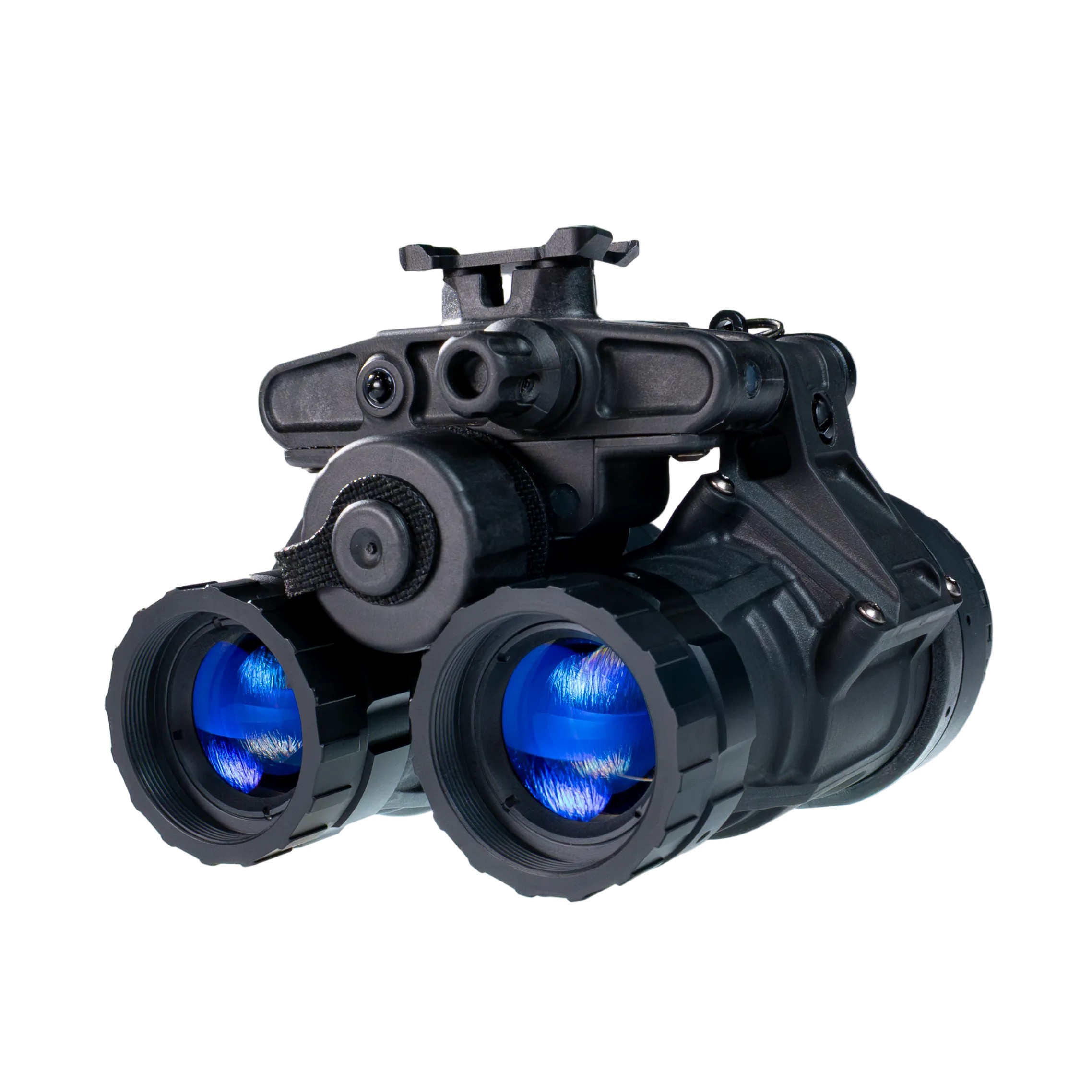
The material choice cascades into the rest of the design. Because the housing is molded rather than milled, Nocturn can offer it in molded and ruggedized versions, in black or Cerakote finishes, and price the bare housing low enough - around $1,350 - that budget-minded builders can supply their own tubes and optics. The Raptor accepts standard PVS-14 optics and MX-11769 image intensifier tubes, so it slots into the existing ecosystem instead of demanding a proprietary one.
There is a manufacturing argument buried in that decision too. Milling aluminum housings is slow and wasteful - you start with a solid billet and cut most of it away. Injection molding a fiber-reinforced composite is a different economic curve: the tooling is expensive to build once, then each part is fast and cheap to produce. For a small company, that trade converts a fixed engineering problem into a scalable production one, which is exactly what a startup wants when it is trying to grow output without growing a machine shop at the same rate.
02 / The interfaceOne knob, and that's the point
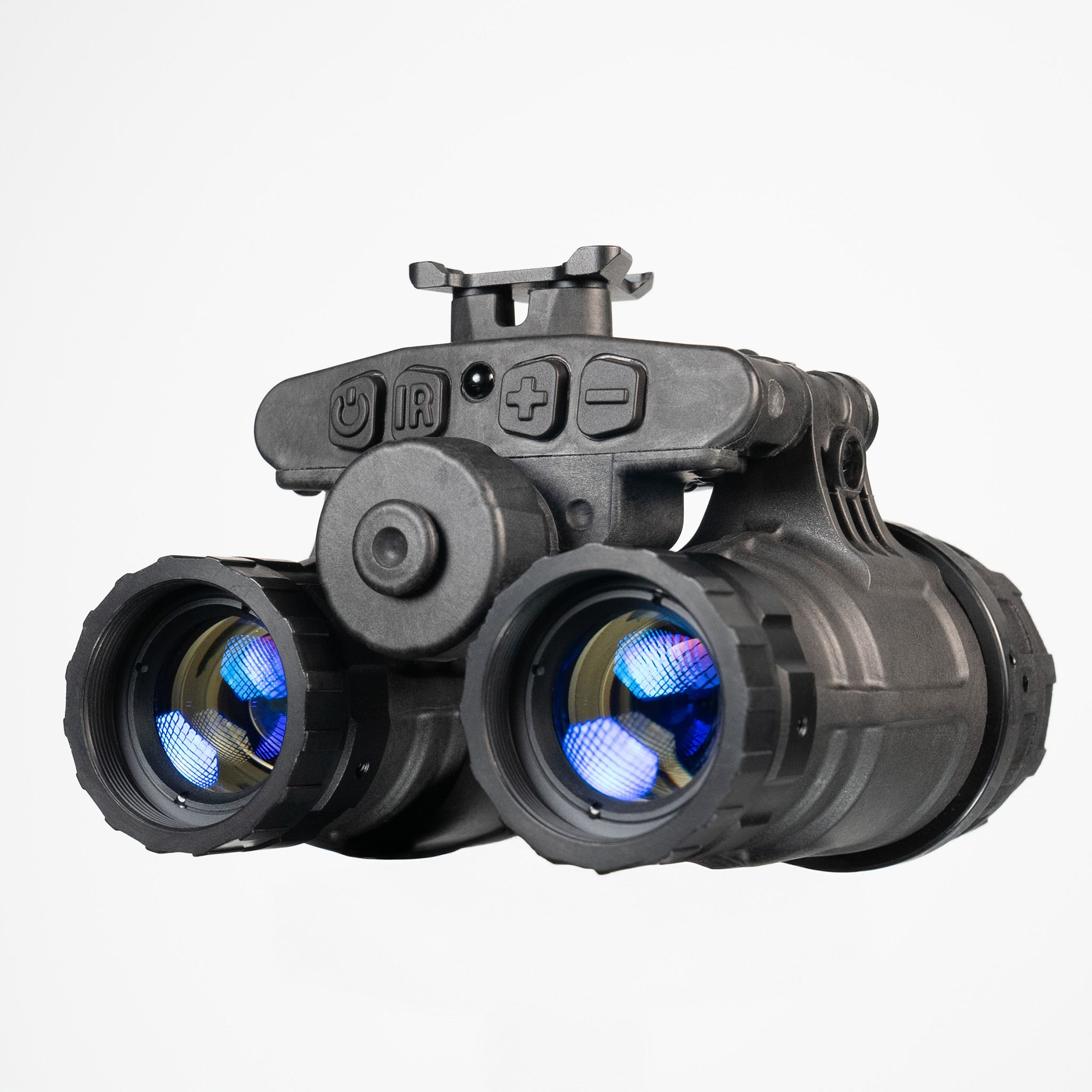
The Raptor's user interface is close to the minimum a night vision goggle can have: a single control knob. Turn it for power and gain. Double-tap it to fire the built-in infrared illuminator, with an integrated indicator that tells you it is on. That is the whole thing. It is the kind of decision that looks like a small feature on a spec sheet and feels like a large one at two in the morning, when your hands are cold and you cannot see the controls you are trying to operate.
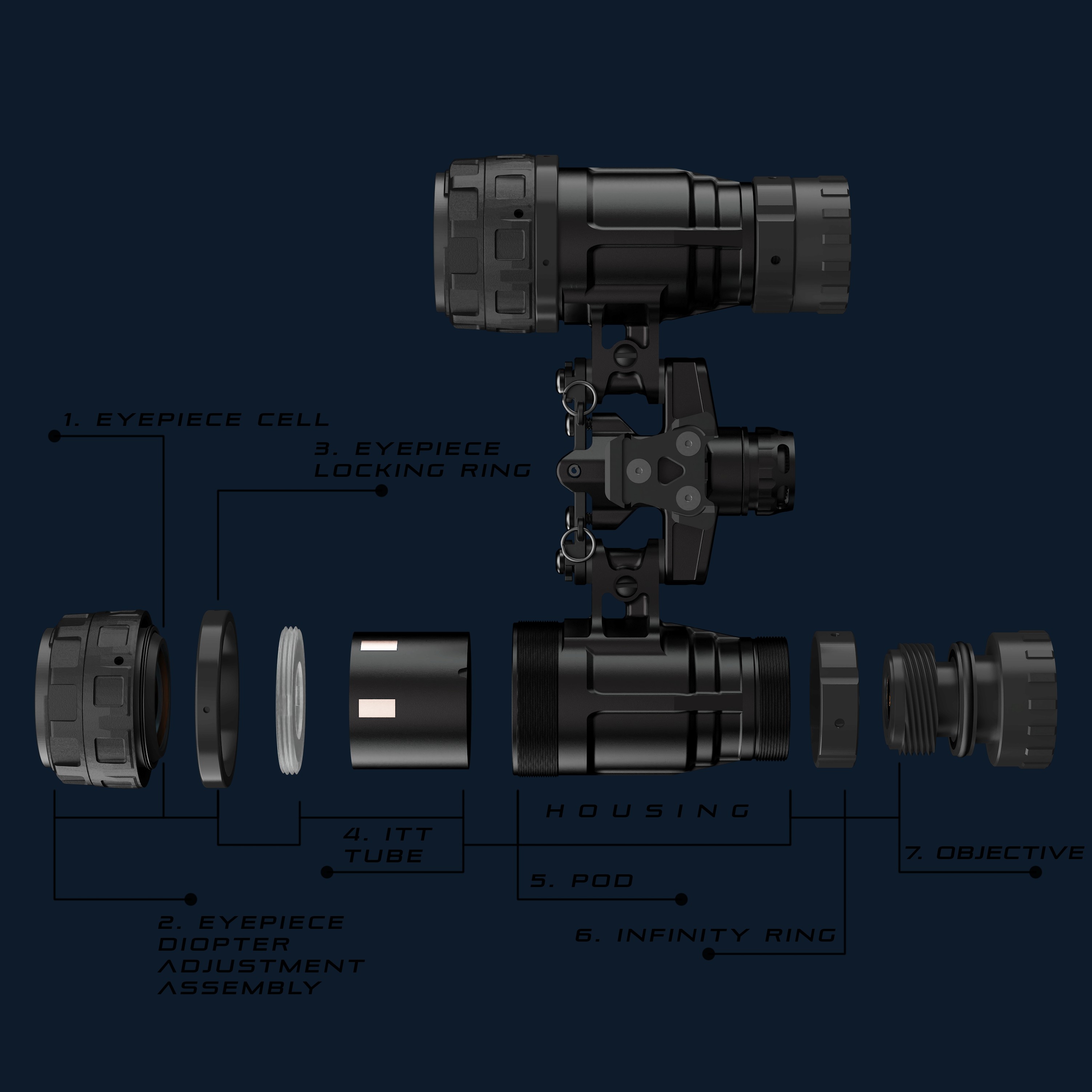
Reduction as a strategy shows up again in how the goggle comes apart. Nocturn publishes exploded-view diagrams of its housings, labelling each component - eyepiece cell, diopter assembly, locking ring, tube, pod, infinity ring, objective - so buyers and dealers understand exactly what they are servicing. For a product sold partly to people who build and repair their own rigs, transparency about the internals is itself a feature.
03 / The proofTested like they're trying to break it
A lighter, cheaper housing invites one obvious question: does it survive? Nocturn's answer is a testing regime that reads as deliberately aggressive. The company says its products are proven "beyond NATO and TOP military standards" and designed to meet or exceed MIL-STD-810H. The waterproofing is rated to IP68+, which Nocturn describes as submersion to roughly 66 feet for over two hours. The drop test is a fall from 10 feet onto concrete, repeated across seven or more orientations.
The commercial logic behind that punishment is the lifetime, no-questions-asked warranty on the housings. A warranty that generous only works if failures are genuinely rare, so the testing and the warranty are two halves of the same bet: spend on durability up front, and the promise to fix anything forever becomes cheap to keep. It is a durable-goods playbook applied to a category that often treats gear as consumable.
04 / The lineupRaptor, Katana, Manticore
Nocturn's catalog is organized around three named binocular lines plus a range of monoculars, panoramic and bridge systems, conversions, and accessories. The naming - the Katana, the Manticore, the Raptor - gives a category otherwise drowning in acronyms an actual personality, which turns out to be a quiet competitive advantage. So does the logo: a bat, the original night flyer, peering through a set of goggles. The external battery pack is, naturally, the "Bat Pack."
Complete systems, in other words, cluster between roughly $1,550 and $2,400 - real money, but well under the price of many legacy dual-tube systems, and available as bare housings for the do-it-yourself crowd. The relationship between price and configuration is worth seeing laid out:
05 / The marketTwo audiences, one storefront
Nocturn sells to the same customers as the defense-optics giants - military units, law enforcement agencies, first responders - and to a second audience the giants have historically ignored: the civilian night vision enthusiast. That market has grown quickly, and Nocturn meets it directly through a Shopify storefront and a network of authorized dealers such as Tactical Night Vision Company, Atomic Defense, Nightfall Optics, and White Rhino Arms. B2B and B2C run through the same catalog.
The civilian side is not a rounding error, either. As night vision has become more attainable, a real community has formed around building, modifying, and reviewing goggles - and that community rewards companies that are legible to it. Nocturn's exploded diagrams, its published specs, its plain compatibility with the PVS-14 standard, and a warranty that removes the fear of a first-time build all lower the barrier to entry. A hobbyist who buys a housing this year is a repeat customer for tubes, mounts, and accessories for years after, which is a quietly durable way to grow revenue without chasing a single large contract.
Against that backdrop, the competitive field includes US Night Vision - whose own blog has run the Raptor head-to-head against its RNVG and ARNVG binoculars - along with Night Vision Devices, Steele Industries, and the large primes like L3Harris and Elbit America. Nocturn is not trying to out-scale any of them. Its position is narrower and more defensible: win on weight, keep the warranty forever, and obsess over the person actually wearing the goggles. For an 11-person shop in New Hampshire, that focus is the strategy.
What is genuinely repeatable here is the entry playbook. Nocturn didn't need a defense prime's budget to enter a category defended by defense primes. It needed a specialist who understood the category's inherited assumptions, one dimension to win on, one promise worth keeping indefinitely, and a customer to build around. The carbon-fiber housing is the headline, but the transferable lesson is that "this is how it has always been made" is, more often than not, just a default waiting to be questioned.