The Kentucky Town That's Been Hiding Inside Your Amp for 60 Years
For six decades a factory in a Kentucky town of 2,500 has been building the speakers inside your amplifier - and letting other brands take the credit.
Somewhere in your amplifier - or your friend's amp, or the wedge monitor at the last show you played - there is a good chance a speaker was built in Eminence, Kentucky, a town of roughly 2,500 people that most guitarists have never heard of. The company that shares the town's name has spent close to 60 years making the part of an amp nobody photographs and everybody hears. And for the first 34 of those years, it put someone else's logo on the box.
Eminence Speaker, LLC is, by its own account and the trade press's, the largest manufacturer of loudspeaker drivers in the United States. It sells guitar and bass speakers under its own name, ships to more than 90 countries, and quietly supplies the drivers inside amplifiers from Fender, Peavey, Ampeg, Yamaha and a long list of brands that would rather you thought of the speaker as theirs. That double life - famous product, invisible maker - is the whole story.
01 / The originThree speakers a day, and a very long game
The company began in 1966, when Bob Gault - an engineer who had worked at Magnavox and CTS (Chicago Telephone Supply) - opened a factory of less than 6,000 square feet in downtown Eminence. The first order was modest to the point of comedy: three 18-inch speakers a day for the amplifier company Ampeg. Gault picked the location for logistics and labor. The town sat well for shipping across the USA, and the surrounding Henry County community could staff a factory that made things at scale.
It grew. By 1972 the company had outgrown the downtown building and moved to the Shawnee Industrial Park on Mulberry Pike, opening near 30,000 square feet and later expanding to a 100,000 square-foot building under one roof. Gault ran it as president until 1992, retired in 1993, and his son Rob Gault took the company forward. Two generations, one factory, no venture capital.
02 / The pivotThe day it finally put its own name on the box
For decades Eminence was a pure OEM shop - a supplier that builds a product for another company to sell under its own brand. It is a fine business and a quiet one. You get the volume and the contracts; someone else gets the name recognition. Then in 2000, Eminence started distributing its own branded line of products. That is the hinge of the entire company. The supplier that made everyone else famous decided to become a brand.
Most manufacturers guard their OEM customer list like a recipe. Eminence did the opposite and built marketing around it. When you are the supplier a whole industry quietly relies on, transparency becomes the moat: naming the brands that trust you is itself the pitch. It is a genuinely clever move for a company that spent its early life anonymous.
03 / The catalogAn American flag, a British flag, one factory
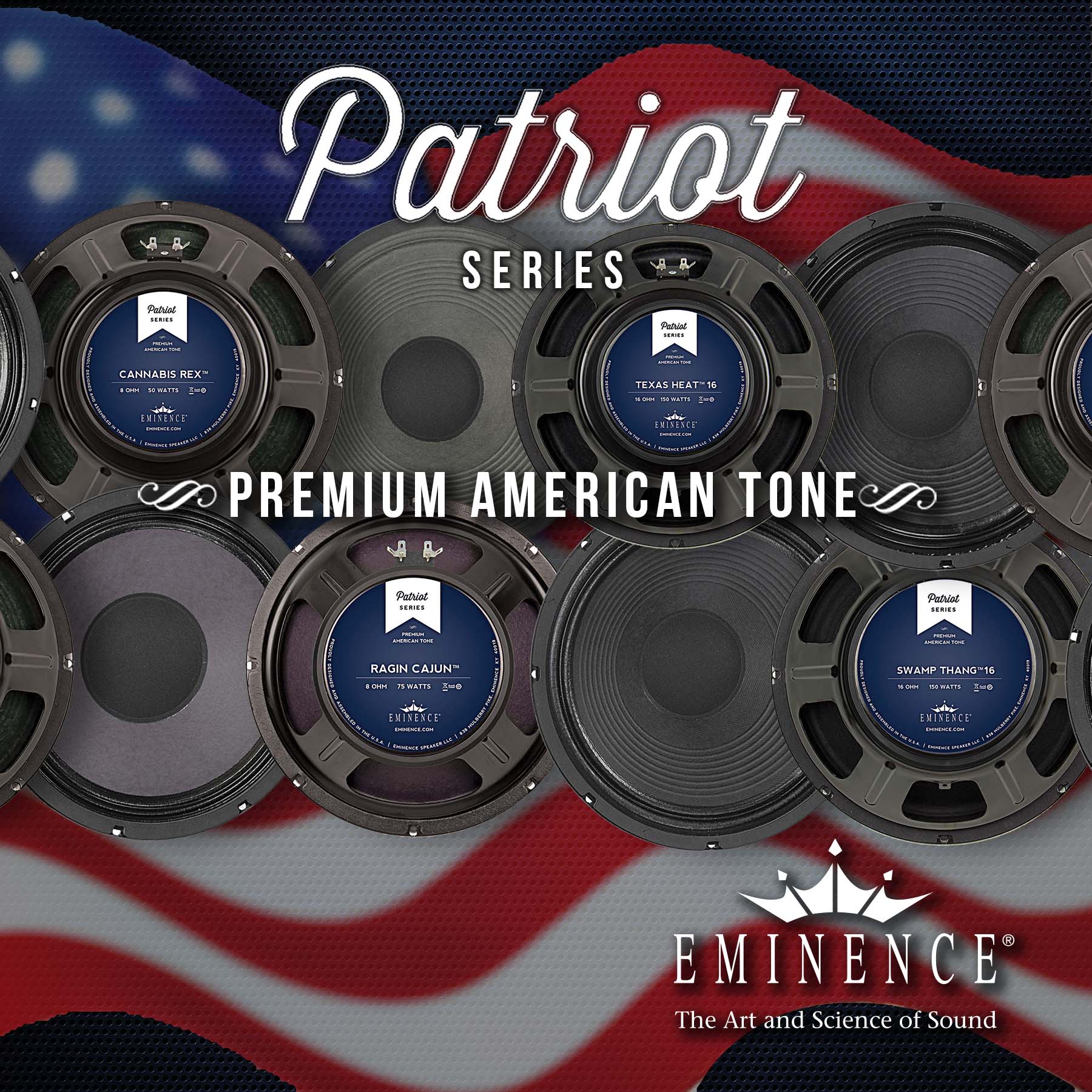
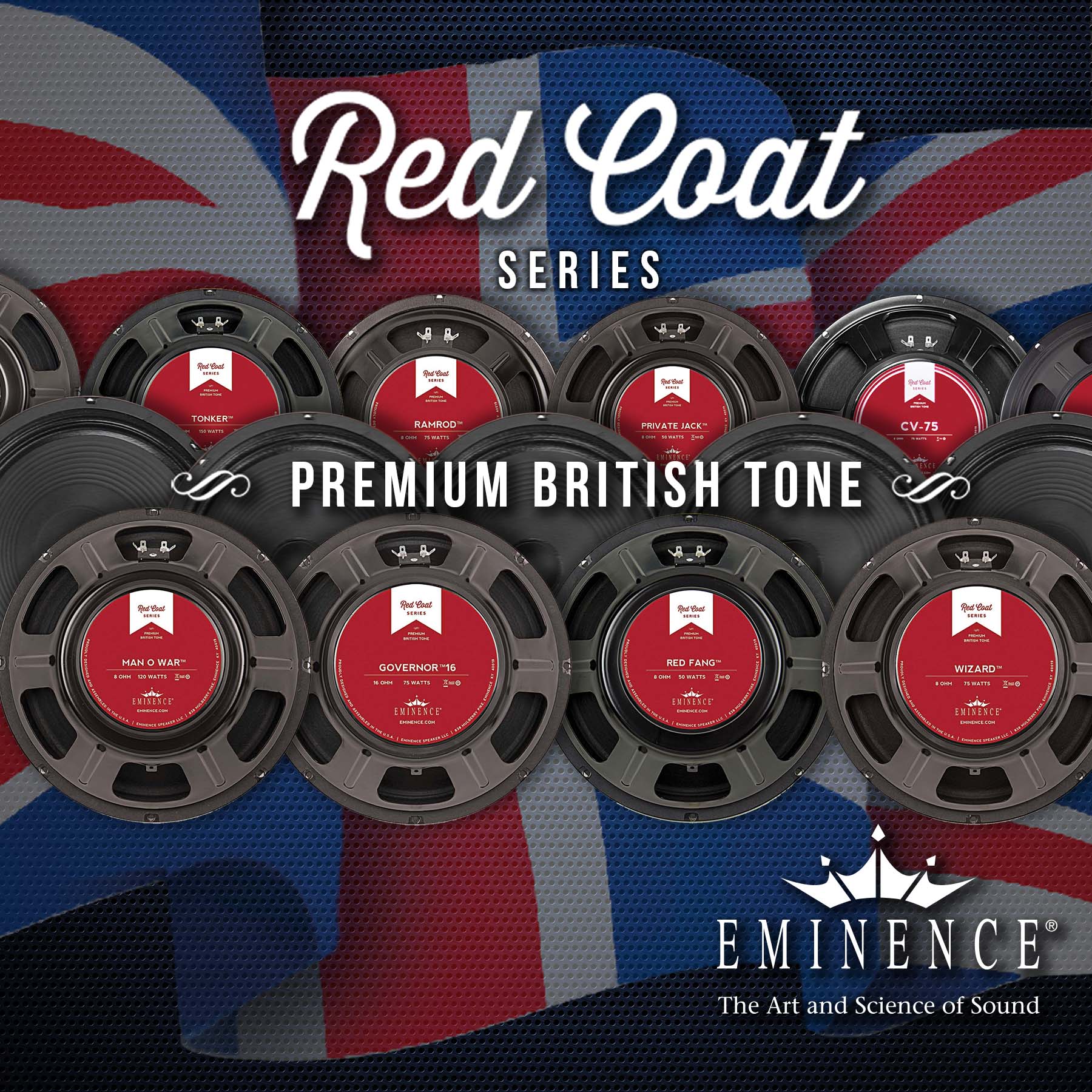
The branded line grew into families of guitar and bass speakers that players now ask for by series name. Three anchor the catalog. The Legend series aims for clean, neutral, high-headroom tone - a speaker meant to get out of the way so you hear more of your amp and guitar, with some models built on lightweight neodymium magnets. The Patriot series is voiced for classic American amp tones and wears an American flag on its backplate. The Redcoat series chases classic British amp tones and wears - of course - a British flag.
There is a good joke buried in that lineup. An American company in rural Kentucky bottles the sound of British amplifiers, stamps a Union Jack on the back, and sells it back to the world. The Patriot and Redcoat are built on the same floor, by the same people, from the same parts bins. The flags are marketing; the factory is one address.
The product families, at a glance
- LegendClean, neutral, high-headroom guitar and bass speakers; some neodymium models
- PatriotAmerican-voiced guitar speakers, American flag backplate
- RedcoatBritish-voiced guitar speakers, British flag backplate
- Pro AudioAmerican Standard & Neodymium series, high-frequency devices B2B
- Custom / OEMDrivers built to spec for amplifier and audio brands B2B
- Impulse ResponsesDownloadable digital samples of Eminence speakers DIGITAL
04 / The clever bitSelling the same sound twice
Here is the part worth stealing if you build anything. Eminence sells you a physical speaker. It also sells you an impulse response - a downloadable digital fingerprint of how one of its speakers sounds, which you drop into recording software or an amp profiler to get that speaker's character without owning the speaker. A hardware company found a software line of revenue sitting inside its own catalog. Same asset, two products, near-zero marginal cost on the second one.
That is the shape of a modern manufacturer: a factory that also runs a store, that also runs a download shop. The physical speakers reach players through distributors and Eminence's own e-commerce site; the OEM drivers reach amp brands on contract; the impulse responses reach bedroom producers as a click. Three ways to sell the same expertise.
05 / The customersCinemas, stadiums, car doors and a lot of guitar cabs
Ask who uses an Eminence speaker and the honest answer is: more people than know it. Guitarists and bassists buy the branded series to swap the tone of their rigs. Amp builders order custom drivers. And the pro-audio and OEM side turns up in cinemas, stadiums, arenas, amphitheaters, nightclubs, churches, and vehicle audio - cars, RVs, boats, motorcycles. The keyword list the company works from runs from "tour grade devices" to "high frequency devices" to plain "car audio." One factory, an unusually wide blast radius.

06 / The saleWhen Italy bought an American icon
In the fall of 2023, after nearly six decades of Gault-family ownership, Eminence was sold to B&C Speakers S.p.A., an Italian company based near Florence that is the world's largest maker of professional loudspeaker drivers. The deal was structured in two moves: B&C took 100% of Eminence Speaker LLC in Kentucky and committed to buy the assets of Eminence Dongguan Enterprise in China, the overseas operation Eminence had added in 2006. Trade filings put the price for the US share capital at roughly $3.56 million.
It is a small headline number for a company with an outsized industry footprint, and it raises the obvious question a "Made in the USA" brand always faces when it changes hands across an ocean: what stays the same? B&C's stated plan is to relaunch and enhance the brand, not fold it - keeping an American icon American in everything but ownership. Whether that holds is the story's next chapter.
07 / The mapSixty years on one timeline
08 / The takeawayWhat a guitarist - or a founder - can copy
For a player, the practical value is simple: a speaker swap is the cheapest way to change an amp's voice, and Eminence's series make that choice legible - neutral, American, or British, pick a lane. For anyone building a business, the lesson is sharper. Eminence spent decades being excellent and anonymous, then used that reputation - not marketing spend - to launch a brand, and later found software revenue hiding inside its hardware. Being the trusted supplier first, and the famous name second, turns out to be a durable order of operations.
The limits are real too. This is a low-margin, capital-heavy, physical business in a niche category, and being the best manufacturer in America did not translate into a nine-figure exit. The playbook works if you want a resilient, respected, family-scale company that lasts 60 years. It is not a rocket ship, and Eminence never pretended otherwise.