The cleverest thing about KICKER is not that it made a subwoofer square. It is that, long before “productizing a service” became startup furniture, a pair of Oklahoma speaker builders took the dusty, fussy work of custom car audio and put it in a box. Literally. In 1980, Steve Irby built a full-range speaker enclosure that fit behind the bench seat of a pickup. A local dealer wanted more. The Original KICKER gave drivers a finished object where installers had previously seen a carpentry assignment.
That product turned Stillwater Designs, founded in 1973 as a two-person maker of professional loudspeakers, into a mobile-audio company. It also supplied a durable operating idea: find a hostile little environment, do the engineering the customer would rather avoid, and ship the result ready to work. Cars brought cramped cabins, heat, road noise and factory wiring. Boats added water, salt and ultraviolet light. Motorcycles brought tiny charging systems and the small matter of wind roaring past the listener's helmet. KICKER kept accepting the room as it was.
01 / The accidental wedge
A product shaped like its hometown
KICKER's origin story has an unusually useful prop: an Oklahoma pickup truck. The oil boom had put thousands of them on local roads, while the narrow space behind a standard cab's seat made conventional home or professional speaker cabinets absurd. Irby had been building large PA systems since his teenage years. When he shrank that knowledge into a vehicle enclosure, he overbuilt the little box with cooling, a large suspension and a substantial magnet. Truckers supplied the impolite early nickname. The cleaner half - KICKER - survived.
The insight was not “young men enjoy bass.” Any electronics shop could see that. It was that a ready-made enclosure could collapse several decisions - driver matching, cabinet volume, construction and fit - into one purchase. Dealers could install more systems without maintaining as much of a wood shop. Buyers could get a predictable result without becoming amateur acousticians. KICKER still sells individual components to the devoted DIY crowd, but the loaded enclosure remains the purest expression of the business.
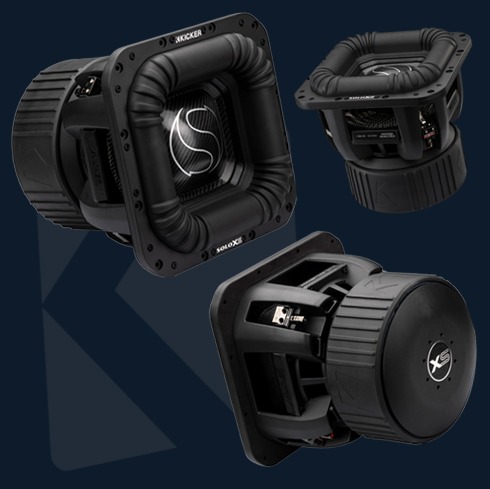
The square family portrait. Nobody was asked to smile; all of them were busy moving air.
“People want simple solutions, not complicated ones.”Steve Irby, on what KICKER learned from digital signal processing
02 / Geometry as a logo
Why the famous woofer has corners
KICKER did not invent the square speaker, a point its own technical paper makes plainly. It did pioneer a deep-dish, long-travel square subwoofer built to produce serious low frequencies. The appeal is measurable. A 10-inch square has 100 square inches of theoretical face area; a 10-inch circle has about 78.5. Rounded corners reduce the practical advantage, so KICKER cites roughly 20 percent more cone area than a similarly sized round driver. More moving surface can push more air from the same face of an enclosure.
Corners also create mechanical trouble. A conventional surround deforms unevenly there, so KICKER engineered ribbed corners to let the material flex as the cone travels. That detail turned a striking silhouette into protected engineering. The Solo-Baric L7, introduced in 2000, became a brand code you could recognize from across a show floor. Later versions collected CES recognition, design patents and, in the case of the revived SoloX L7X, a 2022 SEMA Global Media Award.
The differentiation is narrower than the swagger suggests. JL Audio, Rockford Fosgate, Alpine, JBL, Hertz, Sundown and others can all make formidable bass. KICKER's advantage is the combination: familiar visual language, a broad good-better-best catalog, fit-specific boxes, installer distribution and the institutional memory of building for vehicles. The square is the billboard. The system around it is the business.
The KICKER packaging loop
03 / What failed first
The customer did not want another control panel
The most revealing KICKER failure was not a smoking voice coil. It was complexity. Digital signal processing can correct timing and frequency-response problems created by a car's lopsided seats and reflective surfaces. KICKER made sophisticated DSP amplifiers, but Irby noticed that most people would not invest the time required to understand and tune them. Capability was not the same as a result.
That changed the product brief. The KEY line moved equalization, time alignment and limiting behind a button. A microphone listens, the processor calculates, and the user gets a tuned system in minutes. Experts can still choose more adjustable equipment. Everyone else gets the “easy button.” This is the useful reversal: when a technically better product asks customers to study, the first broken component may be the interface.
A larger market shift forced a similar rethink. By 2006, factory audio had improved and dashboards had become more integrated with vehicle electronics. Replacing a head unit was no longer routine. Stillwater Designs bought interface specialist SoundGate for an undisclosed amount, bringing its know-how to Oklahoma. The old approach - remove the factory system and start over - was failing first. Integration became a product category.
04 / The money and the customer
From a budget bump to four figures of thunder
KICKER earns money by selling physical products through a hybrid network: direct ecommerce, about 1,200 authorized dealers in the United States, and international distributors serving more than 2,000 dealers in roughly 50 countries. Vehicle and marine programs add another route. The catalog spans entry-level speakers, amplifiers and accessories; powered under-seat subs; complete enclosures; premium marine systems; and competition hardware that assumes the buyer has also budgeted for serious electrical work.
What does the idea cost today?
Those ranges explain the customer map. A commuter can add useful bass without losing the trunk. A truck owner can buy a molded box that respects the back seat. A professional installer saves fabrication time. A boat owner pays for sealed motors, UV resistance and hardware meant for spray. A sound-pressure competitor buys the SoloX end of the catalog, where heat dissipation, recone kits and thousands of watts matter. KICKER is not one product for one tribe; it is a ladder built around the same desire to make a hostile space sound intentional.
The company remains privately held, with no disclosed venture rounds or public valuation. That matters because its growth reads less like a funding staircase than a sequence of adjacent product moves. Marine audio was attractive because boats also run on 12 volts, but the company had to learn weatherproofing. Powersports demanded efficient speakers that would not flatten a small battery. Each move reused some expertise and required a new test.
05 / What to steal
Copy the constraint, not the cone
The transferable KICKER playbook starts with an awkward job. Look for a customer already improvising around a fixed constraint: a narrow cavity, a terrible workflow, a regulation, a legacy system nobody can remove. Then pre-engineer the ugly middle. Bundle the pieces that must work together. Give specialists an escape hatch, but make the default useful before the manual becomes homework. Finally, expand only into markets where the core capability travels. KICKER moved from car to marine audio because 12-volt engineering transferred; it did not wake up and launch kitchen appliances because both categories contain wires.
Works when
The constraint is common, expensive or annoying; fit and reliability matter; a finished bundle saves real labor; and distribution can teach or install the product.
Breaks when
Customers prize infinite customization, the environment is not repeatable, cheap generic parts are good enough, or integration data changes faster than hardware can ship.
There are limits. A loaded enclosure cannot match every bespoke cabinet. Square geometry is not magic; amplification, enclosure design, installation and tuning still determine the result. High-output systems can demand upgraded wiring and create heat, hearing and even fire risks when installed or driven badly. On newer vehicles, active noise cancellation, data-bus audio and factory processing can turn a “simple upgrade” into diagnosis. The product works best when the buyer respects the system around the speaker.
KICKER's current releases show both ends of its formula. At SEMA 2025 it previewed SoloXS subwoofers rated up to 4,000 watts RMS, equipment for people who regard flexing sheet metal as applause. Beside them sat the HS12 Hideaway, a 12-inch powered sub designed to disappear under a seat, plus vehicle-specific enclosures for Tacomas and Jeeps. One product announces itself from the next county. The other tries not to be seen. Both answer the same old Stillwater question: how much sound can fit in the space the customer actually has?
The square subwoofer made KICKER recognizable. The complete box made it repeatable.
More than five decades after Irby and a roommate began building PA cabinets, KICKER still designs and ships from a 280,000-square-foot facility in Stillwater. The headquarters, founder involvement and dealer network give the company a particular shape: part engineering shop, part consumer brand, part institution in a hobby that can be very serious about rattling mirrors. Its best idea was never loudness alone. It was recognizing that good sound has to survive the car, the weather, the wiring and, occasionally, the customer.