Mark Clayton’s headphones had a habit of leaving before he did. He would be moving through a workout, the music would be doing its job, and then the headband would lose the argument. For someone whose profession depended on catching things, this was an irritating arrangement. He wanted to run, turn, jump, and keep listening. Eventually, he began drawing a pair that might let him.
The idea sounds small enough to fit on a napkin. Its consequences occupied years. Clayton became the founder and CEO of LIVV Audio, learning a business in which a good sample, a funded campaign, and a finished product are three separate achievements. Between them lie factories, testing, deliveries, and opportunities for an expensive surprise.
His old job had a useful clarity. A receiver runs a route. Someone throws the ball. The scoreboard eventually expresses an opinion. Making headphones supplied fewer clean endings. Even after the first product reached customers, there would be another design, another funding effort, another attempt to make a familiar complaint disappear.
The receiver who had to learn his position
Clayton was born in Oklahoma City in 1982 and moved to Arlington, Texas, as a child. At Sam Houston High School, his future did not arrive neatly labeled. He had been a quarterback on the junior varsity team before a coach moved him to receiver. College recruiting followed. A change of position had changed the possibilities.
At Oklahoma, those possibilities became measurable. His 2001 season produced 524 receiving yards. In 2003, the figure was 1,425, alongside 83 catches and 15 receiving touchdowns. He earned first-team All-American recognition that year, then again in 2004. The improvement had a visible shape: a player learning to turn opportunities into distance.
Two All-American seasons followed a quieter beginning. Figures include bowl games.
Baltimore selected him twenty-second overall in the 2005 NFL Draft. He played for the Ravens, then the St. Louis Rams. Across his NFL career, he caught 260 passes for 3,448 yards and 14 receiving touchdowns. These are credentials that can make a second career look inevitable in retrospect. The second career still had to be learned.
There were reminders of his earlier position, too. Against Cincinnati in 2008, the receiver threw a 32-yard touchdown pass to Derrick Mason. The quarterback had apparently kept a forwarding address. Years later, Clayton would again find a use for skills that did not quite match the title on his job description.
The music was supposed to come along
Music belonged to Clayton’s football routine, from the locker room to the field. He liked the enveloping sound of over-ear headphones, particularly the bass. Earbuds could have changed the equipment problem, but they would also have changed the experience he wanted. His preference was the starting point for the design.
“I love big sounds,” he said. That is a more revealing product brief than a page of market terminology. Clayton wanted the feeling of the music and the freedom to keep moving. A headphone that required him to keep reaching up and adjusting it interrupted both.
By his account, a broken pair of Beats in 2008 helped set the thinking in motion. Sketches followed during his playing years. The physical question was specific: how could a band hold a pair of over-ear cups securely while the wearer changed direction? The answer involved the shape and position of the band itself.
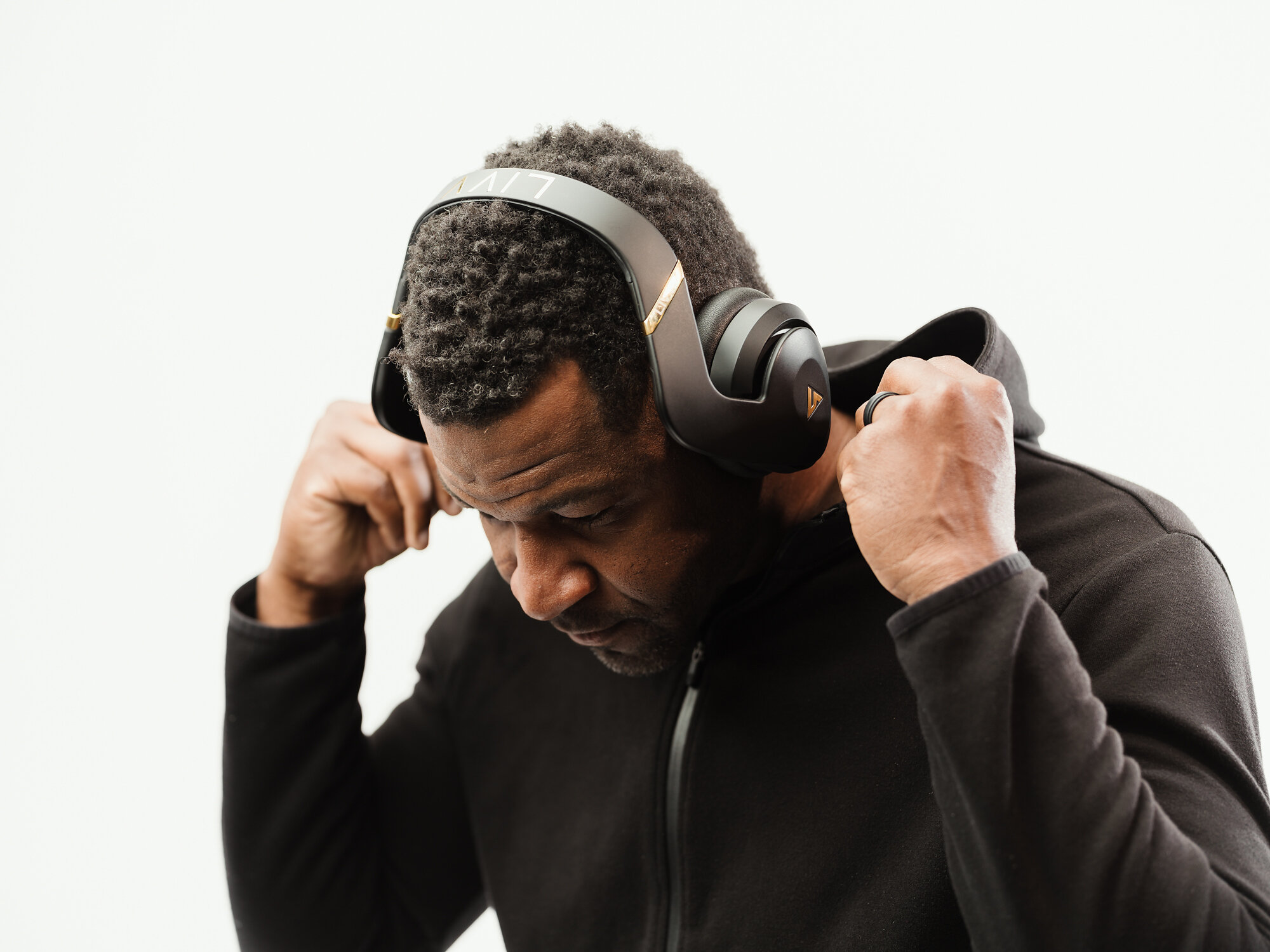
The name carried the same idea. When Clayton tried an early prototype, the ability to move freely suggested “live.” The ordinary spelling was already taken for trademark purposes, so the company became LIVV. Even naming the freedom required a small adjustment.
A different kind of training camp
Around 2013, Clayton spent time in Nashville with design collaborator Dale Lott. They worked in Lott’s garage studio, using a 3D printer to produce parts, try them, and change them. Overnight printing offered a rather different preparation for the next day’s work than reviewing an opponent’s defense.
Clayton brought knowledge of what went wrong when he moved. Lott helped translate that into geometry and parts. Their experiments shifted how the band connected to the cups and where it sat behind the crown of the head. A complaint was becoming something that could be held, worn, and tested.
The early SureFit design used tension to keep the headphones secure, with the wearer able to alter the fit by changing the band’s angle. Development involved more than ten iterations. Clayton described a year and a half of testing and trying. A useful shape, it turned out, required quite a collection of less useful shapes first.
The tests could be lively. LIVV worked with parkour athletes, whose jumps, flips, and changes of direction offered an efficient way of exposing a loose fit. A headphone has very little room for a diplomatic answer when its wearer goes upside down.
“Relationships are what fueled the product development stage to get to our first working prototype.”
Mark Clayton
Clayton self-funded early development. His account of the process repeatedly returns to introductions and collaborators. He knew the problem intimately; reaching a working answer still meant finding people with knowledge he did not have. That willingness to seek help would matter after the garage phase ended.
The awkward distance between a prototype and a business
LIVV’s September 2015 Kickstarter campaign gave the idea a public test. Web partner Razoyo recorded 624 backers, and the following September it reported that headphones were shipping to supporters. For a founder, those are concrete moments: people commit money, then a box finally leaves for them.
The preparation extended beyond the hardware. Razoyo had initially worked toward a Magento storefront before changing to a WordPress site that better suited the crowdfunding effort. Even the website needed to fit the stage of the business. Building the company involved repeated decisions about what was useful now.
The first headphones also contained an onboard music player. Clayton wanted listeners to be able to leave their phones behind. That ambition added another technical task: combining stored music and Bluetooth in the same product. The desire for simplicity on the customer’s side was accumulating complexity on the founder’s.
Then manufacturing problems caught up with the first generation. A later account described delays and malware affecting some of the onboard players, followed by a recall. Clayton paused the project. The fact that a prototype worked had offered no protection against trouble in the production batch.
The return involved reconsidering the product as well as finding support. The first design’s security had been pursued so strongly that the next version needed broader appeal and a more polished appearance. Clayton worked with JLab Audio as an incubating partner on the redesign. Staying put remained the brief; persuading someone to wear the result was part of the brief, too.
- 2013Early prototypes
- 2015Kickstarter campaign
- 2016Backer shipments
- 2024LIVV Pro funding
New teammates, same stubborn question
In December 2024, LIVV Audio announced that it had secured $1 million toward a $1.5 million seed round. Former tennis player Mark Knowles was among the investors. The money supported a later chapter for the company, with the LIVV Pro offered at $349.99.
The company’s advertised specifications included up to 50 hours of battery life, removable ear pads, and water resistance. Its current product description also lists active noise cancellation and a sensor that detects when the headphones are being worn. These features show how far the job had expanded from moving a headband.
Clayton’s aim was to offer the familiar conveniences of a premium headphone alongside the secure fit he had wanted as a player. The customer he understood was already willing to wear something substantial over the ears. LIVV’s task was to make that preference easier to carry into an active day.
As a founder, he also learned to hear rejection as information. He has described investors explaining why they declined, and using those conversations to improve his pitch and business model. Football had accustomed him to criticism and correction. In business, he still had to ask which part needed work.
By February 2026, another partnership had formed. Uptown Brands named LIVV Audio among its inaugural investments, pairing capital with The Uptown Agency’s communications work. Clayton welcomed having the people shaping the brand’s message invested in its progress. The roster now included a team concerned with how the product reached an audience.
Even the parking space counts
Clayton has a useful piece of advice for his son: pay attention to details, including parking the car between the lines. It is a pleasantly unglamorous instruction from someone who played professional football. No stadium is required. The standard is available in an ordinary parking lot.
He also talks about faith, preparation, and trusting teammates. Those ideas appear across the two careers, even as the practical work changes. A friend, Jeremy Butler, helped prompt his interest in business by asking what kind of company he would want to have. Other people supplied the next introductions and the next skills.
The audio venture has given Clayton a reason to keep explaining, learning, and returning to a problem he can describe without a presentation. He wanted his music to come with him. A decade of development gathered around that preference, bringing prototypes, customers, setbacks, and new colleagues with it.
There is something appealingly ordinary about the ambition beneath all that work. Run the route. Turn your head. Keep the song going. Clayton had spent years training his hands to bring the ball in. His next assignment was getting the headphones to stay where he had left them.
Keep listening
Conversations, career records, and the company Clayton built.
- LIVV Audio
- Clayton on LinkedIn
- Clayton on Instagram
- Clayton on Facebook
- LIVV Audio on YouTube
- Watch: Clayton talks LIVV with Nestor Aparicio
- Listen: NFL Players: Second Acts
- Listen: The Blueprint, June 2026
- The early designs: Sports Illustrated
- Clayton’s product-development Q&A
- The 2015 campaign announcement
- Razoyo on the campaign and delivery
- Parkour testing and the early business
- The manufacturing setbacks and redesign
- The December 2024 funding announcement
- AFROTECH on the LIVV Pro launch
- The February 2026 investment partnership
- Clayton on preparation and teammates
- Oklahoma football: career figures
- Career biography