A handbook about accessibility had an accessibility problem of its own. The Association of Registered Graphic Designers distributed its AccessAbility guidance as a downloadable PDF: useful information, stuck in a format that was awkward to navigate and revise. Mangrove Web helped turn it into a custom WordPress website. The improvement was wonderfully practical. Readers could find their way around; the organization could keep the material current.
That project captures what the woman-owned agency sells. There is design, certainly, and code. But much of the value lies in making an organization’s working life less difficult after the designers have left the call. An attractive website has limited usefulness if changing a paragraph becomes a small procurement exercise.
Mangrove serves nonprofits, foundations, advocacy organizations and businesses with social or environmental ambitions. Its portfolio stretches from Sierra Club Canada to Assiniboine Credit Union and the Biomimicry Institute. These clients have different audiences, but a common challenge: complicated work must become understandable online, and the people responsible for explaining it need tools they can operate.
The editor gets a vote
For RGD, Mangrove’s assignment included translating the handbook into web content, organizing it and building a flexible publishing system. The agency reports that the resulting site meets WCAG Level AA requirements. It used the Equalize Digital plugin alongside a manual checklist and continuing design and development reviews. Accessibility was part of making the product, with attention extending beyond the page’s appearance.
The same concern for the person behind the screen appears in a rather different commission. Assiniboine Credit Union needed to replace a custom public website that had become cumbersome. Mangrove built the replacement on HubSpot, which was already part of the credit union’s marketing workflow. The agency added a branch and ATM locator and a custom tool for managing rates.
Here, the platform decision followed the client’s circumstances. WordPress expertise did not require every problem to become a WordPress project. Keeping familiar tools in the picture could make maintaining the site more straightforward for employees. The public website also had to help members find useful information without wrestling with the institution’s internal complexity.
For a prospective customer, this is a good question to bring to a first meeting: who will update the site, and what will their Tuesday look like? Mangrove explicitly includes documentation and training in its handoff. The editor’s experience belongs in the brief beside the visitor’s experience.
A company with saltwater in its origin story
Founder Maiya Holliday arrived at development through nonprofit work. After studying international development at UCLA, she worked for an organization running volunteer programs overseas and taught herself to work on its website. A subsequent job at a Berkeley development company deepened her technical experience.
Then came Panama. In 2009, after building a website in exchange for a trip, Holliday realized she could work from elsewhere. She returned to freelance, sometimes from a lagoon-side workspace reached by boat. The company’s original logo came from her photograph of a nearby mangrove tree. This is an unusually literal case of a business taking root.
The origin also helps explain its distributed structure. Holliday later worked from Australia for largely American clients; an international team grew out of a working arrangement she had already tested. Mangrove’s identity as a remote business preceded the pandemic-era rush to discover video meetings.
The Canadian addition changed the offering
Mangrove acquired Manoverboard, a Canadian B Corp creative agency, on January 16, 2023. The companies had already collaborated. Mangrove had historically leaned toward development, often implementing work from design partners; the acquisition brought additional branding and creative capabilities into the business.
The announcement described six Manoverboard colleagues joining Mangrove’s staff of 18. Andrew Boardman, Manoverboard’s former principal, entered the leadership team. The expanded services included identity design, advanced animation, digital data modeling and deeper accessibility and sustainability work. The commercial logic was easy to follow: more of a complex assignment could happen within one agency.
Getting there absorbed attention. In its 2022 report, the leadership team described spending more than half the year assessing and preparing the combination. Other annual goals received less attention while that work took precedence. Even a deal between friendly, philosophically compatible businesses takes hours away from something else.
“When do we breathe?”
Mangrove’s founder and partners, reflecting on 2022
Today’s menu spans strategic guidance, brand identity, content strategy, website design, development and accessibility, alongside ongoing optimization and support. The agency sits in the custom-services market: a partner for organizations needing coordinated thinking and implementation. Its public materials also describe Shopify and headless content-management work, giving customers options beyond its substantial WordPress practice.
Nature photographs, working parts
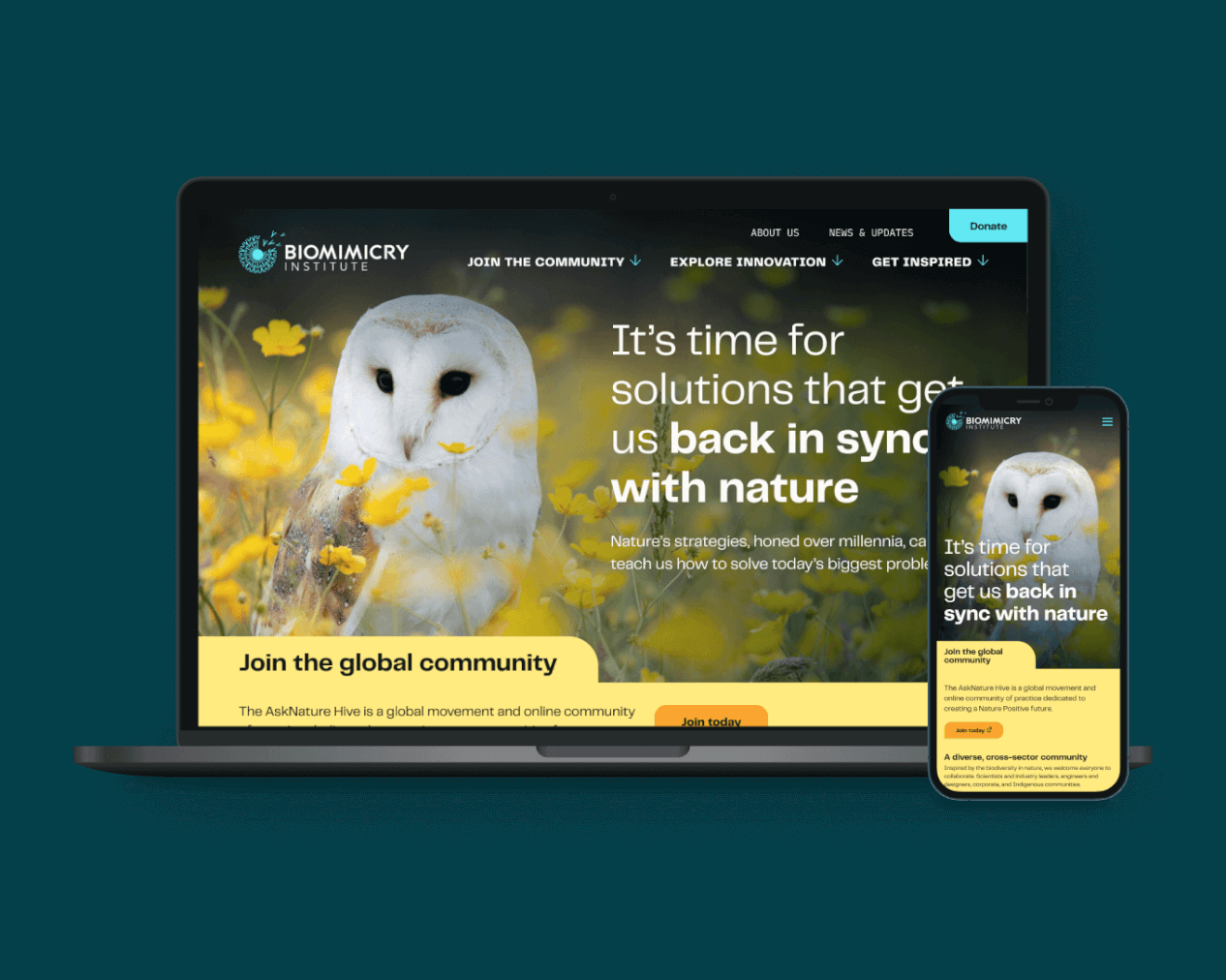
The Biomimicry Institute project shows how those disciplines meet. Mangrove built flexible WordPress content blocks, a filterable blog and a portfolio area for initiatives. Rachel Dearborn of Dearborn Strategies contributed brand and content strategy; SEO consultant Jessica Poulin of Column & Row also collaborated. The site had to communicate ambitious ideas while giving staff room to keep publishing.
Sierra Club Canada’s brief made the tradeoffs more explicit. The environmental organization wanted an engaging site that also respected visitors with limited bandwidth. Mangrove reduced the size and resolution of landscape images while preserving their visual effect. It combined a regional chapter map, multilingual capability and a customized WordPress system that let chapter and project leaders update content within the brand’s rules.
That is a useful account of sustainable design because the decisions are visible. Image size, information structure and publishing flexibility can be discussed, tested and revised. A customer can ask what each feature contributes and what it asks of the visitor’s connection. The mountain view still has a job to do.
The badge comes with arithmetic
B Lab lists Mangrove as certified since November 2016, with an overall B Impact score of 112. The company became a legal benefit corporation in 2017 and obtained WBENC certification in 2024. These credentials give buyers something concrete to examine when ownership and business practices matter to procurement.
The reports also record missed targets. Donations were 0.89% of gross revenue in 2023 and 0.77% in 2024, below the stated 1% goal. Mangrove attributed the shortfall to reduced revenue. It postponed improvements to its Make-It-Accessible resource because it lacked capacity, and a planned standalone sustainability service did not materialize.
A downturn and staffing changes left a smaller organization. The 2023-2024 report described 15 people and a two-person leadership team after longtime partners Megan Yarnall and Marie Koesnodihardjo moved on. Those details complicate a tidy expansion narrative. They also make the reporting worth reading.
The following year brought a different result. In highlights published in July 2026, Mangrove reported donating 2.28% of 2025 gross revenue and contributing more than 200 pro bono hours. It said 96.5% of its business came from purpose-driven organizations or those led by women, non-binary people or BIPOC individuals. These are the company’s reported figures, with categories that can overlap.
The agency also reported that 80% of its team identified as female or non-binary. Its emphasis on representation extends to mentoring and support for organizations such as Girls Who Code. The work, the hiring priorities and the giving are presented as parts of the same business. Tracking the results exposes the occasions when ambitions run ahead of capacity.
Custom work has a custom-sized bill
Mangrove’s Clutch listing puts its minimum project at $25,000-plus and its hourly rate at $150-$199. These are directory figures, rather than a quote for a particular assignment. They place the agency well beyond the casual purchase of a template. Revenue comes from commissioned work and continuing client relationships, including maintenance and retainers.
Its own budgeting guide explains the moving parts: unique page designs, integrations, animation, rush schedules and the depth of content or accessibility work. Reusing suitable page components can constrain costs; making every page behave differently pushes in the other direction. Testing takes time too. A budget conversation needs to identify those choices before they become surprises.
For a small organization that needs only a few straightforward pages and can handle publishing itself, a template or independent developer may be a better fit. Mangrove’s approach becomes more relevant when several problems arrive together: a confusing story, an awkward publishing system, accessibility requirements and connections to other business tools. The buyer is paying for judgment across those decisions.
There is plenty to copy without commissioning a rebuild. Name the people responsible for updates. Ask them to demonstrate a routine change. Set a realistic content structure, agree on testing and reserve time for training. Then treat launch as the beginning of ownership. Mangrove’s work offers a sensible test of a finished website: can the people who need it keep using it?
Explore the work
Mangrove’s website · Project portfolio · Agency journal · LinkedIn · Twitter / X · Facebook · GitHub
Read RGD’s AccessAbility guide · Listen: Sierra Club Canada’s website launch podcast