Mandle Cheung wanted to conduct Mahler. The difficulty was finding an orchestra willing to help him learn. By the time his Mandle Philharmonic gave its first public concert in November 2018, he had spent roughly two years preparing Mahler’s Fourth Symphony. Asked why a beginner should tackle music of such ambition, he had a compact answer: “I’m too old for that.” Simpler repertoire would have to find somebody with more time.
Cheung had already built a life in which people answered to him. He founded ComputerTalk in 1987, creating a business in communications software. Now he was financing a room full of professionals whose knowledge he needed. In rehearsals, the person holding the baton could also be the person receiving the lesson. The arrangement rearranged the usual hierarchy before anyone had played the first note.
There is an appealing story here about returning to an early love. There is also a more awkward story about money purchasing access. Both belong to Cheung’s musical life. The bill makes the orchestra possible; the orchestra makes the learning audible. When the public arrives, everyone hears the result.
The concerto in the pocket radio
The beginning was small enough to fit in a hand. At thirteen, growing up in Hong Kong, Cheung heard Saint-Saëns’ Third Violin Concerto through earphones on a pocket radio. His family was not especially musical. Yet that encounter established a preference that lasted across countries and careers. A radio broadcast had supplied an education in what he wanted to hear.
His early music-making had an improvised streak. Faced with a Chopin score containing five flats, he used pieces of paper to mark the piano’s black keys. In Grade 8 he joined a harmonica band. The instrument remained part of his life when he moved to Canada in 1968 to study at the University of Manitoba. Computer science supplied his degree; music supplied some of his other classes.
One teacher was Arthur Polson, the violinist and conductor who helped connect him with the CBC’s orchestral musicians in Winnipeg. Cheung performed Arthur Benjamin’s Harmonica Concerto. Years later, realizing that he did not have a recording, he contacted the CBC. The performance was still in its archives. His younger musical self had been keeping an appointment there while the older one was busy elsewhere.
Work took precedence. During the years of building his technology company, listening itself fell away for a period. Mahler eventually drew him back. The ambition to conduct would take longer to turn into something that required a rehearsal room.
- 1968Hong Kong to Manitoba
- 1987ComputerTalk begins
- 2018First public Mandle Phil concert
- 2026Mahler with the RPO in London
The business that paid for rehearsal
ComputerTalk began in a rented basement room in downtown Toronto. Cheung initially hired part-time programmers, then brought in Dennis Menard as an early full-time programmer. Menard stayed for about thirty-five years. The business grew into a team of roughly a hundred people, giving its founder the income to employ a different collection of specialists.
Today ComputerTalk is headquartered in Markham, Ontario. Its ice Contact Center software helps organizations handle communications across channels, with integrations, analytics and artificial intelligence. The company has worked with Microsoft technology since 2005, following the progression from Live Communications Server through successive products to Teams. For a business concerned with connecting people, the underlying platforms have supplied plenty of moving targets.
Cheung’s public business remarks are correspondingly practical. He has emphasized the productivity of bringing different kinds of communication together and the usefulness of Microsoft’s platform in delivering contact-center services. This is the work that occupied decades before the concert announcements began. The musical career rests on a much longer commercial one.
By 2020, he described making high-level decisions while his ComputerTalk team carried them through. That division of work had freed capital for music. It is easy to imagine every successful business owner yearning to escape the office. Cheung’s chosen destination involved another schedule, another team and considerable homework. Leisure had acquired an accounts-payable department.
Learning in front of the people who know
The idea took shape around 2015. Cheung visited community orchestras, watched rehearsals and met conductors and players. Eventually he decided to work with professional musicians throughout his own ensemble. Their experience would support the performances and his preparation. Hiring expertise also meant agreeing to the ordinary machinery of professional music: contracts, union rules, rehearsal time and payment.
An early group of about twenty-five musicians helped him read Mahler’s First. He depended on help even with navigating the score. Sharon and Cecilia Lee were among the people who helped turn the impulse into an ensemble. The project gathered musicians before it gathered an audience, allowing an uncertain beginner to do some of his most exposed learning in private.
Public performance changed the stakes. The November 2018 debut at Glenn Gould Studio included Mahler’s Fourth; Mahler’s First followed in March 2019. The orchestra drew on Toronto’s professional musical community, including players with experience in established ensembles. For them, the project provided paid work and substantial repertoire. For Cheung, it provided people capable of answering the questions the score raised.
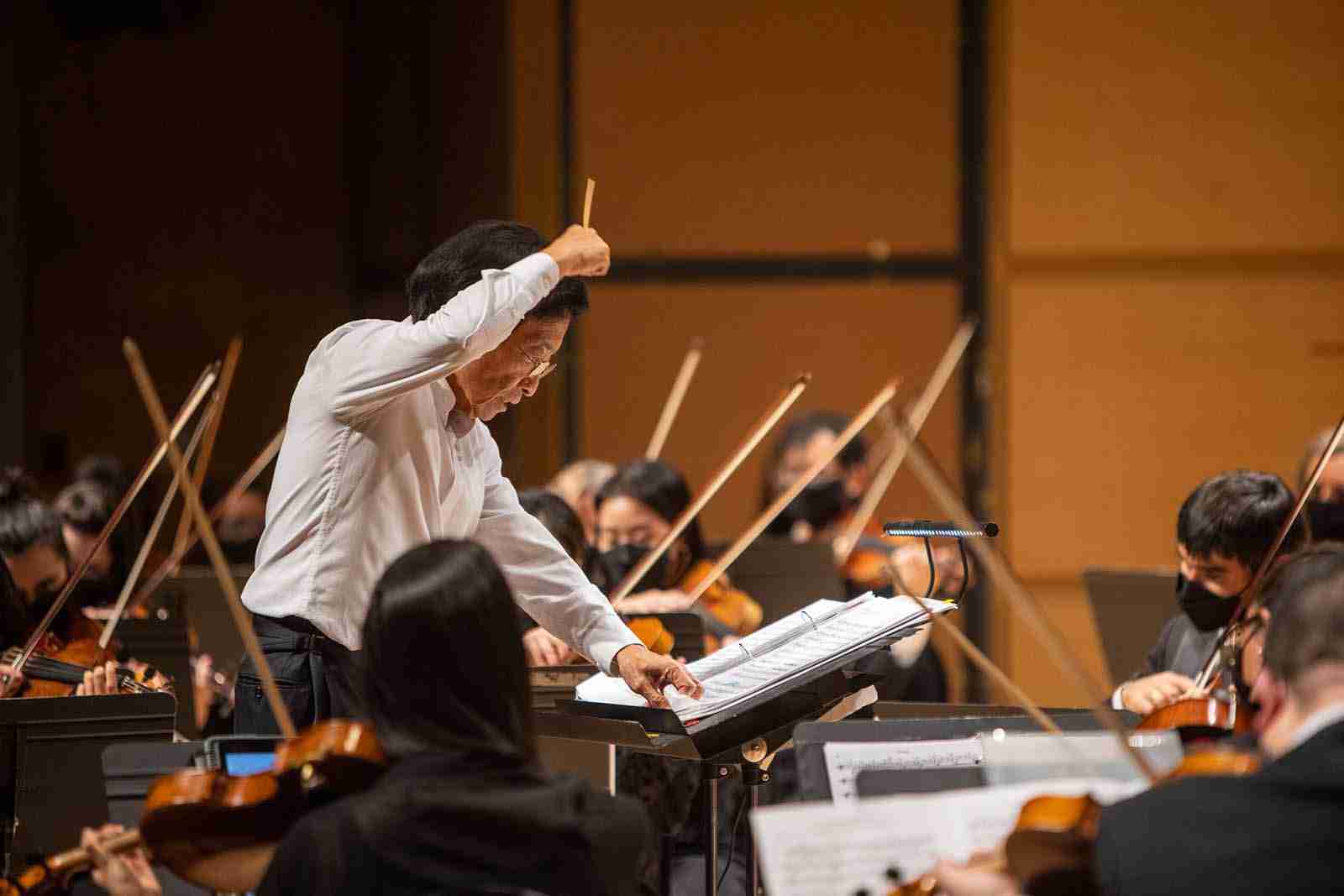
Preparing the January 2020 concert meant studying Brahms and Beethoven, working with pianist Sae Yoon Chon and adding Li Huanzhi’s Spring Festival Overture. Cheung spent months on preparation and consulted players as rehearsals progressed. Double bassist Mike Cox noted the unusual opportunity to offer a conductor criticism. Contrabassoonist Graham Martin valued the players and the atmosphere.
“Let’s do it again, please.”
Mandle Cheung, in rehearsal, 2020
That request contains much of the arrangement. Repetition takes time, and an orchestra’s time costs money. Cheung was buying the chance to try again with people who could hear what needed changing. The audience would eventually hear a single performance, with all those earlier attempts folded into it.
For the January 2020 production, his team put the cost at about $300,000. Tickets were advertised at $17, with concessions and discounts, and about a thousand had been sold when he discussed the concert. Those figures describe that particular event, rather than a permanent price list. They do, however, explain why the business belongs in this musical story. Ticket sales alone were never going to pay that bill. The founder was underwriting the distance between what an audience paid to listen and what it cost him to learn.
A podium comes with an argument
Financing his own orchestra gave Cheung a platform with his name on it. Hiring an established orchestra introduced another question: what does its name imply about the conductor standing before it? On June 25, 2025, he led the Toronto Symphony Orchestra in Mahler’s Second at Roy Thomson Hall. He paid for the engagement. The arrangement prompted public scrutiny and disagreement.
The distinction matters. A paid engagement is a different route from the usual professional progression through study, assisting and invitations. It gives a wealthy beginner access that most aspiring conductors cannot purchase. It also pays musicians and brings a performance before an audience. Those consequences coexist, however neatly a concert listing arranges the names.
Cheung’s response has been to place considerable weight on the listeners. His confidence can be disarming; it can also be provocative in a profession where preparation and judgment are fiercely contested. The concert itself included the Amadeus Choir and soloists Kirsten LeBlanc and Mireille Lebel. Audience enthusiasm became part of the discussion afterward, alongside the circumstances that had put him onstage.
In August 2026 he conducted the Royal Philharmonic Orchestra at Alexandra Palace Theatre in London, again in Mahler’s Second, with the Brighton Festival Chorus, soprano Elizabeth Watts and mezzo-soprano Jennifer Johnston. The public experiment had crossed the Atlantic. A private ambition was now producing performances, and arguments about performances, in another country.
The London account earned a mixed assessment. There were moments of uncertain ensemble and stretches that needed greater relaxation, alongside effective handling of tempo changes, expressive string playing and a forceful conclusion. Such details resist the easy verdict that either money explains everything or enthusiasm excuses everything. A concert contains passages, entrances, balances and decisions. Each can be heard.
The score keeps getting larger
Cheung’s next announced assignment is Mahler’s Eighth at Roy Thomson Hall on November 27, 2026. Orchestra, adult and children’s choirs, and eight soloists are planned. The venue bills it as Toronto’s first performance of the work since 2012. His second beginning has developed a habit of requiring more chairs.
The practical challenge extends well beyond the podium. A large choral work requires people with different schedules to prepare separately and arrive ready to perform together. The conductor’s preparation becomes one component in an operation involving singers, instrumentalists and organizers. A date printed on a ticket is a remarkably firm deadline for so much collective work.
Cheung has watched Karajan and the Berlin Philharmonic closely, studying gesture alongside sound. He also prepares short spoken introductions to help audiences enter the music. Before walking onstage, he can address the room from backstage. Listeners encounter his voice before they see the baton. For someone whose first decisive musical experience came through earphones, it is a pleasing way to begin.
His career invites a comparison between the chief executive and the conductor: the leader, the specialists, the complicated coordination. Cheung himself has pushed back against that comparison. Conducting unfolds in real time, with decisions exposed as the music continues. Business success bought him a chance to face that condition. Once the players begin, he has to keep his place.
Listen, then keep reading
Hear the performances and follow the next concert.
- Mandle Philharmonic performances on YouTube ↗
- November 27, 2026: Mahler’s Eighth at Roy Thomson Hall ↗
- Mandle Philharmonic website ↗ · Instagram · Facebook
- Mandle Cheung on LinkedIn ↗
- ComputerTalk ↗
- The 2019 profile: building an orchestra ↗
- A 2026 conversation about work and music ↗
- The Alexandra Palace performance reviewed ↗