Seven hundred shop floors ought to look like progress. They did, for a while, to Joanna Griffiths. Knix had made its way into retail locations across North America, the sort of footprint a young apparel company could reasonably put in a pitch deck with some satisfaction. Then, in 2016, she withdrew from more than 700 of them. She wanted to sell directly to the people who would open the parcel, try on the product and decide whether it belonged in their lives.
The move makes an awkward opening for a conventional success story. A founder builds distribution, then dismantles it. An MBA graduate spends years getting into shops, then starts again in a browser. The interesting part of Griffiths’s career sits inside that awkwardness: her willingness to treat an established arrangement as something she could revise.
Ten years later, there has been another departure. In July 2026, Griffiths announced that she would step away from her operating role at Knix. Nicole Tapscott, the company’s chief commercial officer, was appointed brand president effective August 1. Griffiths planned to travel with her family beginning that autumn. A career spent persuading people to try something new had reached a moment when she would have to do the same herself.
Seven hundred doors, then one
There is a distinction between getting a product onto a shelf and getting its story across. A shelf can accommodate a box. It has considerably less room for a founder’s explanation. For a company making an unfamiliar proposition in an established apparel category, that difference can become expensive.
Knix launched in 2013 and initially sold through retailers. Crowdfunding later provided a more immediate encounter with customers. The response to its Evolution Bra made Griffiths reconsider the route to market. People were willing to place orders with the brand, before the finished purchase had arrived in their hands.
Leaving wholesale did not happen with a dramatic flick of a switch. The team took about nine months to fulfil existing orders before the relaunch. That detail gives the decision its proper texture. Walking away still meant doing the work already promised. A change of strategy had a packing list.
North American retail locations left behind as Knix focused on direct online sales.
The new model gave Knix more control over how it spoke, what it showed and how it heard back. Griffiths could make the customer relationship part of the business itself. A complaint about fit or comfort had somewhere to land. The same conversation could influence the next product and the next campaign.
The record-label plan
Griffiths’s original ambition involved a rather different kind of label. She studied commerce at Queen’s University, graduating in 2005, with her sights set on the music industry. “I only wanted to work at a record label,” she recalled. She became a publicist, working at Universal Music Group and the Toronto International Film Festival before taking an MBA at INSEAD.
It is tempting to tidy up that route, as though every early job were secretly preparing her to sell underwear. People deserve a less convenient biography. She wanted the entertainment career at the time. The later usefulness of publicity experience does not make the earlier ambition pretend.
Still, knowing how to introduce an unfamiliar name to an audience has obvious applications. Publicity asks who will care, what will make them listen and which detail will survive the journey from one person to another. When Griffiths eventually started Knix, she brought experience in that work, even as she learned a new industry.
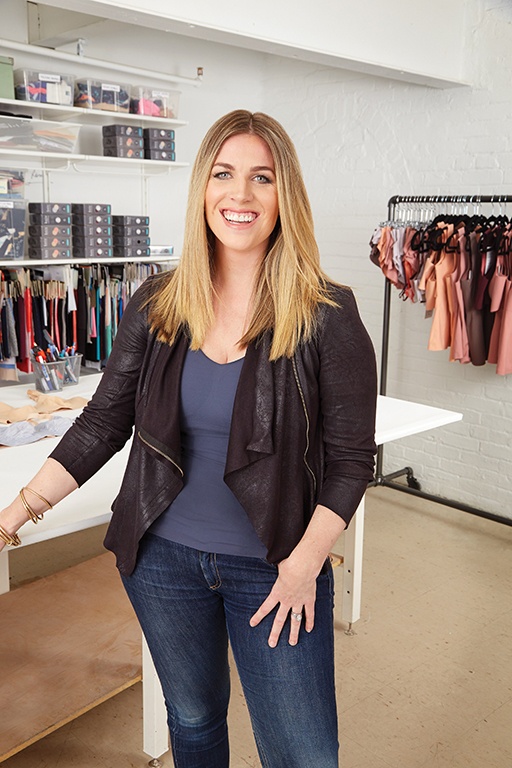
At INSEAD, she developed the business idea and won both the Business Venture Competition and the Women’s Award for Entrepreneurship, securing initial capital. She graduated in 2012. The company followed the next year. The school competition supplied more than an item for her biography: it gave an idea a first formal vote of confidence.
Her earliest job was sweeping floors at a hair salon. By 2019, she was describing a personal motto with the economy of a family saying: “No hands, no cookies.” The explanation was straightforward. If you wanted something, you had to put your hand up and go after it. A cookie is a modest unit of ambition. It does make the point pleasantly difficult to misunderstand.
A bra, a browser, and 19,000 votes
The Evolution Bra campaign offered a way to test that ambition in public. By May 2016, Knix reported US$1,551,287 raised across Kickstarter and Indiegogo from more than 19,000 backers. Its original campaign goal had been US$30,000. The amounts describe combined crowdfunding, rather than a single campaign or an investment round.
The product could be worn eight ways, with reversible fabric and interchangeable straps. Its pitch put comfort and versatility at the centre of the purchase. Customers had been involved in development. The company was asking them to help bring something into production that answered complaints they already recognised.
More than 19,000 backers across Kickstarter and Indiegogo. Dollar figures share the same scale.
A pledge is a particularly useful form of feedback because it costs the person making it something. Compliments can be generous and vague. An order has a quantity. For Griffiths, the response made the direct relationship with customers harder to treat as a side project.
That relationship also affected the early team. In a 2013 account of hiring, she described colleagues separated by nearly 30 years in age. Different tastes made discussions lively, but they also meant decisions about packaging, design and communication faced several perspectives before reaching a customer. Agreement took work. She considered those differences useful.
Who gets to be in the picture?
The question of whose preferences counted became a question of whose face appeared. Knix used customers in its advertising and built an identity around a broader range of ages and sizes. That gave the brand a recognisable point of view in a category accustomed to a narrow visual vocabulary.
In 2020, the Age Doesn’t Matter campaign included women in their 50s, 60s, 70s and 80s. Four decades shared the frame. Griffiths worked with director Soleil Denault on the project, which was released for International Women’s Day.
The choice was specific enough to be useful. Saying a brand is for everyone can remain comfortably abstract. Casting people whom advertising routinely overlooks forces a company to show what that sentence means. It also gives the audience something to disagree with, remember or pass along.
“Many people say to dream big, but I say to dream often.”
Joanna Griffiths
Griffiths returned to the subject at the 2024 INSEAD Entrepreneurship Forum, discussing how Knix challenged conventional beauty standards. Her old interest in media had found room inside the apparel business. Campaigns became another place to work through the company’s view of its customer.
There were partners as well as customers in that wider circle. Ashley Graham joined Knix’s 2021 financing and later collaborated creatively with the brand. TZP partner Erin O’Brien Edwards had visited its basement office in 2016, years before the investment. Relationships had time to develop before they became deal announcements.
An exit with work still to do
In 2022, Essity acquired 80 percent of Knix for US$320 million, giving the company a US$400 million valuation. Griffiths retained the remaining 20 percent at the time and continued as president. Knix announced completion of the transaction in September, alongside a milestone of two million customers.
That is a company transaction, with a company valuation. The more revealing personal detail is the decision to stay. The sale changed ownership while Griffiths continued leading the brand. There were products to make, customers to serve and a business to develop after the photograph of the milestone had been taken.
Ownership at the acquisition. Implied company valuation: US$400 million.
Recognition followed. In January 2023, she was announced as Canada’s EY Entrepreneur Of The Year 2022, then represented the country at the world competition that June. The award year and the announcement year differ, a small calendar wrinkle that can otherwise make a biography unnecessarily confusing.
Her response to the acquisition record was more interesting than the record’s wording. She hoped another female founder would surpass it. There is an appealing lack of possessiveness in wanting a distinction to have a short tenancy. A bigger result elsewhere would mean the field had more room.
The next door opens outward
By the time of the 2026 handover, Knix’s distribution had evolved again. The company had its own stores and was developing selected wholesale partnerships, including Holt Renfrew. The earlier withdrawal from retailers had never needed to function as an eternal rule. A mature brand could return to those conversations with a different position and a clearer identity.
Griffiths’s successor came from inside the company. Tapscott had worked as chief marketing officer and chief commercial officer, with previous experience at Casper and Mejuri. The transition put leadership in the hands of someone already involved in the business’s recent growth.
Griffiths, meanwhile, still has a connection to the film world. She serves on TIFF’s board, returning in a different capacity to an organisation where she once worked. The early career remains part of the later life, even after a substantial detour through apparel.
Family travel is now part of her announced next chapter. The person who once imagined running a media company has built and passed on something else. Her story leaves a useful question hanging over those 700 shop floors: when an arrangement looks successful from outside, are you still allowed to change it? Griffiths has made a career of answering with a decision.