Before there was a purple cereal box, there was a cricket. Gabi Lewis and Greg Sewitz, friends from Brown University, built Exo, a protein-bar business using insects. They sold it in 2018. The experience left them with a useful distinction: an interesting ingredient and an ingredient people want to eat are different things. Breakfast would give them another chance to test it.
- Familiar cereal flavors, rebuilt around protein.
- A premium price and an online-to-retail expansion.
- Now pastries and oats, too. Read each product’s label.
With Exo, supply was difficult and mainstream demand required persuasion. The founders had to sell the idea of eating insects before selling the bar. For Magic Spoon, they chose something shoppers already understood. Nobody needed a tutorial on cereal. The question was whether adults who had abandoned sugary breakfasts could be persuaded to return.
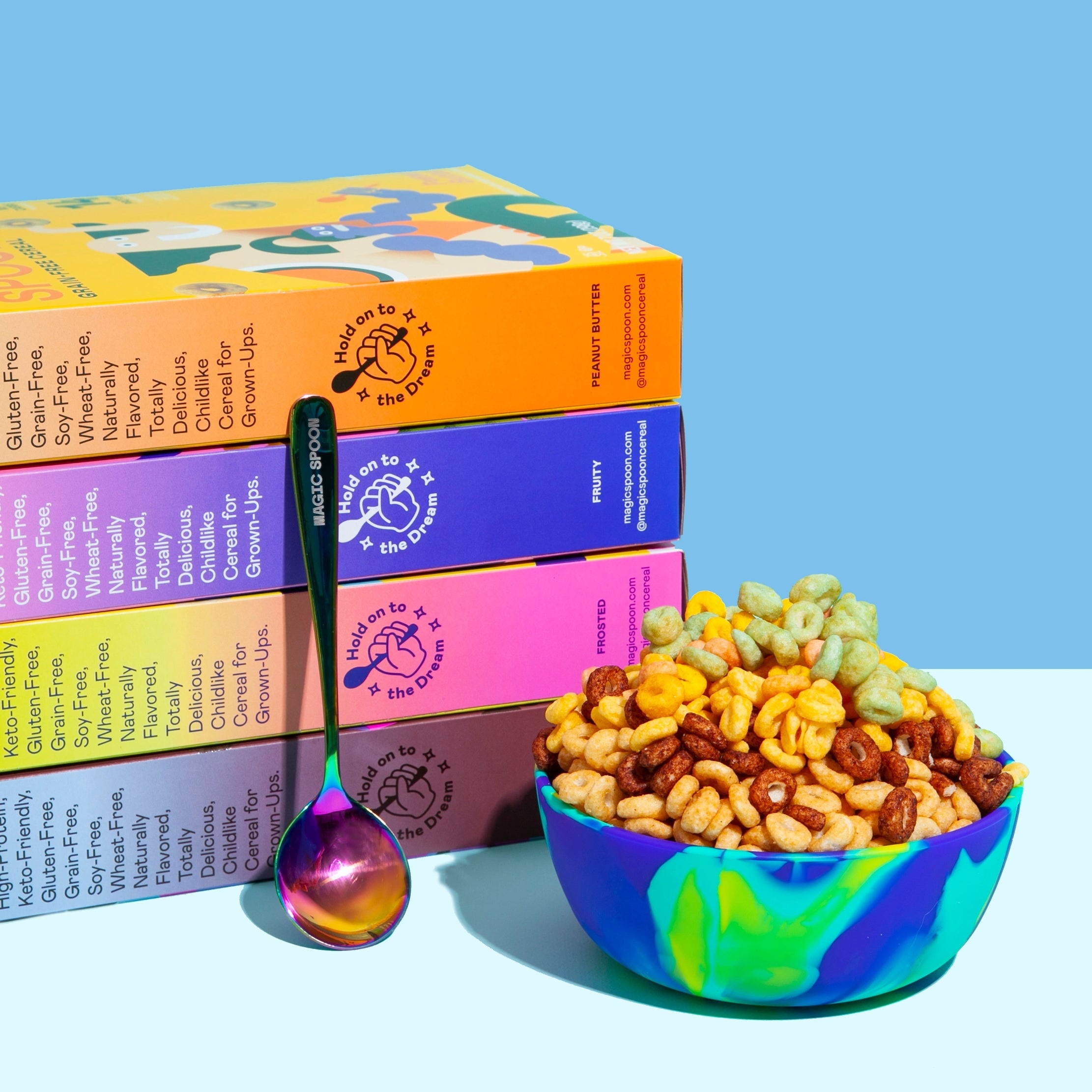
Launched in 2019, Magic Spoon offered the childhood routine with different arithmetic: more protein, fewer carbohydrates, familiar flavors. The company says development took more than a year. Its mischievous boxes did another job. They gave nutrition-conscious adults permission to buy something that looked wonderfully unserious. A respectable breakfast need not dress like an accountant. The packaging makes room for pleasure.


02The box is a disguise
The original cereal is built around milk proteins, including whey and casein, rather than the usual grain base. Allulose and monk fruit provide sweetness. Fruity, Cocoa, Frosted and Peanut Butter are the classic variety-pack flavors. The product page lists 12-14 grams of protein, zero total sugar and 4-5 grams of net carbohydrates per serving, depending on flavor.
That puts Magic Spoon between two shelves, conceptually: the cereal aisle and the protein-snack aisle. A customer can pour it into a bowl, eat it dry, or use it as a crunchy topping. The attraction is practical as well as sentimental. It offers a ready-to-eat protein option to people who want something beyond another shake or breakfast of eggs.
The audience was never simply children. At launch, the founders described adults who missed cereal, parents seeking an appealing alternative, and people following carbohydrate-restricted diets. Their expertise lay in combining food formulation with branding and direct sales. The wrapper made the product recognizable; the ingredient list supplied a reason to reconsider it.
03A $39 invitation to remember
Here comes the less childlike part. At the time of research, the original four-box variety case cost $39 for a one-time purchase on Magic Spoon’s website. The listed subscription price was $31.20, a 20 percent reduction. That is $9.75 per box before shipping or tax at the one-time price. Saturday morning has acquired a rather adult invoice.
The price objection was visible from the beginning. In a 2019 interview, the founders identified consumers’ expectation of cheap cereal as a major challenge. Their answer was to invite comparison with protein bars, yogurt and shakes. That is a revealing sales technique: define the job a purchase performs before arguing about what it should cost.
The business earns money through packaged-food sales, with online bundles, repeat subscriptions, Amazon and wholesale retail distribution. A subscription gives the company another route to a repeat purchase; a supermarket lets someone try a box without committing to a case. Those channels offer different conveniences. Neither removes the need for the food to earn its next purchase.
04First the internet. Then the aisle.
In September 2019, a $5.5 million seed round led by Lightspeed backed the young company. In June 2022, Magic Spoon announced an $85 million Series B led by HighPost Capital. The funding accompanied its first national retail launch at Target. The company reported that it had already reached more than one million customers in three years.
That financing was capital raised, not the cost of developing a recipe. It supported retail expansion, brand awareness and product innovation. The investor roster included Siddhi Capital, Coefficient Capital and Constellation Capital, alongside celebrity backers. Shakira and Nas may attract attention; cereal still has to survive the less glamorous business of replenishing a grocery shelf.
What changed the distribution decision? Lewis described customers repeatedly asking to buy in stores, alongside a maturing category and emerging competitors. The first rollout reached 1,300 Target stores in June 2022. Sprouts followed. By February 2023, the footprint was 6,800 stores; by February 2024, reporting put it above 16,000. The January 2025 granola announcement claimed more than 20,000 US stores.
Online marketing had relied on influencers, podcasts and social video. Physical retail added aisle displays and a different measurement problem: a purchase at a checkout does not automatically reveal which advertisement prompted it. The useful lesson for another founder is to establish demand, listen for buying friction, and change distribution when customers keep describing the same inconvenience.
05Breakfast is getting bigger than cereal
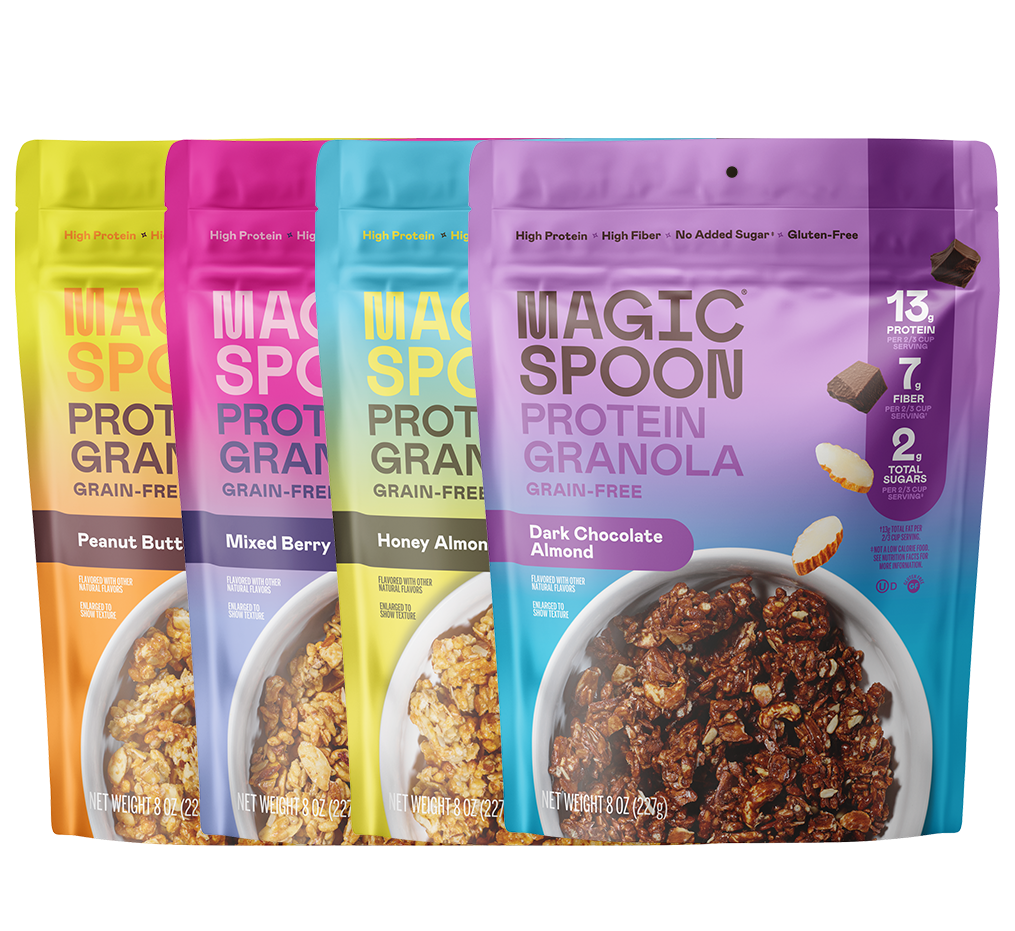
The catalogue now stretches beyond the original rings. Protein Treats make the cereal-bar format portable. January 2025 brought nut-and-seed granola with 13-14 grams of protein and 7-8 grams of fiber per serving. A separate Protein + Fiber cereal introduced a dairy-free option, sold at Whole Foods Market. These products address different breakfast habits rather than merely supplying another color of box.
In January 2026, protein pastries arrived in Frosted Strawberry, Cinnamon Brown Sugar and S’mores. Each serving supplied 11 grams of protein and 6 grams of fiber, with 3 grams of total sugar, including 2 grams added. Then came protein oatmeal in June: Maple Brown Sugar, Apple Cinnamon and Banana Bread, with 15 grams of protein per serving. The grain-free cereal company was now selling oats.
That expansion makes the fine print matter. “Zero sugar,” “grain-free” and “dairy-free” do not describe the entire catalogue. The original cereal contains dairy; the granola contains dairy and nuts. The current FAQ says the marshmallow cereal contains gluten and gelatin. Buyers should compare individual packages, serving sizes and allergens rather than treating the brand name as a dietary guarantee.
Magic Spoon faces specialty alternatives such as Three Wishes and Catalina Crunch, plus established cereal makers moving into protein. Its approach is most persuasive when customers value convenience, playful flavors and changed macronutrients enough to pay the premium. It is a harder proposition for a household shopping primarily on price, or someone whose dietary requirements exclude the formulation. Nostalgia opens the cupboard. The next bowl has to justify keeping it there.
“Just get your product out there.”Gabi Lewis and Greg Sewitz, ForceBrands interview, 2019