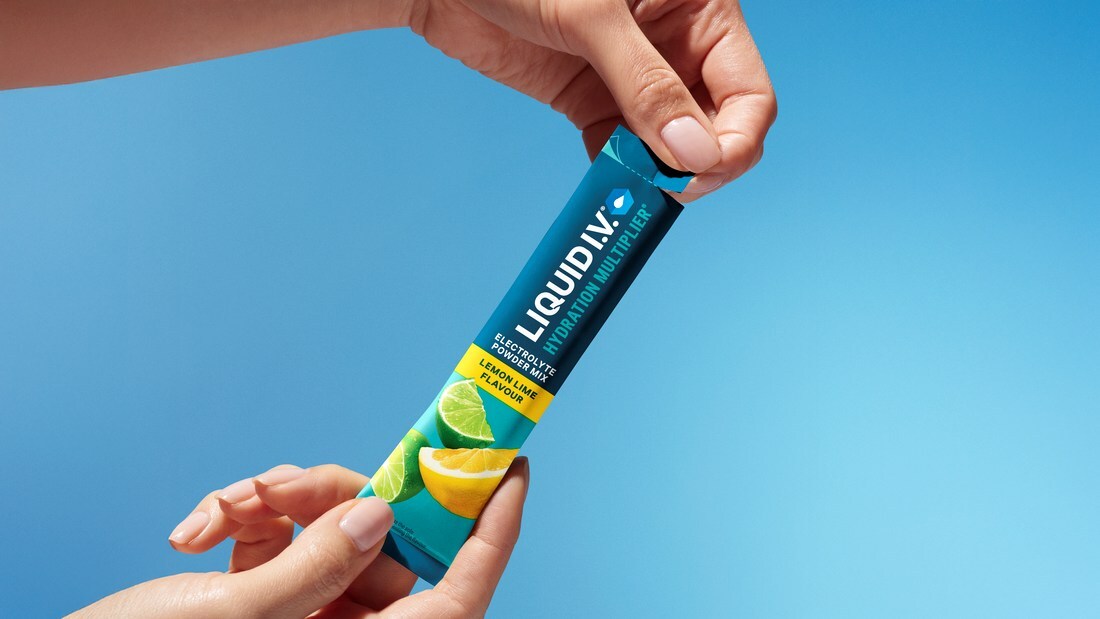
The customer supplies the water. Liquid I.V. supplies the reason to put something in it. That division of labor has carried a Southern California hydration company from an idea discussed among friends to a brand whose chief executive reported more than $1 billion in retail sales in January 2026. The packet is small. The ambition is printed in capital letters: Hydration Multiplier.
There is a useful business story beneath that name. Liquid I.V. sells flavored electrolyte powders through supermarkets, warehouse clubs, Amazon and its own website. Buyers can choose sugar-free versions, caffeine-containing energy mixes and immune-support varieties. The company occupies the intersection of sports drinks and consumer wellness, with the portability of a sachet and the language of a supplement. Its growth asks a deceptively practical question: how many occasions can fit inside one water bottle?
The first container was a bottle
The origin has more hotel-room improvisation than laboratory grandeur. In an early account republished by the company, Cameron Killeen recalled seeing a colleague drinking Pedialyte after a Las Vegas night out. Killeen, Hayden Fulstone and Brandin Cohen began discussing an adult hydration product. Cohen had returned to Los Angeles in 2012 and was sleeping on his friends’ couch. They worked with a beverage chemist, testing ingredients and flavors.
The initial audience was college students and young professionals interested in the morning after. The founders soon identified a broader sports-beverage opportunity and described separate sport and hangover-recovery products. That is an account of how the proposition widened, not evidence that the drink could cure a hangover. The distinction matters for a brand whose name borrows the authority of medical equipment.
The company also reconsidered the container. Agency Moontide says Liquid I.V. had been sold as a bottled drink before their collaboration helped shift the business toward powder, alongside work on pricing and positioning. This is the documented early correction: the delivery format changed. Powder made it possible to carry several servings without carrying several drinks. The consumer could add water at the destination.
Costco gave the pitch a shopping cart
A portable product still needs an explanation. Moontide describes geographically targeted campaigns tied to retail partners, in-store demonstrations and appearances at marathons and bicycle races. The sequence is sensible: put the product near people with an immediate reason to consider it, let them try it, then show them where to buy it. For another consumer brand, that alignment is more reproducible than a celebrity endorsement.
Liquid I.V.’s year-end 2018 message celebrated a West Coast Costco launch and promised national availability the following January. The same note reported more than 300,000 servings donated during 2018. Distribution and giving were already traveling together in the company’s public story. By July 2019, Cohen told beverage-industry publication BevNET that Liquid I.V. was in roughly 20,000 retail locations, with outlets including Whole Foods, CVS and Costco.
These channels do different jobs. A warehouse club puts a multipack in a recurring shopping trip. An online storefront can explain formulations, sell variety packs and offer replenishment. Event sampling connects a taste with a moment. The business lesson is to coordinate those jobs. An advertisement that creates curiosity is less valuable when the interested customer cannot readily find the product.
Famous investors, ordinary arithmetic
The financing brought recognizable names. Liquid I.V. raised a $5 million Series B in August 2018, then another $5 million strategic round reported in July 2019. Cohen and music executive Scooter Braun led the latter effort. Participants included Justin and Hailey Bieber, Kendall Jenner, Kevin Hart and Steve Aoki. Cohen told BevNET the second round had been unexpected; the opportunity to gather influential people already familiar with the product helped prompt it.
Capital and potential reach arrived in the same package. Celebrity investors could introduce the brand to audiences in music, entertainment and social media. That does not tell us what each introduction cost or prove which investor generated sales. The two disclosed rounds establish $10 million raised across those transactions. They are not an audited total of everything spent building Liquid I.V.
Unilever acquired the business in 2020 for an undisclosed amount. The strategic logic was expansion into health, wellness and personal nutrition. For Liquid I.V., ownership by a global consumer-goods company brought room to accelerate operations and product development. For readers keeping score, the billion-dollar retail-sales milestone is a different measure from company revenue, financing or the price paid for the acquisition.
“When you’ve got something good, keep working on it.”Mike Keech, CEO, speaking to Entrepreneur in January 2026
Sugar became a product question
The original formulation’s explanation centers on electrolytes and glucose. The company describes sugar as helping water absorption, while sodium supports fluid retention. Liquid I.V. built earlier marketing around Cellular Transport Technology; its current umbrella is LIV HYDRASCIENCE. The science story now covers intake, absorption, retention and fluid distribution. Behind the branding are distinct questions about what a drink contains and what happens after someone consumes it.
Then consumers wanted an option without sugar. In June 2023, Liquid I.V. introduced Hydration Multiplier Sugar-Free, initially in Lemon Lime, Green Grape and White Peach. Its US formulation uses an amino acid-allulose blend. The change expanded the offer for people who wanted the format while avoiding the original product’s sugar. It also required the brand to explain a second formulation, rather than simply repeat the original pitch.
The company’s clinical program includes research on fluid retention and hydration markers. One study summarized on its research page used a randomized, single-blind, crossover design and compared the original and sugar-free drinks with water over four hours. Those endpoints make the claims more specific. They do not establish that every purchaser needs an electrolyte powder, or that every drinking occasion will produce the same result.
Expertise is part of the commercial proposition. Liquid I.V. identifies teams working in exercise physiology, food science and nutrition, and a scientific advisory board chaired by scientific-affairs leader Dana Ryan. The challenge is translating that work into useful language without allowing the product name to do more promising than the evidence supports. A powder stirred into water remains an oral beverage.
The $1.56 decision
On September 8, 2026, the US website listed a 16-stick Lemon Lime pouch at $24.99 for a one-time order, or about $1.56 a serving. Its displayed subscription price was $17.49, approximately $1.09 a stick. Retail prices and promotions vary. At those posted prices, the recurring-order discount was $7.50 per pouch. The economics encourage a customer to turn occasional use into scheduled replenishment.
$7.50 less per pouch at the displayed subscription price. Before any applicable shipping or tax.
The customer is paying for flavor, measured portions and convenience as well as ingredients. A stick is easy to pack for travel or take to exercise. The range offers different propositions: original hydration, sugar-free hydration, energy with caffeine, and added immune-support ingredients. Choosing between them means reading the specific product rather than assuming every pouch delivers the same thing.
Choice is also the competitive constraint. Gatorade, Pedialyte and specialist powders occupy nearby territory; ordinary water competes for the same bottle. Associated Press reporting in 2026 described Gatorade broadening its appeal beyond athletes, while sports-drink mix unit sales were growing. Liquid I.V. helped make everyday hydration an attractive marketing occasion. Other companies can see the occasion too.
A water company still needs working taps
The Impact Program adds a second use for the company’s sales. Liquid I.V.’s impact page reports more than 1% of revenue directed to its projects, 15 million servings donated annually and more than $6 million in cumulative grants to partners expanding clean-water access. These are company-reported measures, with different units and timeframes. A donated serving and a dollar for water infrastructure should not be counted as interchangeable outcomes.
That distinction became unusually literal at Bondi Beach in March 2026. Liquid I.V. installed three symbolic non-working fountains along the promenade to draw attention to unequal access to clean drinking water. For a product mixed with water, the dependency is unavoidable. Hydration powder can be distributed quickly, but a packet cannot operate a water system. The grants address a different part of the problem.
Public employee accounts describe a company that has evolved as it grew. In an Instant podcast interview, longtime employee Domonique Brown distinguished early product education from a later period of more careful brand management, followed by an emphasis on experimentation. That account helps explain the organizational job: preserve enough curiosity to develop products while making a much larger business consistent.
The next frontier has a warehouse
Expansion now involves factories and local tastes as well as campaigns. Unilever’s 2025 annual report described Liquid I.V.’s entry into India with locally tailored flavors, sugar-free launches in additional markets and a US sugar-free energy line. It also reported bringing around half of Liquid I.V.’s production in-house. Growth at this scale needs dependable supply, not merely another memorable flavor name.
In July 2026, the brand announced launches in Spain, Germany, France, Sweden and Iceland, bringing its reported presence to 15 markets. Amazon and Costco were central to the rollout. The company also reported 15 completed clinical studies. The same three tasks keep resurfacing: substantiate the proposition, make the product available and persuade people to try it.
That approach has limits. A powder loses some convenience when the customer has no water or container. Subscription savings have little value if unopened pouches accumulate. Retail reach cannot guarantee repeat purchases when taste or price disappoints. The part another founder can copy is the discipline of matching format, occasion and distribution. Liquid I.V.’s packet succeeds only when someone tears it open again.