Before Ron Rudzin sold a mattress through a website, someone told him to put on a sports jacket. He was sixteen, helping at a furniture store in Manhattan, doing warehouse work and cleaning showroom tables. The jacket marked a promotion of sorts: he was going to learn to sell. It is a modest beginning for a business story. No garage. No revelation over a circuit board. Just a teenager being considered presentable enough to approach a customer.
His father had arranged the job with a friend who was opening the store. Rudzin would help grow the business to 219 locations, accumulating experience in sales, manufacturing, delivery, and the delicate matter of keeping a promise after money has changed hands. Decades later, he co-founded Saatva, a company that sold mattresses online. Eventually, it opened stores of its own. The sports jacket had proved remarkably portable.
A sports jacket at sixteen
Rudzin grew up in Flushing, Queens, playing baseball and football. His account of his father contains the ingredients of his later management philosophy: a tough, strong man who was also sensitive. Competition and consideration belonged together. Years afterward, Rudzin still described playing basketball a couple of times a week, with an acknowledgment that age had done nothing to improve his speed.
Furniture offered an early apprenticeship in other people’s decisions. At twenty, he began investing in stores at Jennifer Furniture Industries. He became a senior vice president as the business expanded. New York University got a couple of months of his attention before he pursued the furniture career. His subsequent education involved considerably more floor space.
That background matters to the way Rudzin talks about entrepreneurship. His vocabulary includes margins and logistics as readily as branding. A bed may begin as an attractive proposition on a screen, but someone must make it, get it into a truck, and carry it into a home. He had already spent years dealing with those verbs before e-commerce gave him a new place to find customers.
A mattress, taken apart
The financial crisis supplied an unwelcome interruption. Rudzin has described selling out of his position in 2008 as pressure on housing spread into home furnishings. At the same time, he was reading about Zappos and becoming interested in selling online. He wanted another business in a field he understood. Luxury mattresses attracted him because of their margins.
His research was physical. He bought luxury mattresses and examined their raw materials, testing the distance between what went into a product and what a customer paid. The proposition that emerged was straightforward: sell directly online and offer comparable quality at a lower price. Saatva launched in 2010.
Ricky Joshi brought complementary experience in digital business. Rudzin brought the operating knowledge. Their early meeting, arranged through friends, gave him a collaborator who understood the internet side of the idea. There is something pleasingly ordinary about that introduction. A company selling through a new channel still began with people telling other people whom they ought to meet.
The product also required a particular kind of delivery. Saatva built around mattresses delivered intact and brought into the home. Manufacturing and delivery relationships became part of the proposition. The order confirmation was only the beginning of a job that ended in someone’s bedroom. Rudzin’s old furniture experience had found an unusually literal fit.
- 01 / DiscoverRead and compare online
- 02 / DiscussAsk a person, visit a room
- 03 / DeliverBring the purchase home
A simple route to draw. A substantial operation to run.
The showroom gets its people back
An online founder returning to physical retail might sound like a reluctant concession. Rudzin’s account is more revealing. While planning Saatva’s Viewing Rooms, he wondered whether salespeople were necessary at all. Put a computer beside each bed, provide the information, and let the visitor order at home. To a person who had spent years teaching people to sell, this was quite an experiment to contemplate.
The first Viewing Room opened in 2019. Customers wanted to talk to the staff. The digital display could explain a product; the conversation could address whatever was still bothering the buyer. In November 2024, Rudzin reported that the company’s 3,300-square-foot Third Avenue location in Manhattan had written more than $10 million in business the previous year.
He told that story while considering artificial intelligence. He had asked managers to find ways to use it throughout the company. Yet their discussion kept returning to how technology could prompt a customer to call or visit. He found the apparent trip back to the 1990s funny. A sophisticated sales operation had arrived at the familiar business of getting someone on the phone.
The useful distinction in his thinking concerns the work each tool performs. A screen can make information available at any hour. A staff member can notice a hesitation and ask another question. Rudzin’s willingness to keep both is a reminder of how much retail depends on an individual deciding that someone has understood them.
The expensive business of changing your mind
For a less flattering account of his own instincts, Rudzin offers the story of Saatva’s content program. His chief marketing officer proposed spending nearly half a million dollars to get it started. The articles would answer consumer questions. Returns could take a year or more. For a business accustomed to paying for measurable traffic, the proposal required an uncomfortable amount of faith.
Rudzin agreed, then kept asking questions. Why did they need journalists? How many articles would be enough? When would the return arrive? He later described himself as a persistent tormentor of the colleague who had made the proposal. Few testimonials for patient leadership are so refreshingly candid about the waiting.
“I reluctantly let myself be persuaded and proceeded to torture the guy for the next two years.”
Ron Rudzin, on approving Saatva’s content program, 2023
By August 2023, he reported more than 850 articles and over $10 million in annual purchases by their readers. Those were his company’s figures, and his account gave the marketing chief credit. The story’s appeal is the admission that a founder can approve a sensible idea and remain an exasperating person to discuss it with.
His hiring philosophy asks for a similar check on ego. In a December 2023 essay, he described the founding rule as “hire nice.” Credentials would not compensate for an inability to support colleagues and customers. He preferred treating leaders as partners, encouraging them to think like owners. His father’s example of toughness with sensitivity had acquired a place in the interview process.
Rudzin makes clear that he expects performance. The interesting question is how he expects to obtain it. Kindness, in his telling, helps people work together and take responsibility. His essays return to the advantages of employees who can listen. A company selling reassurance has a practical interest in employing people who are capable of offering it.
An S on the marquee
Even the name contains a trace of the furniture veteran. Rudzin wanted an S brand, alongside Sealy, Serta, Simmons, and Stearns & Foster. Saatva draws on the Sanskrit word sattva, associated with purity and wholesomeness. He also joked that the name looked good on a marquee. The joke became more useful once the online business started putting its name above physical doors.
His ambitions have since found a larger stage. Saatva announced partnerships with Team USA and the Los Angeles 2028 Olympic and Paralympic Games in 2025. For Rudzin, the arrangement is part of making the brand more widely known. The company that began by reaching shoppers already searching for a mattress is now seeking an audience well beyond that immediate purchase.
In January 2026, Saatva announced promotions across strategy, business development, customer experience, and creative. In June, Rudzin received EY’s Entrepreneur Of The Year New York regional award. The company’s announcement put its staff above 400, its Viewing Room count at 33, and revenue approaching $650 million. These are dated markers of a business whose founder is still adjusting its organization as it grows.
Back in the classroom
There is another return in Rudzin’s story, this time to Queens. Through PENCIL, the nonprofit connecting business leaders with New York public schools, he participated in Principal for a Day and joined the board in 2021. He recruited Saatva leaders as mentors. His account of visiting Newcomers High School dwells on students arriving from different countries and working together.
He came away thinking about access to opportunity and the practical support that makes ambition usable. In 2022, he was preparing to participate at Flushing High School, his own alma mater. For someone whose first break came through his father’s friend, helping students meet people in business has a particular resonance. An introduction can change the work a young person thinks is available.
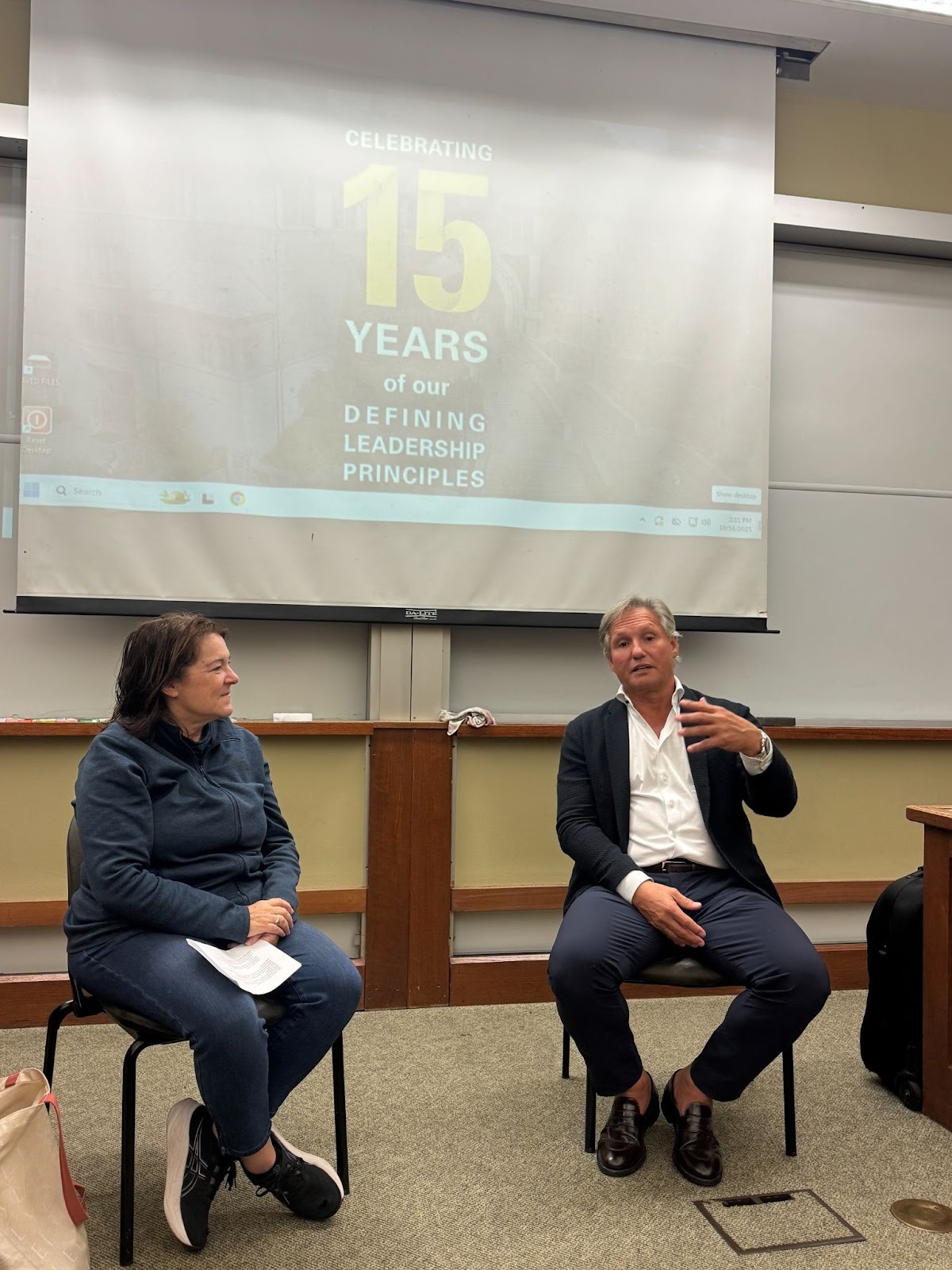
In October 2025, he spoke to a Berkeley Changemaker course about growing and scaling small businesses. “There are no shortcuts to building something meaningful,” he told the students. Behind that sentence sits a career containing warehouse tasks, hundreds of stores, a new selling channel, and several occasions when someone else’s judgment improved the plan.
His February 2026 writing describes making time to learn early in the morning and to think on weekends about where the company needs to go. The former teenage salesman still gives himself homework. After all those years explaining products, Rudzin seems most interesting when he describes paying attention: to a colleague with an expensive proposal, a student with ambition, or a customer who would rather speak to a person.
Continue the conversation
Follow the decisions, hear the interviews, or explore the business.
Visit Saatva Ron Rudzin on LinkedIn The career and leadership interview Watch: inside Saatva’s retail experience Watch: C-Suite Unscripted with Maggie McGrath More essays and conversations