Brandin Cohen had a place in Whole Foods. One place, to be precise: a store in El Segundo, California, where he spent weekends demonstrating Liquid I.V. to shoppers. This was 2014. The celebrity investors would come later. So would the acquisition. For the moment, his audience consisted of people who had come to buy groceries and might, if persuaded, stop for a sample.
It is an agreeable corrective to the usual founder portrait. A company eventually acquired by Unilever began its relationship with a major retailer through the highly personal business of getting strangers to try something. Cohen was there to explain it himself. A founder at a sampling table has immediate access to customer feedback, including the particularly eloquent feedback of someone continuing to walk.
That first store became three in the South Bay, then twelve, then sixty across Whole Foods’ Southern Pacific region. By January 2020, Liquid I.V. had reached Whole Foods nationwide. The sequence gives Cohen’s story its shape: secure an opening, work it carefully, earn another. Behind the eventual reach of the brand sits a remarkably local beginning.
A golfer asks for a different kind of chance
Cohen grew up in Manhattan Beach, with a professional golf career in mind. At Mira Costa High School, he won a Bay League individual championship and was named a Daily Breeze Co-Golfer of the Year. He graduated in 2006 and went to Loyola Marymount University on a golf scholarship. For his first three college years, the sport occupied most of his attention.
The competitive record supplies a useful detail. His high-school team finished his senior season 19-2 and won the CIF Western Divisional Championship. Cohen had already experienced the combination of individual performance and collective results that makes a team sport out of an apparently solitary pursuit. You take your own shot. Other people still depend on it.
When he began considering a career beyond golf, he approached entrepreneurship professor David Choi about joining a class. He lacked the prerequisites. He pleaded for an opportunity anyway. Choi agreed on the condition that Cohen would justify the exception. Eight months later, Cohen earned LMU’s Social Entrepreneur of the Year recognition for a project raising money and meals for children affected by Haiti’s 2010 earthquake.
He graduated in 2010 with a business degree. The class had supplied something harder to put on a transcript: evidence that he could organize people around an idea with a purpose beyond his own advancement. The young golfer who needed permission to enter an entrepreneurship classroom would later help give that classroom a success story to tell.
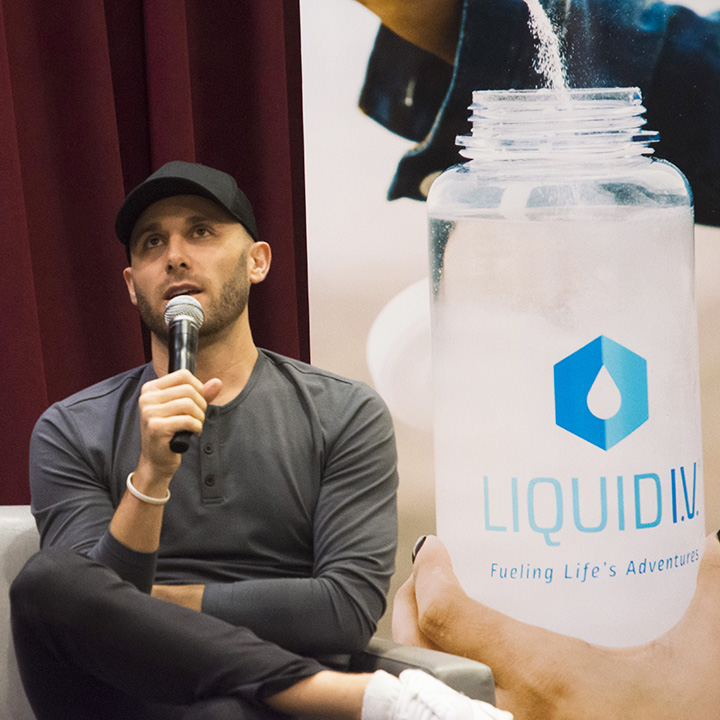
The degree he chose to postpone
After college, Cohen worked in sales and marketing for the Arizona Diamondbacks. Professional baseball put him close to athletes and the products they used. Those observations helped spark the idea for Liquid I.V. Back in Los Angeles, he developed the business with two friends and fellow LMU graduates, Hayden Fulstone and Cameron Killeen. The university’s business incubator helped the young venture get moving.
Liquid I.V. began in 2012; Cohen’s early alumni account dates its market launch to July 2013. It was a small operation with a network: college ambassadors, local gyms and markets, and supporters from LMU. Its first investor came from the university’s baseball community. The relationships were close enough that a person could answer a call before recognizing a brand.
Cohen nearly took another route. He was preparing to pursue an MBA on the East Coast while treating Liquid I.V. as a side project. An interested investor attached a condition to backing it: Cohen had to commit full time. One friend laughed at the prospect of abandoning the degree for the drink business. Cohen remembered the laugh long after the friend became a fan.
The choice required giving a new business more authority over his future than an established educational path. Plenty of ventures fail after exactly that choice; the decision itself guarantees nothing. What distinguishes this account is the work that followed. Cohen accepted the condition, then put himself in front of customers. Belief acquired a weekend schedule.
“Most people aren’t going to believe until it becomes a real thing.”
Brandin Cohen, 2018
When the investors could sell out a concert
By August 2018, the financing had moved beyond the early university circle. Liquid I.V. announced a $5 million Series B led by CircleUp Growth Partners. Its backers included the musician Kygo and baseball player Adam Eaton. The company was assembling a group whose connections reached into both sport and entertainment, two worlds where a portable consumer product could find an audience.
Another $5 million strategic round followed in July 2019. Cohen invested his own money alongside existing investor Scooter Braun. New participants included Justin and Hailey Bieber, Kevin Hart, Kendall Jenner, Steve Aoki and Gary Vaynerchuk. It was an investor list with considerable potential to interrupt an otherwise ordinary marketing meeting.
The mechanism was less mysterious than the names made it sound. A venture investor introduced the company to Braun; Braun’s relationships opened further doors. Cohen described celebrities helping the brand through collaborations. Aoki’s strawberry-cake flavor, for example, echoed the cakes he throws during performances. An existing piece of stagecraft became an idea for a product.
Attention still needed somewhere to go. By July 2019, Cohen said Liquid I.V. was in about 20,000 retail locations, including Whole Foods, Costco and CVS, alongside Amazon and its own website. The famous names and the retail accounts served complementary purposes. Someone could hear about a product through a performer, then encounter it during a shopping trip. The sampling-table problem had become a distribution problem.
El Segundo, 2014
Southern Pacific expansion
All retailers, late 2020
A buyer with a map of the world
At the end of 2019, Liquid I.V. was growing quickly and attracting interest abroad, while its sales were still confined to the United States. Cohen began considering what kind of buyer would fit the next stage. By September 2020, Unilever had acquired the business. The price was undisclosed. More than 35,000 American stores carried the products by the end of that year.
Cohen’s explanation for choosing Unilever centered on distribution. An international consumer-goods business already had relationships and systems that a young American company would otherwise have to develop country by country. For a founder who had started with individual stores, the attraction was concrete: a buyer could help make the next set of introductions on a different scale.
The sale adviser, William Hood & Company, also points to Amazon and Costco as important parts of the growth that preceded the transaction. That is a useful reminder about what an acquisition actually buys. Alongside packaging, inventory and a recognizable name comes a working arrangement between customers and the places where they buy. Cohen and his colleagues had spent years building that arrangement.
An acquisition changes the job, too. The founder who once needed another shelf now has to decide what role to play when a larger organization supplies the shelves. Mike Keech became Liquid I.V.’s CEO in December 2020. Cohen’s place in the story shifted from operating chief to co-founder and former CEO, a transition with consequences beyond a new line on a biography.
The people behind the packets
For former employee and podcast host Bobby Hobert, Cohen’s leadership was visible in a small daily habit: stopping to speak with people around the office. Hobert worked directly with him for fifteen months leading up to the acquisition. His later recollection emphasizes personal connections, composure during difficult stretches and a sense of purpose shared by the team.
That purpose had roots in the college project. Cohen’s ambition for the company included giving products to communities in need, and the business built a donation program as it grew. The connection between commerce and giving appears repeatedly in his public conversations. It also helps explain why his university experience keeps returning in accounts of a career that otherwise seems to belong to supermarket aisles.
Away from dealmaking, there are pleasingly ordinary details. Cohen likes working through ideas on a whiteboard, uses his notes app to reorder tasks and has recommended Dale Carnegie’s The Leader in You. He has also proposed wider sidewalks so three friends can walk together. Even a person with global ambitions can identify an infrastructure grievance on the way to dinner.
Another relationship survived in his wardrobe. CUTS founder Steven Borrelli and Cohen developed a friendship in their companies’ early days, swapping insights as non-competing entrepreneurs. A later CUTS feature noted that Cohen still owned some of the brand’s early colors and fabrics. Old shirts are a modest archive, but an unusually convincing one: evidence of a friendship kept in regular rotation.
“Test small, take the learnings, scale your growth areas, and repeat.”
Brandin Cohen on his working method, 2018
An opening after the exit
By May 2021, Cohen was talking about taking a hiatus after his years as CEO. He returned to friend Jordan Younger’s podcast, The Balanced Blonde, having been its first guest five years earlier. They recorded in his new home. The conversation looked toward what might interest him after the company that had occupied so much of his adult life.
That setting gives the story a quieter ending than an acquisition announcement. A business can be sold on a particular date; a person takes longer to discover how to spend the mornings afterward. Hobert’s later account describes Cohen developing an identity outside Liquid I.V. The founder had helped make a company large enough to continue with another leader. That left room for a life with fewer instructions from the company.
By December 2024, he was also publicly identified as a backer of Rosy Soil, a company selling potting mixes. That puts him on the other side of the founder-investor conversation, supporting a business making its own way through retail. His next chapter includes helping someone else with an opening.
His continuing interest in LMU brings the arc back to the classroom. Cohen has expressed an ambition to help build the university’s entrepreneurship program, extending the opportunity Choi once gave him. There is a satisfying practicality to that aspiration. Someone who benefited from a professor making an exception can help ensure another student gets a hearing.
The through line is a willingness to make the first approach, followed by enough patience to return. A professor, an investor, a shopper, a colleague: each required a different conversation. Cohen’s career grew through those conversations, one opening at a time. Before the acquisition and the celebrated backers, there was a weekend shift in El Segundo. He showed up for it.