At CHAGEE’s first American flagship, in Los Angeles’ Westfield Century City, the menu offered a small linguistic convenience: a latte. The signature BOYA combined jasmine green tea with milk. A customer could encounter an unfamiliar brand and still understand the basic proposition before reaching the counter. You already know how to order this. The leaf will be the surprise.
- Whole-leaf tea, presented through familiar cafe drinks.
- Company-owned U.S. teahouses, starting in Southern California.
- A global expansion story with a repeat-customer problem underneath.
That is a useful way to understand CHAGEE USA, the Irvine-based American operation of a brand born in Yunnan in 2017. Its problem is wonderfully ordinary. People want something pleasant to drink, somewhere to meet, and an order they can make without homework. CHAGEE offers tea as the center of that occasion, with enough familiar furniture around it to make the invitation easy.
A familiar word. A different leaf.
The current U.S. menu stretches across tea lattes, pure teas, matcha, citrus teafreshers and blended teas. BOYA is the signature jasmine-and-milk introduction; peach oolong offers another route in. Someone curious about the tea itself can order a pure tea. The launch also included pastries, among them a jasmine-infused cruffin. Even the pastry had apparently received the memo.
Underneath the cafe language sits a production system. In its American launch announcement, CHAGEE described automated brewing and an extraction process that grinds tea leaves and uses pressure and heat. The practical ambition is consistency: a drink ordered today should resemble the one that earned the return visit. For a chain, that repeatability is part of the product.


CHAGEE occupies the premium tea end of the beverage market. Specialty tea shops are the obvious alternatives, while Starbucks and neighborhood cafes compete for the same afternoon break. The distinction is a menu organized around tea, backed by recognizable signature drinks and an elaborate visual identity. Its appeal depends on customers caring enough about that distinction to come back.
The cup arrives before the habit
Century City’s grand-opening celebration ran May 9-11, 2025. Emily Ratajkowski attended the ribbon-cutting. Visitors could sample BOYA, and promotional cups offered chances to win prizes. This was a carefully staged introduction in a shopping center. Sampling lowered the risk of trying an unfamiliar drink; the ornate cups gave the purchase an afterlife in photographs.
There was an accessible entry price, too. A May 2025 Daily Bruin review reported pure teas at $4.95 and tea lattes at $5.95. Those are launch-era observations, rather than a promise about today’s menu. Still, they locate the proposition: a discretionary cafe purchase, within reach of the student reviewer, rather than a formal tea ceremony requiring an afternoon and a reservation.
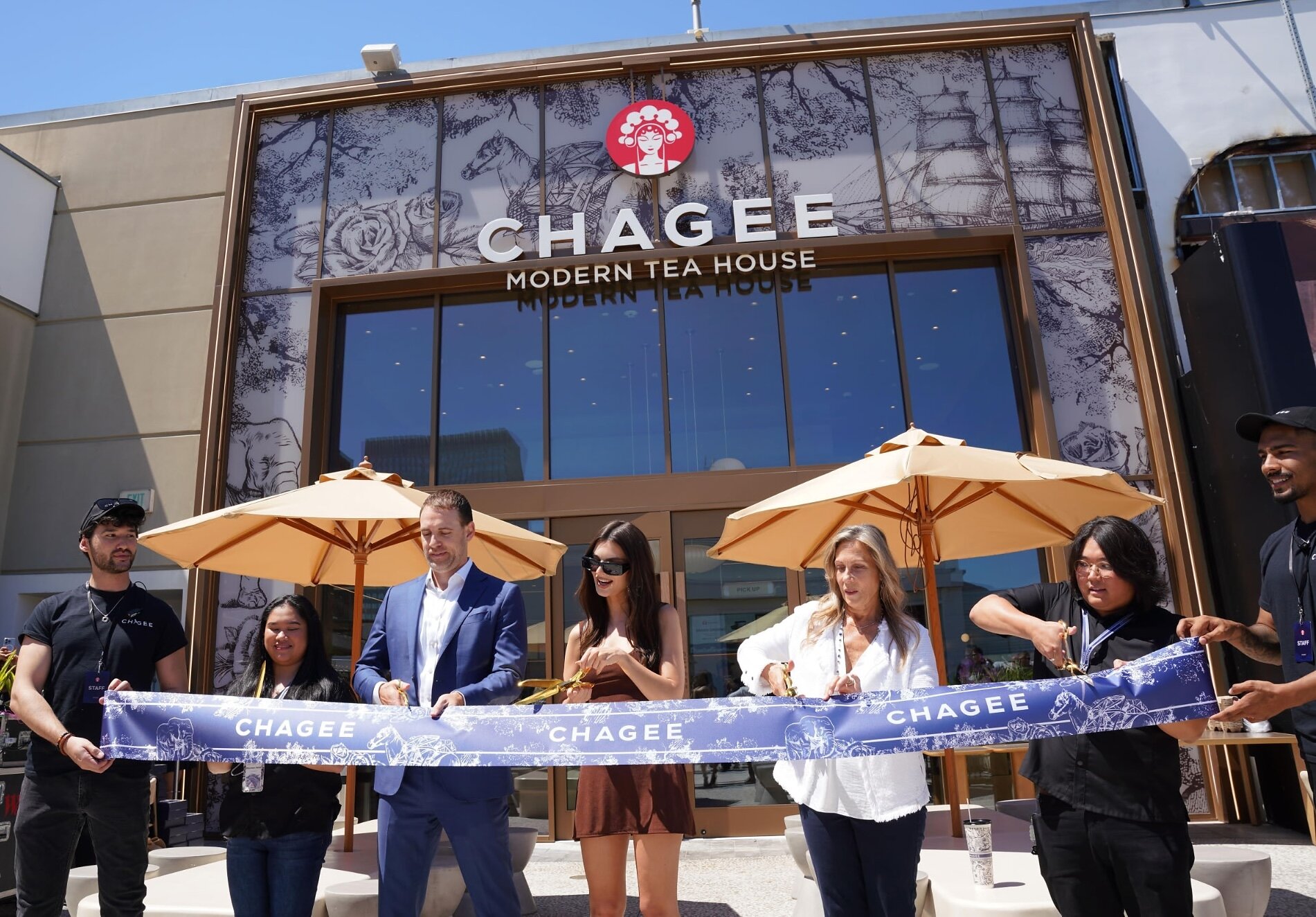
The U.S. operation describes its expansion as company-owned. That gives CHAGEE direct responsibility for the staff, preparation and atmosphere. Its recruiting language stresses hospitality, community and careers, alongside tea heritage. These are promises that become tangible in small encounters: whether an employee can explain the menu, whether the order is right, whether the room feels welcoming after the opening party has gone.
The official locator now reaches beyond the first Los Angeles address, listing places such as Brea, Long Beach, Mission Viejo, Glendale and La Jolla. For customers, that makes the proposition practical: check the nearest teahouse and current menu, then decide whether the visit fits a shopping trip or a meeting with a friend. For CHAGEE, each new neighborhood is another test of whether the same invitation travels.
A bigger chain can have a quieter counter
The global parent’s numbers complicate the cheerful launch story. CHAGEE finished 2024 with 6,440 teahouses and 2025 with 7,453. Yet global same-store gross merchandise value fell 25.5% in the fourth quarter of 2025. GMV measures order value; same-store comparisons examine established locations. More addresses can coexist with less business at the addresses already open.
Year over year, worldwide
Year-end store counts. Same-store GMV is a separate demand measure, not revenue per store.
The warning had appeared earlier: same-store GMV was already down 18.4% in the fourth quarter of 2024. The strain preceded the American flagship. In his March 2026 earnings-call retrospective, founder and CEO Junjie Zhang acknowledged that product launches and marketing had lagged, organizational complexity had slowed execution, and competition had proved tougher than expected. That admission makes the story more useful than a store-opening tally.
“We did not fully keep pace with how fast the market was moving.”
Junjie Zhang / March 2026 earnings call
The response included organizational changes and renewed attention to products and customer experience. The latest reported quarter offers a mixed reading: in Q2 2026, parent revenue rose 2.5%, while global same-store GMV still fell 16.1%. Those results describe the whole group. They cannot establish whether an American teahouse is profitable, or whether a particular California customer has made tea a habit.
What the invitation costs
The parent’s April 2025 Nasdaq IPO raised approximately $472.8 million gross, including the over-allotment. Offering expenses were about $40.3 million, leaving approximately $432.5 million net. That is the cost of raising capital, rather than the cost of opening America. The annual report groups expansion, marketing, technology, products and overseas supply-chain spending together. A beautiful storefront is only the visible portion of the work.
The underlying economics also differ across the business. Globally, CHAGEE earns money supplying ingredients, packaging and equipment to franchisees, collecting related fees, and running its own stores. American company-owned retail puts more of the local operating work directly on CHAGEE. Control over the guest experience comes with responsibility for making the operation pay.
Training is another part of that bill. Training Simplified, a vendor describing its work for CHAGEE, says it localized existing materials and built American onboarding, station checklists and manager training. Treat that as the supplier’s account, but the underlying task is concrete. A global recipe still needs a local employee who can prepare it, explain it and hand it over with confidence. Those details determine what expansion feels like from the other side of the counter.
In April 2026, CHAGEE announced Laufey as its first North American ambassador. The campaign linked a two-latte bundle with chances to attend a private performance. The connection was intelligible: an artist bringing older musical traditions to younger listeners, alongside a brand updating tea’s social setting. Music gave the invitation another reason to exist.
The useful lesson is to make discovery easy, then measure what follows. A signature drink can simplify the first order. A familiar format can reduce hesitation. Neither guarantees repeat demand when budgets tighten, convenience disappoints or the next drink tastes different. CHAGEE’s American opportunity lives in that small interval between trying a cup and deciding to buy another.