Before Junjie Zhang stood at the Nasdaq opening bell, he had worked on both sides of a tea-shop counter. He had been an employee, a regional manager and a franchise partner. Then he took a job at a robotics company. It is an unusually useful set of qualifications for someone proposing to take an old drink around the world: he knew the shop, the shopkeeper and something of the machinery.
CHAGEE, which he founded in 2017, puts tea leaves and milk at the centre of its business. Around that modest proposition, Zhang has assembled thousands of teahouses, automated preparation systems and an international expansion plan. The drink fits in one hand. The organisation required to reproduce it has become rather less portable.
His career offers a way into a question that usually disappears beneath the foam of a successful consumer brand. How does a familiar daily purchase become a habit in another country? Zhang’s answer has involved as much attention to equipment and distribution as to the romance of tea. By June 2026, the network contained 7,639 teahouses. The next task was persuading customers to keep coming back.
A detour through the robotics business
Zhang’s early working life was in the beverage trade. At Yunnan David’s Beverage, he became a regional deputy manager and subsequently a franchise partner. Those roles placed him inside the practical arrangements of a chain: one business, many counters, different people responsible for making the same promise to a customer.
There is a particular education in being a franchise partner. A brand’s decisions arrive as instructions, equipment and supplies; the consequences arrive at your own till. Zhang’s background gave him experience of that relationship before he became the person setting the terms. His later growth through franchised teahouses makes this part of his career especially relevant.
His first beverage jobs included making drinks and cleaning floors. The progression into management matters as much as the modest starting point. In a shop, an instruction has an immediate test: can the person on the next shift carry it out? That experience supplies a concrete background to the business Zhang later built, where preparation must survive the distance between headquarters and a crowded counter.
In July 2015, he joined Shanghai Muye Robotics. He stayed until March 2017, eventually serving as deputy head of the cooperation department with responsibility for Asia Pacific business. His position concerned commercial cooperation. The interesting detail is the movement between industries: a beverage operator spending nearly two years in a company organised around machines.
He founded CHAGEE in June 2017. Its first shop opened in Kunming that November. The chronology places the robotics job immediately before the company he would lead. CHAGEE’s subsequent use of automated equipment gives that detour an appealing relevance, although the machines belong to a larger effort involving suppliers, engineers and store teams.

Two ingredients, a considerable amount of organisation
Tea drinks offer almost unlimited opportunities for addition. Fruit, toppings, textures and seasonal combinations can turn a menu into a small catalogue. Zhang built CHAGEE around a recognisable core: tea brewed from leaves, combined with milk. Jasmine green tea became one of its calling cards.
The Chinese brand name, Bawang Chaji, borrows from Farewell My Concubine, the opera familiar far beyond the tea business. That is a theatrical name for an everyday transaction. It also locates the brand in a cultural tradition before a customer has taken a sip. A takeaway cup can carry more associations than its size would suggest.
The commercial advantage of a concentrated menu becomes clearer behind the counter. Fewer core combinations give a chain fewer processes to reproduce and fewer supplies to coordinate. CHAGEE has worked with partners to develop automated tea-making equipment, aiming to make preparation more consistent across its shops. Repetition, in this business, is a form of hospitality.
Expansion has also required changes to the way shops are owned. In early 2024, CHAGEE ended its existing Singapore franchise arrangements and rebuilt its presence there with company-owned teahouses. By the end of that year, it had six. For a business associated with rapid growth, the reset is a useful detail: Zhang’s company was willing to revisit the arrangements underneath a familiar shopfront.
It is also where Zhang’s career becomes more interesting than a list of openings. He came to the founder’s job having operated within someone else’s beverage system. Now the challenge was to build one that other people could use. A customer might remember the jasmine. A franchise partner must also remember the delivery, the equipment and the instructions.
Paris, with logistics included
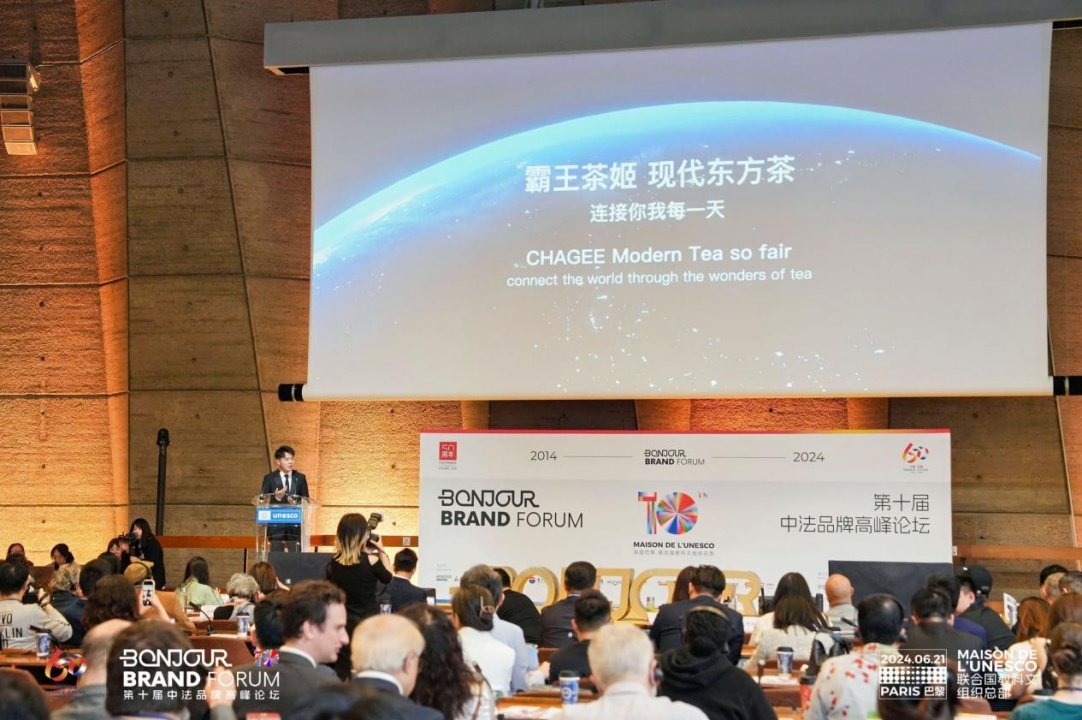
In June 2024, Zhang spoke at the Bonjour Brand Forum at UNESCO’s headquarters in Paris. The setting suited his ambition to give Chinese tea a larger international audience. Guests tasted CHAGEE drinks while the company presented its plans to carry a modern tea-house experience into more countries.
His stated ambition reached well beyond the network then in existence: consumers in more than 100 countries, drinking 15 billion cups a year. Those figures described a future he wanted to build. They also revealed the scale at which he preferred to discuss the business. For Zhang, a tea brand from Yunnan could address the same international audience as a coffee chain.
The revealing part of his Paris speech concerned the less photogenic company required to make that happen. He argued that expansion had to include the industrial chain, covering logistics, design, decoration and dairy suppliers. The people who move the ingredients were part of the international project, alongside the people whose names appear on the cups.
That is a practical qualification to the usual language of cultural exchange. An attractive story can introduce a drink. Deliveries, training and reliable ingredients must sustain it. Zhang’s vision gives tea a diplomatic role, but his account of execution has room for the decidedly undiplomatic problem of getting a store supplied on time.
A seat at a very different table
On August 27, 2024, Zhang joined Haidilao’s board as an independent non-executive director. The hotpot company appointed him to provide supervision and independent judgement. A founder still building his own chain was being asked to help oversee another established restaurant business.
The appointment puts his operating experience into a wider setting. Tea and hotpot have different service rituals, but both involve coordinating ingredients, workers, property and expectations across many locations. Zhang’s career had already taken him from employee to franchise partner to founder. The board seat added another perspective: examining a business whose daily operations he did not run.
His own senior team also complicates the solitary-founder picture. Dengfeng Yin joined CHAGEE in 2019 and became chief operating officer in 2020. Aaron Huang, its chief financial officer, would stand alongside Zhang for the Nasdaq ceremony. By that stage, the founder’s ambition travelled with people responsible for making its operating and financial systems work.
Two American arrivals, nine days apart
On April 17, 2025, CHAGEE began trading on Nasdaq under the ticker CHA. Zhang rang the opening bell with colleagues and supporters. The initial offering priced at $28 per American depositary share and raised approximately $411 million before the later exercise of the underwriters’ option.
“Since founding CHAGEE in 2017, we envisioned creating a global brand.”
Junjie Zhang · April 17, 2025
Nine days later, the company’s first U.S. teahouse opened to the public at Westfield Century City in Los Angeles. Its grand-opening celebration followed in May. One American arrival concerned ownership in the company. The other required someone to order a drink.
The Los Angeles shop supplied a physical version of Zhang’s proposition. There were tea lattes, brewed teas and pastries, with places to sit indoors and on the patio. The surroundings gave tea a place in the social life of a shopping centre. A jasmine-infused cruffin made a small, rather persuasive introduction between the beverage and the bakery counter.
Zhang’s role spans the global parent, Chagee Holdings Limited, where he remains founder, chairman and CEO. The American operation brings that wider business into a new market. For the founder, its significance extends beyond an additional address on the store list: customers encounter the product without needing any prior attachment to the brand’s Chinese history.
Three snapshots of CHAGEE’s teahouses
Global network, including franchised and company-owned teahouses. Bar lengths start at zero.
The return visit is the harder part
By the second quarter of 2026, Zhang was managing a more complicated picture than a rising store count suggests. Overseas gross merchandise value more than doubled from a year earlier. Yet sales at established stores fell in both Greater China and overseas markets. Opening doors and earning repeat business were producing different signals.
Company revenue grew 2.5% year over year. Adjusted net income declined, even as reported net income rose from a comparison period with much higher share-based compensation costs. These distinctions matter because a founder’s story can look quite different depending on which number receives the largest type.
For Zhang, the practical question has returned to the counter. A broader network can put CHAGEE within reach of more customers. It also brings more leases, more teams and more occasions on which the experience has to justify the purchase. An international ambition eventually becomes thousands of local decisions about where to spend an afternoon and buy a drink.
There is something fitting about that return. His route began in the beverage trade, passed through robotics and reached the public markets. The work now asks him to draw on all three. He has described a world drinking billions of cups of tea. Each cup still needs a customer who wants another.
Follow the tea trail
Explore the company, watch Zhang at the opening bell, and read further.
CHAGEE global website ↗CHAGEE in the United States ↗Watch the Nasdaq opening bell ↗Leadership and career biography ↗The Paris forum ↗Inside the Los Angeles teahouse ↗CHAGEE’s August 2026 results ↗CHAGEE on LinkedIn ↗CHAGEE USA on LinkedIn ↗CHAGEE on Instagram ↗