At LISCR, a maritime registry, the trouble was in the handoffs. Different departments handled customer requests in different ways. Support work scattered. Replies slowed. An organization concerned with ships moving around the world had an altogether more familiar problem: getting a request to move cleanly across an office.
- Maganti builds and modernizes business software, then helps operate it.
- Its customer examples connect sensors, ships, and sensitive financial documents.
- The practical lesson: fix the workflow before celebrating the new technology.
Maganti IT Resources rebuilt that service process around Salesforce. Email became a case automatically. External maritime tools connected through APIs. Managers received dashboards suited to their responsibilities. Maganti reports 60% faster case resolution and 40% lower licensing costs. Those are vendor-reported results, but the work behind them is concrete: fewer departmental detours, clearer access, and a shared view of the queue.
This is a useful place to meet Maganti. The company sells software engineering, cloud services, AI work, and technical staffing. Its more interesting proposition concerns what happens between those categories, where a perfectly capable application can become part of a thoroughly confusing business process.
A sensor maker’s bill for complexity
Consider FUTEK, the sensor manufacturer featured in Maganti’s modernization material. Its problem was an aging technology environment and the difficulty of improving digital commerce while keeping existing operations alive. Changing the system could not become a reason for the business to stop.
Maganti’s account describes process mapping, a system assessment, a proof of concept, and migration to Microsoft Azure. The engagement continued into environment management, automated software delivery, monitoring, backups, and recovery planning. The sequence matters. First understand the machinery. Then change it. Then accept responsibility for keeping it working.
The case describes unclear processes producing cascading failures. That is the revealing detail. A slow server is an engineering problem; an unclear process can become everybody’s problem. The reported 42% reduction in failures needing human intervention suggests why a buyer might care as much about fewer interruptions as about a new interface.
The cost figures belong in that same frame. A reduction in total ownership cost measures the burden of running an environment. It is different from the price of hiring Maganti. A sensible buyer would compare migration effort, ongoing support, and internal time alongside the promised savings.
The business after the build
Maganti operates across several buying decisions. A customer can commission an application, seek help with a cloud estate, add a specialist to an existing team, or engage a project team. Its staffing menu includes contract, contract-to-hire, and direct hiring. Consulting can sit under a statement of work with defined deliverables.
This makes it a services business whose relationships can extend beyond a launch. The cloud practice covers Azure, AWS, Google Cloud, and Databricks. The custom-development practice describes work in reviewable eight-to-twelve-week phases. Buyers are choosing engineering capacity, delivery responsibility, and operating support in combinations that suit the job.
decision owners
reviewable releases
continuous care
Public-sector purchasing adds another route. Texas lists Maganti’s DIR-CPO-6260 contract, beginning in June 2026, for services including application work, data and analytics, assessments, and project management. It is a way for eligible organizations to procure work. Being listed does not mean an order has arrived.
Its stated market focus is mid-market manufacturers and regulated enterprises. That puts it among engineering consultancies, managed-service firms, and staffing providers. A buyer with an awkward legacy estate may value that breadth. A buyer whose requirements fit an ordinary packaged application may have little reason to commission custom work.
That choice also changes what a customer should ask to see. A staffing buyer needs evidence that a candidate can do the work. A project buyer needs agreement on the result, acceptance criteria, and responsibility for integration. A managed-services buyer needs to understand who notices a problem and who responds. Maganti offers all three formats; the useful comparison is the particular engagement, rather than the length of the service menu.
Give the fast code somewhere to go
The AI example is similarly specific. For an unnamed wealth-management institution, Maganti describes a system that extracts information and removes personal identifiers from documents and images. It combines entity recognition, rules, and contextual models. The useful unit of progress is a document that can move through a workflow with less manual redaction.
In July 2026, co-founder Sushma Maganti wrote about a related trap: faster coding without more predictable delivery. Her recommendations include measuring review time, increasing review capacity, and treating “AI-generated code as draft material.” That last phrase is refreshingly useful. A draft still needs somebody to take responsibility for it.
The second person who understands the system may be as valuable as the first.
An editorial takeaway from Maganti’s continuity model
The reader can copy the measurement habit immediately. Track how long work waits for review and how long it takes to reach production. A faster coding tool cannot settle disputed requirements or assign an absent decision-maker. Without those agreements, an engineering engagement can accumulate unfinished decisions as quickly as unfinished code.
People who remember how it works
Prasad and Sushma Maganti appear as founder and co-founder in the company’s leadership history. The firm began in 2004 and added India operations in 2012. Today it describes US and India delivery teams, with shadowing and shared knowledge intended to keep an engagement from depending on one person.
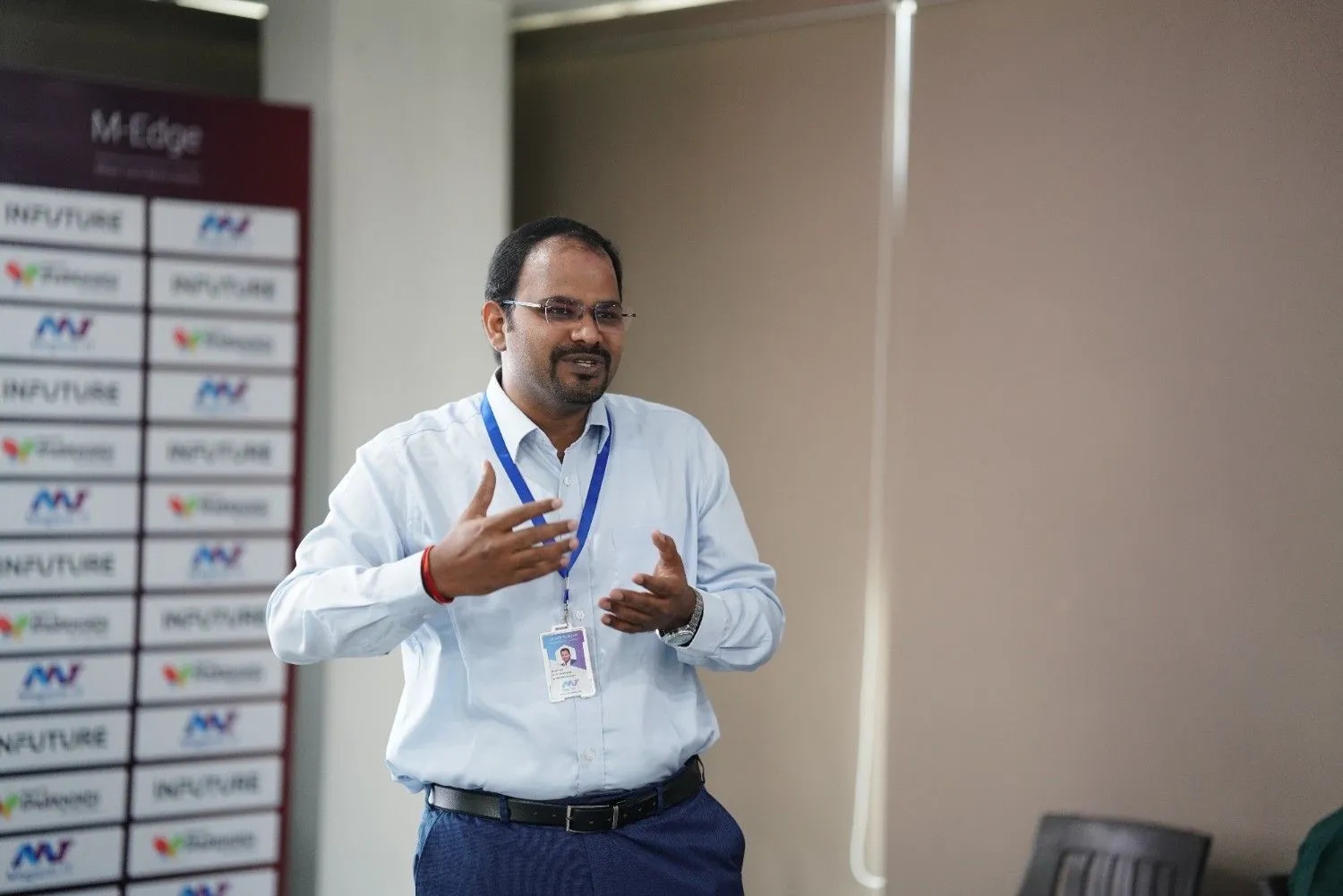
There is a people-development side to the story, too. M-Edge offers practical technology workshops for students. The corporate-giving program describes volunteer involvement and matching employee contributions. In 2024, Sushma received an Enterprising Women of the Year award, a documented recognition alongside the company’s own account of its growth.
None of this makes a difficult migration easy. It does suggest a useful question to bring to the next vendor meeting: who will remember why the system works this way after the original engineer leaves? Software buyers spend plenty of time asking what a team can build. Maganti’s proposition gives them a reason to ask what that team can keep working.
Continuity is especially relevant when work crosses organizational and geographic boundaries. An instruction that seems obvious to one team can become an unanswered question for another. Shared documentation, a second engineer familiar with the application, and named decision owners give that question somewhere to land. These are ordinary practices, which is part of their appeal. They are also practices a customer can ask a prospective partner to demonstrate before handing over a critical system.