The revealing detail in LYRICS’s business description is a tour. A study tour, to be precise. It sits beside training, consulting, and incubation, a curious little cluster of services. One takes people out to look. Another helps them learn. A third offers advice. A fourth concerns the development of young businesses. Read together, they suggest a company interested in the distance between encountering an idea and doing something useful with it.
- LYRICS’s listed specialties connect business learning with consulting and incubation.
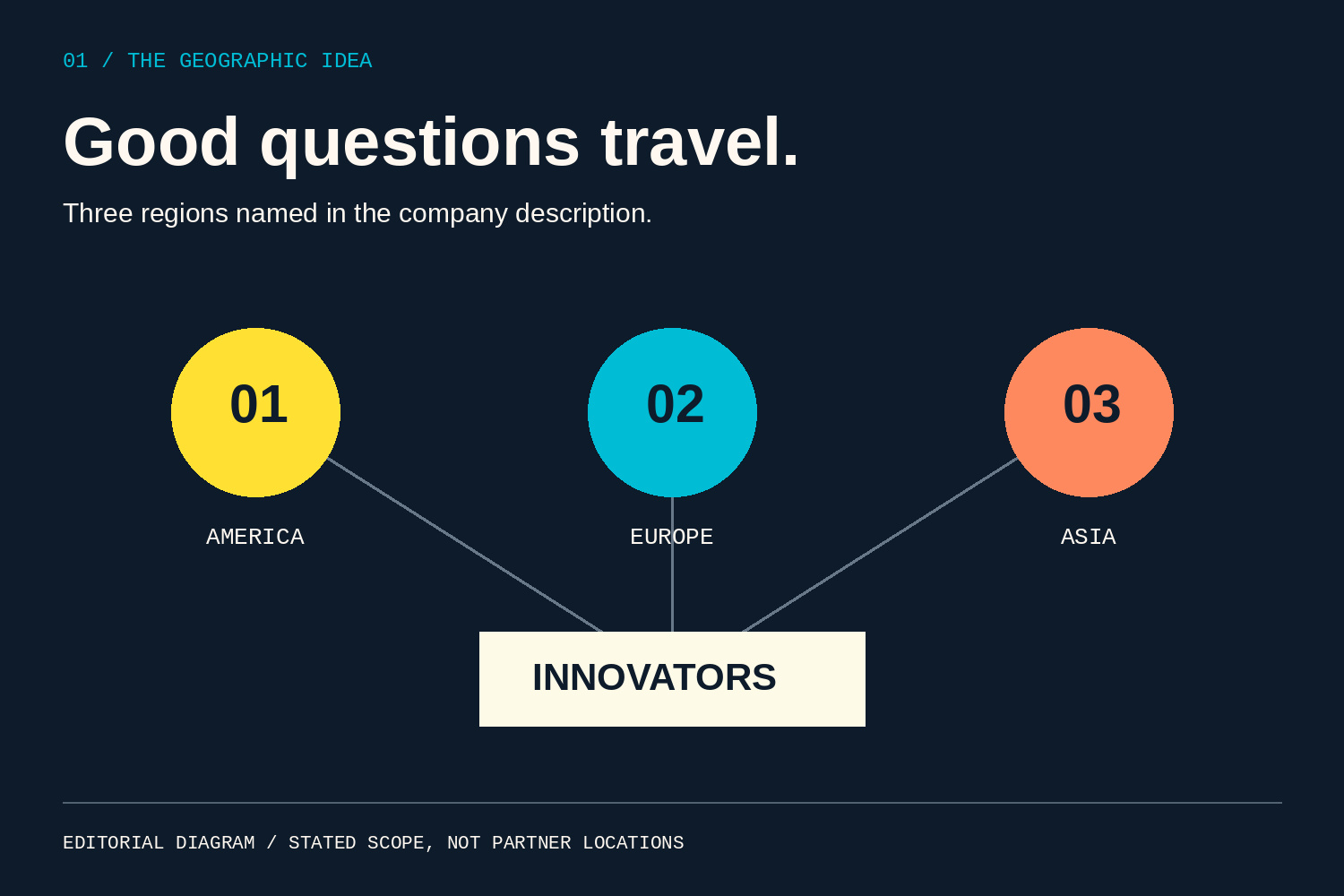
- Its stated innovation search spans America, Europe, and Asia.
- The practical question for a buyer: which decision should this experience improve?
The tour is the clue
LYRICS is a management consulting business based in Sunnyvale, California. Its company description presents a group with business experience and an interest in finding promising innovators. The geography is broad: relationships with incubators and funds across America, Europe, and Asia. Those are the company’s stated ambitions and connections. They give its otherwise familiar service list a particular emphasis: learning across organizational and geographic boundaries.
The study tour makes that emphasis tangible. Training can happen in a classroom. Consulting can arrive as advice. A tour introduces a different possibility: going somewhere to examine how other people work. That distinction matters when reading LYRICS’s positioning. The visit belongs alongside the other services, even though the list alone does not establish that they are sold together or delivered in a prescribed sequence.
Consider the question a prospective buyer might bring. How does another business choose which ideas deserve attention? A presentation can describe a policy. A conversation can probe the awkward exceptions. The appeal of a business visit is the chance to ask a second question, and then a third. That is an argument for the service category, rather than a claim about a particular LYRICS engagement.
A bridge with three shores
The company’s international description introduces two different kinds of counterpart: incubators and funds. Incubation concerns the development of a business; a fund brings an investment perspective. LYRICS places both within its search for innovators. The interesting implication is that business learning and startup discovery might share some of the same conversations, even when the people entering those conversations want different things.
A management team might want exposure to unfamiliar business practices. An innovator might want guidance while developing an enterprise. These are plausible audiences inferred from LYRICS’s services, rather than a roster of its clients. Keeping the distinction clear makes the business easier to understand: its positioning addresses several adjacent needs, without making every participant a customer of every service.
The human work behind that mix appears in public professional listings, too: Yue Zhang is listed in program and operations management, and Catherine Li in assistant project management. Read as historical professional associations, those roles offer a modest but concrete clue about the expertise involved. Programs need coordination. Projects need someone to keep the moving parts moving. A buyer evaluating this service mix should ask who handles preparation, who delivers the substantive work, and who remains responsible afterward. The quality of those handoffs belongs in the buying decision alongside the subject matter and the people a team hopes to meet.
That places LYRICS near several markets at once. There is the educational question of what a team needs to learn, the consulting question of which problem deserves attention, and the incubation question of how a young business should develop. Its distinctive feature is the combination. The service list invites a buyer to consider the connections among those needs, rather than evaluating a visit entirely by its itinerary.
A photograph proves you visited. A useful experiment shows what you learned.
The buyer’s test · editorial perspective
Buy the question before the itinerary
For someone considering this kind of consultancy, a sensible starting point is a decision. Write it down before discussing destinations. Perhaps the team is deciding whether to explore a new market or change a training practice. The example is hypothetical; the discipline is practical. A clear decision gives the organizer something concrete to work toward and gives the buyer a basis for judging relevance.
Then separate the work into understandable pieces. Which part is training? Which part is advice? What does a study tour include? What does incubation mean for the business receiving support? LYRICS’s listed services make those useful questions to ask. Treating the words as distinct commitments helps a buyer compare proposals from consultancies, executive education providers, tour organizers, or startup support programs.
The same discipline applies to cost. Evaluate a proposal against its actual scope: preparation, delivery, travel where relevant, and any follow-up work. Those are budgeting considerations for a prospective engagement, not a statement of LYRICS’s charges. The useful comparison is what each quoted service would accomplish for the decision at hand. A crowded calendar of meetings is a poor substitute for an agreed purpose.
the decision
the constraints
a small test
What travels home
There is a trap in learning from an interesting company: copying what is visible while overlooking what makes it possible. Ask what the practice requires. Does it depend on particular skills, a certain customer relationship, or an unusual budget? Those questions help distinguish an attractive example from a usable one. They also give training and consulting a purpose beyond introducing people to something new.
Access alone would be a weak purchase for a team that cannot name its problem or commit resources to follow through. A visit can still be enjoyable, but enjoyment answers a different brief. For a business seeking change, the useful next step is smaller and more specific: choose one observation, describe why it might apply, and decide how to test that belief.
That is the reading of LYRICS worth carrying away. Its combination of tours, training, consulting, and incubation points toward a problem buyers can recognize: making outside experience relevant to their own work. The company’s service mix starts the conversation. The buyer should finish the brief. Before asking who will be in the room, decide what you need to understand when you leave it.