A tomato is a stubborn audience for a technology pitch. It cannot be impressed by a funding round, and it has little use for a presentation about the future. In Shintaro Matsumoto’s career, tomatoes have supplied something rather more valuable: a place where an idea has to work.
Years before he became president and CEO of NEC X in Palo Alto, Matsumoto helped launch CropScope, NEC’s agricultural technology business. Later, the two parts of his working life met. NEC X invested in Verdi in May 2024, and the startup collaborated with CropScope on a processing-tomato pilot in Portugal. Asked about a favorite memory of his work, he chose that connection.
It is an unusually tangible answer from a venture studio executive. There is a startup, a platform he helped bring into existence, and a crop growing somewhere beyond the conference room. The distance between those things is much of his professional story.
A working life with several translations
Matsumoto joined NEC in 2001. He began in software development, then worked in marketing, international partner alliances and business strategy. In 2015, he moved into agricultural business development. By June 2023, he was leading NEC X in Silicon Valley.
Read as a list, the career looks like a series of transfers. Read through the work, it follows a recurring difficulty: people with different kinds of expertise need to understand one another well enough to build something together. A software developer, a commercial partner and an entrepreneur can agree that a product is promising while meaning quite different things by the word.
His education was at Yokohama National University. His public professional profile also records technical certifications, including ORACLE MASTER gold. Those details give the business-development career an engineering beginning. Before the job involved choosing which ventures to support, it involved the systems underneath the proposition.
That background makes his current role a meeting place for several professions. NEC X works with founders, researchers, engineers, mentors and investors. Each brings a useful concern. Each can also bring a vocabulary that needs a little unpacking before anyone gets to the customer.
What the field would accept
CropScope connects agricultural advice with information from the field. NEC and Kagome’s joint venture, DXAS Agricultural Technology, began business in Portugal in September 2022. Matsumoto participated in its establishment and also serves as an external director.
The partnership puts two kinds of experience in the same business: NEC’s technical resources and Kagome’s knowledge of tomato cultivation. Its work includes AI farming advice and irrigation control. Here, usefulness can be measured in something more concrete than enthusiasm for a demonstration.
In a Portuguese demonstration reported in October 2022, CropScope-supported cultivation produced about 20 percent more yield with about 15 percent less irrigation than a comparison field without the system. The comparison belongs to that particular trial. It is a result worth keeping at its actual scale, rather than promoting into a promise about every farm.
Approximate yield increase
Approximate irrigation reduction
Compared with a field without CropScope. Results describe this demonstration, not a universal outcome.
Agricultural technology provides a sharp test of collaboration. Advice has to arrive in a form that can be acted on. Sensors and models belong to the process, alongside the experience of the people tending the crop. A useful calculation must eventually become a useful decision.
Verdi brought another route into that practical work. Its farm-automation platform joined Elev X! Boost, the NEC X program for startups preparing to scale. The CropScope connection gave Matsumoto’s earlier agricultural work a second life inside the portfolio he now helped oversee. A career does occasionally produce a pleasing piece of symmetry.
The room in Mountain View
On September 14, 2023, Matsumoto presented NEC X’s direction at the FutureFusion Forum in Mountain View. NEC X was marking its fifth anniversary. He had been CEO for only a few months.
More than 250 people attended the day-long gathering at the Hyatt Centric, including entrepreneurs, investors, academics and corporate leaders. The conference room was packed, with standing room only. MIT figures Aude Oliva and John Carrier were among the speakers, alongside startup and diplomatic representatives.
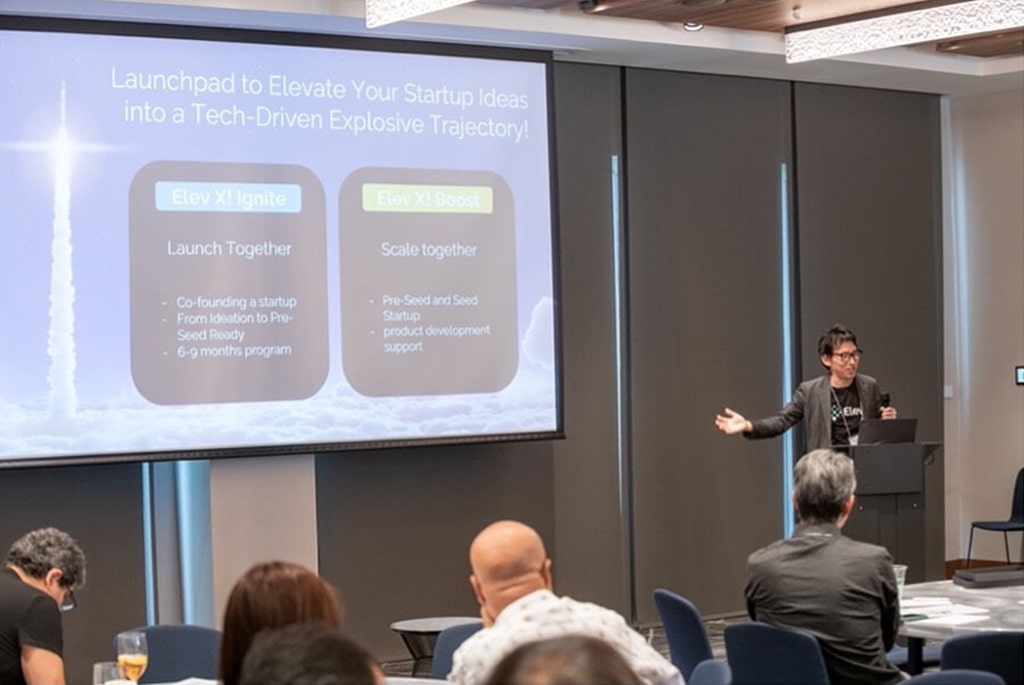
There were startup pitches, too. Matsumoto described the questions those pitches attracted and the networking that followed. The gathering gave a public setting to a change in how NEC X described its work: more attention to entrepreneurs, with the research resources arranged around their businesses.
The photograph captures a familiar conference-room scene. Its importance lies in what he was introducing. Elev X! brought the studio’s approach into two tracks, Ignite and Boost. The words are energetic; the underlying distinction is practical. Beginning a business and helping an existing one grow require different kinds of assistance.
Let the problem come first
NEC X began in 2018 with an approach that started inside the corporation. Technology and business ideas emerging from NEC would be matched with entrepreneurs who could commercialize them. Matsumoto has described the limits of that model, even while acknowledging its early successes.
The revised approach gave founders’ own visions and industry problems more room. NEC technology could help answer a need, and external technology could play a part as well. That change puts a demanding question earlier in the conversation: what, precisely, is the business trying to solve?
NEC technology
Find a founder to commercialize it
Founder + customer problem
Bring in technology and support
Ignite supports early-stage founders through discovery, validation and the work of bringing a business to market. Boost works with seed-stage businesses through a tailored combination of partnerships, technical resources and commercialization support. The structure recognizes that a company’s needs change as it develops.
In 2025, the Elev X! Venture Studio Program won the Best Tech Incubator/Accelerator category at the Global Business Tech Awards. An award is a public milestone. The underlying work remains more granular: making a useful connection, shaping a product, finding out whether a customer actually needs it.
Listening is part of the selection
Matsumoto pays particular attention to how founders learn. An initial idea may change within months. He wants entrepreneurs who can absorb advice, keep their own judgment and continue working when the direction shifts.
That is a more interesting test than simple agreeableness. A founder who accepts every suggestion can end up with a business assembled by committee. Someone who rejects every suggestion can make a very efficient job of remaining wrong. The useful space between those habits takes judgment.
Matsumoto has also admitted to a small failure of judgment himself. When a colleague joined after graduate school, he assumed she was much younger than he was. Discovering otherwise made him reconsider his assumptions. It is a modest anecdote, and a revealing one for a person whose work includes evaluating people.
“well-intentioned busybody”
Matsumoto’s description of himself
His chosen description suggests an appetite for helping that does not always wait politely on the sidelines. He has emphasized trust and candid communication in work across organizations. Those are useful qualities when supporting a founder means entering a project that already belongs, emotionally and practically, to somebody else.
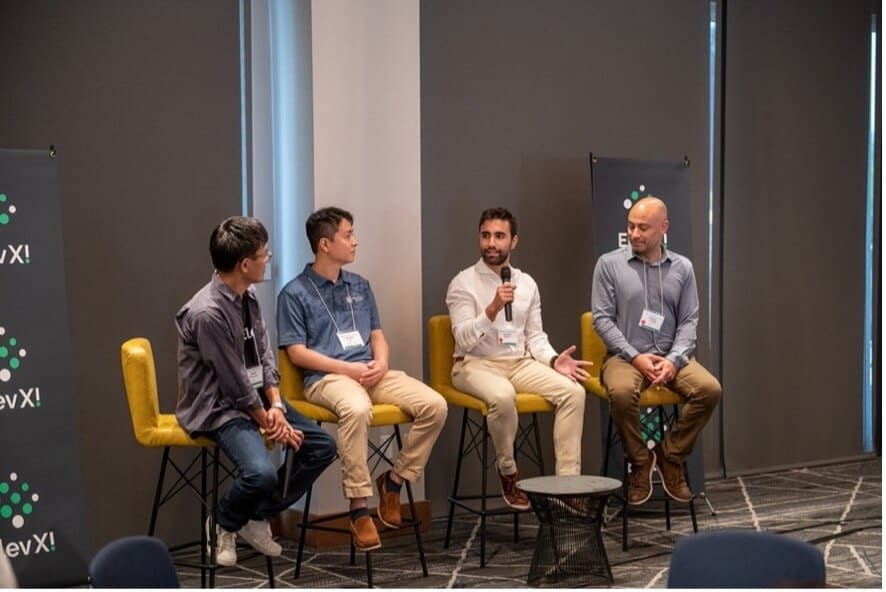
The job also puts him among people with whom learning goes both ways. With NEC X’s Naoto Mizuguchi, he presented the studio’s evolution in a Stanford Graduate School of Business class invited by Charles O’Reilly. Matsumoto’s account dwelled on the students’ questions and what he learned from the exchange.
The next question for AI
Matsumoto’s recent public comments return to the practical conditions surrounding technology. In December 2025, he discussed agricultural compliance and traceability, including AgriAssure’s work on navigating different regulatory systems.
For smaller producers, moving between countries’ requirements can be a substantial burden. His discussion placed AI alongside the tasks of organizing information, handling data responsibly and making cross-border work easier. It is another agricultural problem whose usefulness depends on the details.
In NEC X’s January 2026 outlook, he turned to AI agents: how they are designed, where companies deploy them and how far they should receive authority to make decisions. He emphasized security, governance and identity management as those systems become part of organizational work.
He also pointed to a difficulty that should sound familiar to anyone translating between professions: the knowledge people carry from experience is not always easy to model. A system can have access to information and still face a hard task in reproducing the judgment used on the ground.
These are his expectations for technology’s development, rather than finished outcomes. They put his attention on implementation: the permissions, expertise and working relationships around a product. A company has to decide where an AI system belongs before it can judge how much to trust it there.
A useful thing, in somebody else’s hands
NEC X’s connections stretch from Silicon Valley to NEC’s research network and beyond. Matsumoto’s own working life includes Japan, the agricultural collaboration in Portugal and the founders he supports from Palo Alto. The value of those connections depends on what people can do with them.
His aspirations are tied to helping entrepreneurs build businesses with practical value and reach new markets. That leaves room for a great deal of ambition, but it also supplies an everyday test. Somewhere, someone has to use the thing.
The tomato connection is worth returning to because it keeps the story honest. CropScope was earlier work. Verdi was another team’s opportunity. Bringing them together let an old investment of effort become useful again. For an executive who calls himself a busybody, that seems a rather good reason to stay involved.
Follow the work
Interviews, firsthand reflections and the programs behind the story.
- Shintaro Matsumoto on LinkedIn ↗
- NEC X: company website ↗
- Explore Elev X! ↗
- The venture studio interview, February 2025 ↗
- Matsumoto on founders and farming (Japanese) ↗
- His account of FutureFusion Forum ↗
- NEC X’s 2026 technology outlook ↗
- NEC X on X (company account) ↗
- NEC X on Facebook (company account) ↗