Ten people. In 2011, that was the proposition behind zuluMe, the private mobile network Lynda Brown-Ganzert was running in Vancouver. While a swelling friend count could turn an ordinary social profile into a small municipal directory, she was interested in the people who actually belonged in your day. Ten friends, relatives or colleagues. A manageable circle. Even a dinner party has its limits.
The number makes an appealing doorway into her career. Brown-Ganzert now leads RxPx, following the merger of Curatio, the company she founded, and RxMx in 2022. Her work has expanded across borders and institutions. Yet that earlier interest in a useful connection remains a good way to understand the person behind the title. A network can grow enormous while the reason to use it stays intensely particular.
A computer, a prize, a first business
Brown-Ganzert was born in Powell River, British Columbia. The early signs of her interests were delightfully unambiguous. In her account for a guide to careers in information technology, she recalled winning a calculator at a Grade 4 school fair, then a prize for explaining how computers work in Grade 8. Entrepreneurship class suited her considerably better than physics. School subjects sometimes provide a rather frank performance review.
She started her first business at fourteen. That fact has survived into her later accounts of her career, but the childhood prizes supply something more revealing than precocity. They show a young person drawn to both the machinery and what she could do with it. The technical interest and the entrepreneurial interest arrived together; neither had to wait politely for the other to finish.
Her own explanation gives each parent a place in the story. Her father encouraged her enthusiasm for technology. Her mother modeled community building and bringing people together. That is a more domestic beginning than the usual founder mythology allows. No solitary genius is required. A household can contain both a fascination with computers and a practical education in making people feel included.
“I don’t know how to do this, but I can figure it out”.
Lynda Brown-Ganzert, on the growth mindset she values
She later earned undergraduate and graduate degrees at Simon Fraser University, including a Master of Education. Communications and education make a useful pairing for someone whose work keeps asking what happens between a person and a screen. They also suggest why design and participation would matter to her alongside the underlying technology.
Building somewhere for an industry to gather
Before Curatio, Brown-Ganzert founded GoBe Media, which made games for children across platforms. She also worked in senior roles at Electronic Arts, Edelman and Nordicity. Those names span games, communications and consulting. Together they describe a career spent moving between the people who make digital products, the people who explain them, and the organizations trying to work out where a new market is going.
At New Media BC, she helped an industry organize itself. She was also the founding president of the Canadian Interactive Alliance, bringing provincial associations together for national advocacy. There is an obvious family resemblance between that work and a private network: first establish who needs to be connected, then build a structure in which they can do something together.
The Centre for Digital Media gave that impulse a physical address and an educational purpose. Brown-Ganzert helped develop its business plan and secure approximately $40 million in provincial backing. The centre opened in 2007, home to Canada’s first Master of Digital Media program. Making a new graduate program possible involves a different kind of building from shipping an app. The result outlasts a release cycle.
She would return to that educational setting as visiting or sessional faculty. Her work also included a national trade action plan for digital media and representing Canada on two United Nations missions. This is the less photogenic part of a technology career: associations, plans, teaching and policy. It helps explain how someone can build companies while also working on the conditions that let other companies exist.
There is a practical generosity in that choice of assignments. An industry needs places to teach its next recruits, ways to speak collectively and people willing to translate its interests for government. Such work rarely fits neatly into a product demonstration. Brown-Ganzert made it a recurring part of her professional life.
The boutique social network
Then there was zuluMe. Released for Apple mobile devices in June 2011, it offered a visual, private way to keep a small group informed. Brown-Ganzert described it as a “boutique option for social networking”. The phrase suits the scale: fewer people, more relevance, less rummaging through an overstuffed address book.
The app’s features included sharing pictures and locations. Her example was wonderfully ordinary: a photograph from a child’s first day of preschool reaching grandparents. That is a useful corrective to the grand language surrounding new technology. A product may involve sophisticated engineering and still earn its place through an event that matters to one family.
Look at zuluMe alongside GoBe and the institutional work, and the continuity becomes easier to see. Children, relatives, colleagues and industry members are different audiences. Each gives a designer a similar problem: how to make participation feel worthwhile. A connection needs some reason to persist after the first introduction. Otherwise, the software has merely arranged a very elaborate exchange of business cards.
Accepting help is part of the job
Curatio began in 2013. In the following year, the company turned to the National Research Council’s Industrial Research Assistance Program. Early support covered product usability, functionality and hiring young graduates. Later work addressed product strategy, intellectual property and international opportunities. Growth involved a succession of specific problems, each requiring a different conversation.
That record supplies a useful counterweight to the image of the founder who carries every answer in her pocket. Brown-Ganzert sought advice on explaining the company’s value and understanding its market. Relationships with researchers, potential partners and investors became part of the business’s development. Asking for help appears here as ordinary operating practice.
The international work was similarly concrete: understanding another country’s business landscape, preparing for meetings, finding the right distribution relationships. The glamorous word is expansion. Much of the work consists of preparation. A passport can get a founder into a country; it cannot explain whom she should meet when she arrives.
In October 2019, Curatio received a $250,000 investment through VentureClash at Yale. More than 300 companies had entered the competition; eight received investments. The amount was capital for a business, with an added vote of confidence from people outside its home market. It also offered a very tangible answer to the question of whether the work was traveling.
Two companies, one working week
The 2022 combination brought a different problem: how to make two established teams function together. Brown-Ganzert has described the experience as a “blended family”. It is a useful comparison because it acknowledges the attachments people already have. Both groups arrived with their own beginnings and commitments. A new name could not do all the integrating.
Her answer included a regular meeting rhythm and shared values: accountability, growth mindset, compassion and measurement. Daily huddles and monthly gatherings supplied repeated opportunities to stay connected. Games brought another sort of contact. Employees suggested having birthdays off, and the company adopted the idea. It is a pleasingly specific benefit, requiring no inspirational poster.
That combination of routine and individual attention makes sense for a remote organization. People need dependable ways to work together, alongside evidence that someone has noticed their particular lives. The ten-person network had become a larger organizational challenge. The question of how to maintain meaningful contact had followed her into management.
The boardroom and the ski hill
Brown-Ganzert’s public service extended to chairing Simon Fraser University’s board of governors; she holds the title of chair emerita. In June 2015, she was appointed to the Canada Foundation for Innovation’s board. Her other board work has included Emily Carr University and the Information Technology Association of Canada. The settings vary, but education, design and the digital economy keep meeting in her calendar.
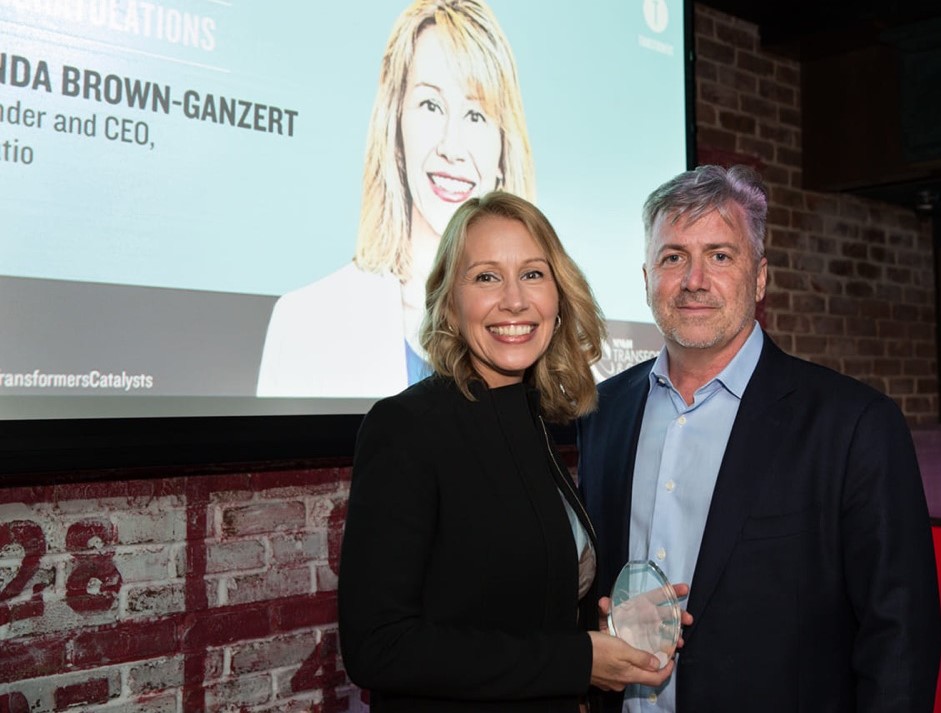
Recognition has followed that mixture of entrepreneurship and community work. She was among Business in Vancouver’s Influential Women in Business honourees in 2023. In 2025, Women Leaders in Pharma named her the recipient of its Excellence in Leadership award. Awards mark particular moments; the longer record shows how much of her career has involved work alongside other people.
Her interests outside work offer a welcome change of altitude. In a 2017 interview, her bucket list included learning another language through immersion and surfing inside a wave. Her happy places included beaches, mountains and exploring cities on foot. A later profile placed her on the ski hill, trying to keep up with her children. Family recreation has its own demanding performance metrics.
Asked whom she would choose for lunch, she named the late Canadian digital-media figure McLean Greaves, whose thinking had expanded her sense of what was possible. It was a revealing answer: another person, another conversation, another opening of the imagination. She also joked that, as an early-stage CEO, she rarely had lunch. Even a connector occasionally needs a sandwich.
Her next public stop includes Vancouver’s Futureproof Festival of AI, scheduled for October 28-30, 2026. The technology under discussion has changed since the days of the calculator prize. Her recurring subject remains familiar: what people can make possible together. Somewhere between the school fair, the graduate program and the remote team sits that small circle of ten, still asking a useful question about who belongs in it.