Look at the bottom of Pub’s demonstration video. There is a Facebook share button, another share button, a copy-link button, and then a small turquoise invitation: License. A woman holds a red balloon against a green mountainside. The scenery does its job. But the interesting part of the picture is that last control. Pub had given a potential customer somewhere to go.
- Pub built tools for creators and media companies to license video.
- Its bet: put the transaction beside the content people already watch.
- Founder Jon Ward says it raised about $200,000 before eventually closing.
Consider the distinction between liking a video and wanting to use it. A viewer can share enthusiasm in seconds. A publisher needs permission. The same picture can produce two very different journeys. Pub’s proposition was to shorten the second one. The company, founded in Austin in 2017, occupied a small but consequential space between seeing something useful and being able to buy the right to use it.
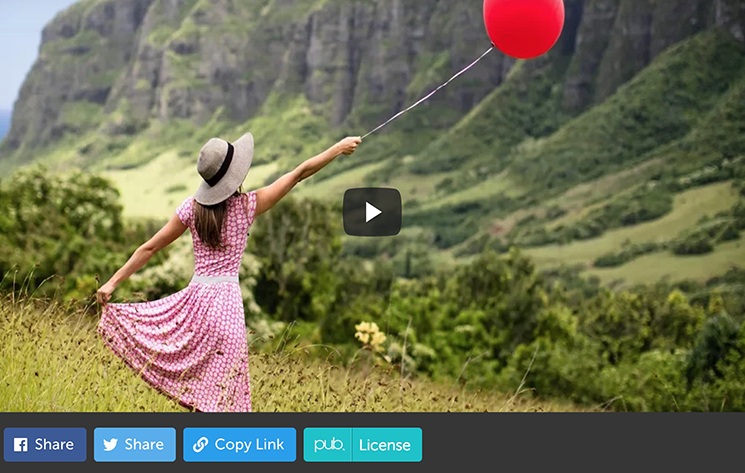
The sale hiding beside the share
In its January 2019 product announcement, Pub said it had spoken with more than 1,000 creators and media companies. It reported that nearly 80% of licensing inquiries went unattended or uncompleted, while successful negotiations could stretch to six months. These were the company’s findings, rather than independently measured industry benchmarks.
There is a useful product question inside those numbers: what, exactly, is being lost? An unanswered request is not necessarily a sale waiting to happen. The buyer might have an unsuitable budget. The owner might dislike the proposed use. But an inquiry that never reaches a decision cannot teach either side much. Pub treated that neglected moment as a place to build software.
Its mission, as described on its company profile, was to simplify video licensing and make creators’ work available to license anywhere. Read “anywhere” as a design ambition. The appealing move was to meet prospective buyers where the video had already caught their attention. Sending everyone on a fresh search would ask them to discover the same thing twice.
- 01WatchFind the video
- 02LicenseFollow the control
- 03ApproveOwner clears buyer
- 04ChooseSpecify the use
A small button with a long form behind it
The launch described YouTube and JW Player integrations, individual video links, owner approval of licensees, and a required Pub account. Owners could configure more than 15,000 license permutations per video. Clip licensing let them set per-second prices while buyers selected an excerpt.
That combination explains the customer more clearly than the word “entertainment.” Pub was addressing the person who controlled footage and the person who wanted permission to publish it. Its place in the market was licensing infrastructure: the machinery around a commercial exchange. The product was useful only if those two people could reach terms that made sense to both.
Take a hypothetical buyer who wants twelve seconds for a particular distribution channel. A full-length video offered under one broad price may be an awkward fit. A configurable license can make the request more precise. It also gives the seller more decisions to prepare. Simplicity at the button depends on somebody doing the complicated work behind it.
“We made a license button that can be placed anywhere.”Pub, January 2019
The contrast with a destination catalog is instructive. A catalog asks buyers to begin their search inside a collection. Pub’s button approach let discovery begin with a video already in circulation. That is a distinction in the proposed journey, not proof of superior sales. For an owner with interested viewers, the placement could matter. Without interested buyers, a purchase control would have very little to do.
The number on the other side of the screen
Then there was the company’s own purchasing problem: it needed capital. In a later public reflection, founder Jon Ward said Pub had raised about $200,000, built a product, acquired customers, and achieved only limited traction. He recalled pitching an accelerator three times. After it ultimately declined to include Pub, he said, the company shut down about four months later.
Enough to build a product and win customers. The company still closed.
That figure describes money raised. It is not a development invoice, a customer price, or a complete accounting of the venture. Treating it as any of those would turn a revealing number into a misleading one. What makes the account striking is the sequence: working product, some demand, another attempt at financing, and then closure.

Ward believed accelerator money would have bought at least another year. That is his counterfactual, not an alternate history we can verify. His account supports a narrower conclusion: the company stopped before it had secured the funding and commercial momentum needed to continue. It does not establish that a particular feature failed, or that another year would have produced a sustainable business.
For a team considering similar software, I would separate three tests: can the owner describe the rights clearly, can the buyer find a suitable offer, and will the exchange earn enough to justify operating it? Those questions turn the button from a pleasing interface detail into a business experiment. Passing the first two would still leave the third open. Pub’s combination of a product and limited traction makes that distinction particularly worth examining.
Copy the placement. Test the transaction.
The practical lesson I take from Pub is to put the next commercial step beside the thing that creates interest. A creator could make availability clear and explain how to request a defined use. A software team could test whether that change produces qualified inquiries before building an elaborate licensing system. The measurement that matters is a completed, worthwhile transaction.
The conditions matter, too. This approach needs owners able to grant the requested rights, buyers with a reason to pay, and terms both sides can accept. It will struggle when every request requires a fresh negotiation or when attention never becomes purchasing intent. Pub’s story leaves a useful question for anyone designing a marketplace: after you make the button easier to find, what will make people finish the deal?