Before there was GigFinesse, there was an unanswered email. Mir Hwang was touring Canada with his band, trying to persuade venues to book them. Then he began writing under a fictitious booking agent’s name. Replies arrived. The musicians had acquired neither new songs nor better instruments. They had acquired someone who appeared to vouch for them. A small deception had exposed a respectable business problem: talent was available; confidence was harder to arrange.
- The job: curate and run live entertainment for hospitality venues.
- The method: local artists, human judgment, and shared booking software.
- The useful lesson: budget for the operation around the performance.
GigFinesse, founded in 2019 by Hwang and his cousin Ryan Kim, now works on that confidence problem at national scale. Hotels, restaurants, clubs, and other venues buy programming that comes with the administrative machinery to keep it happening. Artists get opportunities with a stated fee and schedule. The audience, ideally, notices none of this. Nobody orders another cocktail because the tax forms were beautifully processed.
A $250 room, and a different customer
Hwang was a session drummer studying pre-med at NYU. Kim was a software engineer at Google. They gave up those paths to work on GigFinesse. The early business found customers and startup-competition support. Then the pandemic shut the rooms. In his 2022 letter, Hwang recalled leaving New York in a U-Haul, expecting to wait out a disruption of perhaps a month. That month became six.
In 2021, Hwang moved to Austin with a suitcase and backpack. He told Washington Square News that his dorm-room sublet cost $250 a month. Chemistry tutoring paid the bills while he walked from prospective customer to prospective customer. This was an inexpensive test with an expensive question: could the business work somewhere its founders had no established network?
The answer changed the customer picture. GigFinesse had initially concentrated on traditional ticketed venues. Austin offered breweries, wineries, coffee shops, hotels, and restaurants using entertainment to shape the atmosphere. Their managers had similar booking troubles, but a different measure of success. They needed music that belonged in the room, without acquiring another full-time job.
The room gets a vote
A venue begins with its audience, budget, equipment, and ambitions. GigFinesse’s in-house A&R team curates talent against that brief, then handles show logistics and asks for feedback. Its venue page describes a roster exceeding 10,000 artists and programming in more than 70 cities. Those are company-reported figures, useful as a picture of reach rather than a promise about any particular town.
The product’s judgment can be quite blunt. Its venue walkthrough says a performer receiving a thumbs-down review will not be rebooked at that venue. That does not establish that the performer is bad. It records that the relationship was wrong. A room full of diners and a room full of ticket buyers can ask radically different things of the same musician.
At the Fairmont Breakers Long Beach, GigFinesse describes distinct assignments: jazz for the intimate Alter Ego lounge, weekend DJs for the HALO rooftop, and seasonal programming elsewhere. One property has several audiences. Treating them separately gives the curator something more useful than “find us a good band.” It gives the musician a job to do.
The software remembers what the manager forgets
The Green Room supplies the less romantic necessities. Venue users can inspect calendars, artist information, show schedules, equipment details, and promotional materials. Permissions govern reviews and invoices. Consolidated billing and performer settlements reduce the number of separate financial chores; posters and website integrations help make the event visible. The technology carries information that would otherwise travel through somebody’s phone.
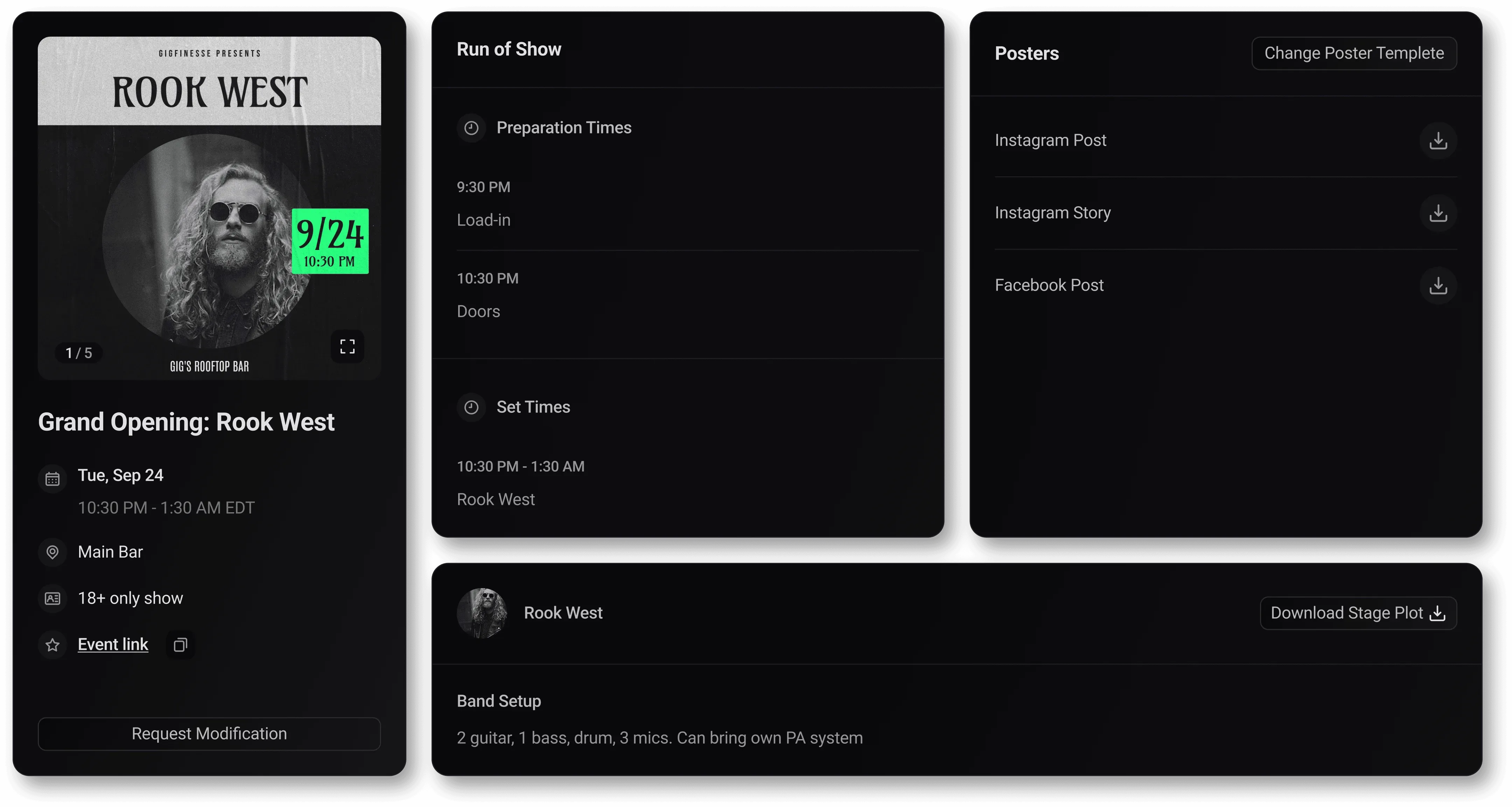
For artists, the offer is more concrete than an invitation to join a vast directory. Support guidance describes personalized recommendations showing the exact dollar amount, timing, and venue. It also says applications are accepted where opportunities exist. This is a curated supply network. An artist should judge it by suitable paid work, rather than assume a profile creates demand.
Sometimes the better calendar has fewer entries
GigFinesse’s Culinary Dropout case study describes building local artist rosters before new restaurants open. The common standard concerns reliability, energy, volume, and professionalism; the players remain local. The brand can carry its musical identity into a new market without asking an opening manager to become a talent scout during an already crowded week.
Punch Bowl Social supplies a useful complication. In GigFinesse’s account, frequent performances had stopped delivering the returns the operator wanted. The response was fewer, more deliberate events, including seasonal occasions and recurring trivia or music bingo. Programming was centralized under one director. The vendor’s own story makes a sensible point: a fuller calendar can still be the wrong calendar.
“What we learned is that the marketplace was not the whole opportunity.”Mir Hwang, speaking to Inc., May 2026
The alternatives range from a local talent buyer to booking marketplaces such as GigSalad and The Bash. BeatGig also offers booking, calendars, payments, and marketing software. GigFinesse’s pitch rests on combining those operational tools with a curation team that runs recurring hospitality programs. Buyers should compare who actually owns the work after the booking.
The bill includes more than the band
GigFinesse’s June 2026 guidance puts typical hospitality artist fees at $200-$400 for solo acoustic performers, $300-$600 for duos, and $500-$1,500 or more for bands. Its service comparison says most properties fall in a $1,200-$3,500 monthly range, with pricing dependent on consumption and the property. These are published guidelines, not a universal all-in quote.
The economic case depends on repetition. A small venue with an occasional resident musician may manage perfectly well through existing relationships. GigFinesse itself acknowledges that boundary. Repeated nights and multiple locations create more work in sourcing, promotion, accounting, and replacements. Privée, its private-event offering, addresses a different brief: speakers, entertainment, activations, and production for individual gatherings.
Inc. reported a Series A in May 2026, following the announced $3.6 million seed round in 2022. By September, NYU described more than 1,000 shows monthly nationwide. The business has grown around a practical discovery readers can copy: define the room, make the fee explicit, keep the operational details in a shared system, and let feedback change the next booking. The applause belongs to the artist. Somebody still has to arrange the next Thursday.
Keep the conversation going
GigFinesse · Apply as an artist · Venue programming · Privée
LinkedIn · Instagram · Facebook
Field Notes blog · Inc. founder interview · Watch: The Modern Hotelier interview