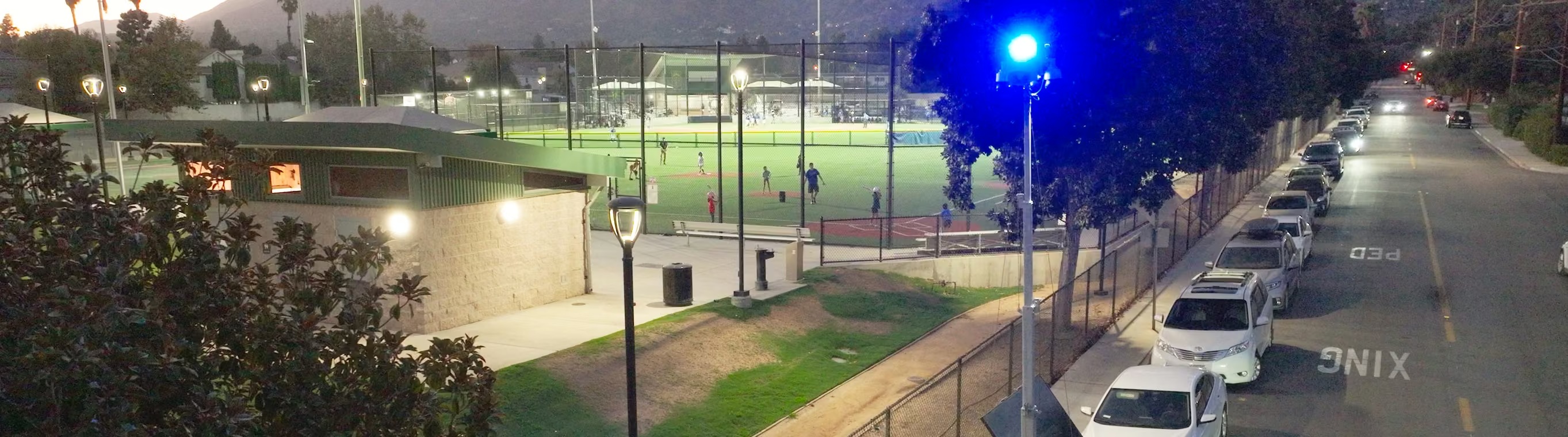
Consider the parking lot. A store can lock its doors, count its inventory, and put a manager by the register. Outside, the rules get looser. There are delivery trucks, dark corners, people crossing between cars. Getting electricity and an internet connection to the right spot can become a construction project of its own. LVT, short for LiveView Technologies, sells a conspicuous answer: a surveillance unit that brings its power and communications with it.
- Solar surveillance without fixed site infrastructure.
- Video, deterrence and response by subscription.
- Essentials starts at $1,000 monthly; advanced AI is a separate proposition.
The point is to make a place visibly watched, then give someone the means to act. Retailers, construction companies, utilities and police departments can watch live video remotely, receive alerts and use lights or audio to discourage unwanted activity. It is an outdoor security business built around the inconvenient places where ordinary cameras are awkward to install.
01The housing crash supplied the product brief
Ryan Porter and Bob Brenner started HomeView Technologies in 2005 so customers could watch houses being built. Porter came from construction finance; Brenner brought manufacturing experience. In Porter’s recollection: “At first it was just me and Bob.” The attractive feature was access: you could see progress without driving to the site.
Then the housing market collapsed. The customer base was exposed to the same economic shock. Utah’s transportation department offered a different problem: seeing winter road conditions in locations without convenient electricity or internet. Solar power and cellular transmission became practical necessities. Moving cumbersome camera poles eventually prompted a trailer. Each inconvenience helped specify the next product.
Steve Lindsey and David Studdert joined in 2011, bringing technical and business development expertise. Cloud video management and on-site computing expanded what the hardware could do. By the 2017 ISC West trade show, LVT was courting security buyers. Its company history recalls a large retailer ordering deployment across hundreds of properties. The audience had changed; the problem of seeing a distant place remained.

02The camera gets a voice
The familiar mobile unit combines a mast, cameras, solar panels, communications and deterrents. Its companion cloud platform lets operators manage footage and alerts from a computer or phone. An edge controller handles work at the site, including power management and system components. That combination of software, electronics and field equipment is LVT’s central expertise. Operators can review an incident, retrieve recorded video and coordinate activity across locations without sending someone to each camera to collect evidence in person.
In April 2025, LVT announced AI capabilities in beta that could generate spoken warnings referring to someone’s visible characteristics, direct a spotlight toward a detection and search footage with natural-language queries. Think of the difference between a general announcement and a warning that makes clear which person has been noticed. That is the behavioral wager behind personalized talk-down.
Customers can route alerts to their own security teams or use LVT Alert Response. Cameras still need a response plan: who checks the event, who speaks, who escalates? A faster detection does little good if responsibility for the next step sits in three different inboxes.
- 01SeeCameras capture activity
- 02AssessSoftware or operators review
- 03ActWarn, illuminate, escalate
03A monthly bill with wheels
LVT pairs hardware subscriptions with its software. That makes the business partly a fleet operation: units must be financed, deployed, connected and maintained. In 2022 it announced a $50 million Series B, followed by an $85 million credit facility. The resulting $135 million headline combined equity and debt. The distinction matters when the product requires equipment sitting in customers’ parking lots.
There is now a useful public price marker. In August 2026, LVT introduced Essentials at $1,000 per month. It includes a 20-megapixel Axis multi-sensor camera, blue strobes, live streaming and 14 days of recorded video. It excludes LVT’s agentic AI and advanced capabilities. Annualizing the advertised rate gives $12,000; it does not establish the price of a fully configured deployment.
The range is widening beyond trailers. GuardGate, announced in March 2026, adds portable vehicle access control, remote operation and event logs. Live Unit Surround puts multiple camera heads on a building around a central hub. For a site short on parking spaces, moving the equipment onto the building is an unusually literal product improvement.
× 12 months = $12,000Annualized rate; deployment terms require a quote.
04The evidence includes an unplugged lesson
Named users include Schnucks and Advance Auto Parts. In June 2026, truck-parking operator Freight Ninja described 28 mobile units deployed across its network. Its yards offer a clear use case: valuable equipment, large outdoor spaces and activity beyond normal office hours. The buyer wants fewer blind spots without treating every location as a permanent building project.
Community results require more care. An October 2026 Detroit survey released by LVT reported that 75.4% of community respondents wanted retailers to keep using its units. The study included 198 respondents across four groups and explicitly described its findings as nonrepresentative. That measures the views of participants, rather than proving a camera caused a citywide change in crime.
An earlier ACCESS Taskforce webinar contained a revealing admission: some participating retailers were not using their command-center access and consequently were not sharing footage with police. The equipment could be present while the workflow was absent. Training, permissions and clear ownership belong in the installation plan.
There is also a harder counterexample. In October 2025, reporting on Colorado’s highway network described 136 cameras removed after the state terminated its LVT deal. Officials cited prolonged outages and missed service agreements in an $8 million project; they also said state staff could not directly repair the vendor-operated cameras. LVT did not respond to that report’s request for comment. Availability deserves a field test, especially at remote sites.
The equipment could be present while the workflow was absent.
A lesson from the ACCESS webinar
05Buy the response, test the connection
LVT competes with other mobile surveillance suppliers, including WCCTV, as well as fixed installations and security guards. Solar power, cellular connectivity and audio deterrence also appear in rival offerings. LVT’s proposition rests on how its hardware, management software, automation and response options work together. A solar panel alone does not settle the comparison.
The lesson buyers can copy is straightforward: map the trouble spot, define what warrants intervention, assign the responder and run a pilot through the conditions that matter. Check signal strength, winter power requirements, blind spots and repair responsibilities. A site without viable communications, adequate power planning or anyone accountable for alerts is a poor fit for remote live oversight. The useful question is what happens after someone is seen.