The revealing detail in Lucie Boivin’s account of childhood is not a grand ambition. It is a handful of objects: rulers, logic blocks, reflection mirrors. She remembers sitting in primary-school classrooms, crimped hair and curious eyes fixed on the materials in front of her. She also remembers the peculiar atmosphere of a new school year - the oversized backpacks, the sense of reset, the smell of fresh supplies.
Roughly two decades later, she climbed the steps of 700 Avenue Beaumont in Montreal, home to Brault & Bouthillier. The sight of the offices and store brought those classroom objects back into focus. The materials she once held were no longer just memories. They belonged to an industry, a product discipline and, eventually, her executive remit.
Boivin is now identified as CMO and Senior Vice President of Products and Brands at Brault & Bouthillier, whose banners include BB Education and Louise Kool & Galt. The title spans an unusually broad seam. On one side sits the tactile life of learning: paint, manipulatives, robotics kits, classroom furniture and games. On the other sits the machinery required to get thousands of those items into schools and early-childhood settings: accounts, approvals, price lists, recurring orders and an ecommerce platform capable of respecting them.
Her public work shows how those worlds connect. The same habit runs through both: begin with what the user is actually trying to do, then make the system answer that reality.
The object before the order
Brault & Bouthillier has been operating since 1944. Its history follows changes in Quebec education: the spread of public kindergarten, the rise of plastic arts, early classroom computing, science and technology programs, robotics, flexible learning spaces and sensory rooms. The company says it carries more than 12,000 products from more than 350 suppliers. Its assortment runs from early childhood through secondary school.
Scale can make a catalogue look like a warehouse problem. Boivin’s description of product selection makes it sound closer to editorial judgment. Category teams visit trade shows and look for items that answer educators’ needs. The candidates are checked for quality and safety, then considered against educational programs and the language in which those programs are taught. When the answer is not obvious, the company consults pedagogues and specialists.
“Le jeu, c’est du sérieux!”Lucie Boivin, BB Education magazine
Then come the critics with the least interest in corporate diplomacy. The BB Brigade is a rotating group of young testers drawn from the company’s orbit. Their assignment is to react to prospective products with the spontaneity of children. Sometimes, Boivin has written, the feedback is almost too candid. For the company, it is the last test.
That practice matters because an educational product has at least three audiences. An institution buys it. An educator chooses and deploys it. A child uses it. Each sees a different form of value, and each can expose a different failure. A purchasing department notices whether the order fits its rules. A teacher notices whether the material supports a lesson. A child notices whether the thing invites another minute of attention.
The three-customer test
This is why the phrase “educational retail” understates the job. The catalogue is a translation layer between pedagogical intent and classroom action. A counting tool, programmable mouse or set of outdoor blocks does not finish its journey when it is shipped. Its real test begins on the floor, table or playground.
The sequence also guards against a common product mistake: allowing one kind of evidence to impersonate the whole answer. A trade-show discovery can reveal novelty, but not classroom endurance. A curriculum match can establish relevance, but not attention. A child’s enthusiasm can show appeal, but not procurement fit. Brault & Bouthillier’s published process layers those signals instead. Search, technical review, pedagogical consultation and live use each answer a different question. The product earns confidence gradually. That is slower than choosing from a sales sheet, yet it explains why Boivin writes about selection as a journey rather than a single gate.
The cart is an organization chart
The digital side of the business presents a different kind of translation problem. Consumer ecommerce typically imagines one person browsing, paying and receiving. Institutional commerce is less tidy. Several users may operate under one account. A large order can require approval. Pricing may vary by organization. Buyers repeat familiar orders and want to avoid rebuilding a list one item at a time.
Brault & Bouthillier’s Shopify Plus project was built around those conditions. The work added fast-ordering tools, recurring purchase lists, corporate-account management and synchronized dynamic pricing. It also had to connect marketing with third-party applications and back-office ERP and product-information systems. A classroom order may look simple at the front of the screen, but behind it is a small map of the institution itself.
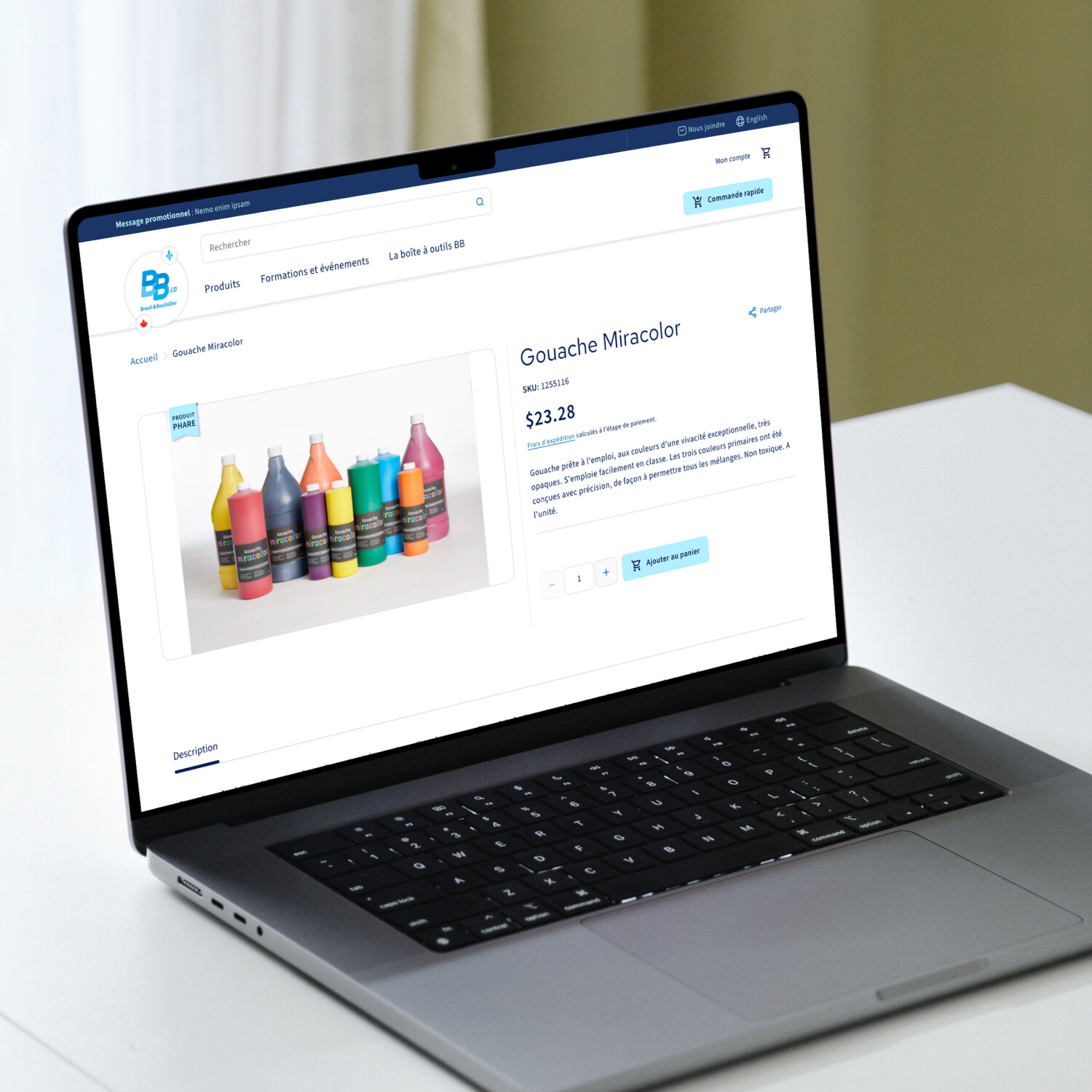
The published project results include more than 3,000 new customer profiles after launch, more than 121 synchronized price lists and an 8.6 percent month-over-month increase in average order value. The numbers are useful, but they are not the most interesting evidence. The deeper change is that the interface learned the customer’s operating grammar.
Boivin framed the project as a balancing act among strategic vision, customer experience and operational reality. That triangle is a compact description of executive work. Strategy without operational contact becomes a presentation. Operations without customer understanding preserve yesterday’s friction. Customer experience without budget or system constraints becomes a prototype nobody can maintain.
“This project represents an important milestone in our digital transformation.”Lucie Boivin, on the B2B platform project
Her language around the project is notably collective. She emphasizes collaboration, transparency and decisions aligned with objectives, budgets and schedules. The point is not to romanticize the migration. The project involved technical limitations, third-party applications and many stakeholders. Its success depended on making tradeoffs legible enough that different teams could keep moving in the same direction.
Memory as product research
Boivin’s 2024 essay for the company’s 80th anniversary returns to the physical side of this system. She calls the school year’s return a renewal, almost her own December 31. The line works because it is observant rather than abstract. Most adults can remember school through things: a hard plastic chair, the grain of a desk, a certain pencil, the snap of a binder. The object carries the institution into memory.
For an executive responsible for products and brands, that kind of memory is not merely sentimental. It is evidence about the duration of a product experience. Classroom materials are handled repeatedly, often by many children, under conditions no polished product page can reproduce. They need to survive what Boivin playfully calls the small and large tornadoes of school and daycare life. They also need to earn their space in crowded rooms and constrained budgets.
Her account of the BB Brigade adds an important correction to nostalgia. Adults may remember a beloved classroom object, but today’s children still get to reject tomorrow’s candidate. Expertise proposes; use disposes. The product team’s rigor and the child’s blunt response belong in the same process.
That dynamic reaches the ecommerce project too. A digital platform is another manipulative, in the broadest sense: a tool people use to make something happen. If a buyer cannot assemble a recurring order quickly, if an administrator cannot govern an account, or if pricing does not reflect an agreement, the interface has failed its classroom test long before a box arrives.
Holding the whole chain
The most interesting part of Boivin’s remit is the refusal to separate brand from operations. The brand promise is that educators will find relevant, durable and thoughtful tools. Product selection has to make that promise true. Ecommerce has to make the promise accessible. Institutional workflows have to make it repeatable. A missed connection anywhere along the chain becomes a customer-experience problem everywhere else.
Her path through the building at Avenue Beaumont gives that chain a human shape. The child who once studied logic blocks became the executive helping decide which materials deserve a place in the catalogue and how those materials reach the adults who need them. The story is appealing because it closes a loop, but the loop remains active. Each new product, platform feature and candid young tester can still revise what the company thinks it knows.
That may be the transferable idea in Boivin’s work: treat the customer experience as a living system of judgments. Listen to specialists without muting users. Respect the institution without forgetting the person at the desk. Modernize the interface without flattening the operational truth underneath it. And when the product is meant for play, take the play seriously enough to let a child have the final word.