A hotel guest earns a reward. Somewhere else, an airline wants her next booking. A retailer would quite like to see her on Saturday. The interesting question is whether those three businesses can make the same reward useful. In June 2026, Spenn, Norwegian Reward and Strawberry went live together on GRAVTY, Loyalty Juggernaut’s software. A shared points currency had acquired a common operating platform. The customer gets more places to spend. Behind the curtain, the work gets complicated.
- The product: GRAVTY runs enterprise rewards, member data, offers and partner operations.
- The bet: connecting brands makes loyalty more useful between purchases.
- The commitment: enterprise software, integration work and disciplined program economics.
01 / The reward has to go somewhere
Consider the hotel business. Someone who stays twice a year leaves a long silence between transactions. Dining, shopping and other partners offer additional reasons to participate. A reward that works across those encounters can become a habit. That is the commercial logic behind an ecosystem: give the member more opportunities to use a relationship that otherwise sits dormant.
Global Hotel Alliance’s 2021 redesign provides a useful clue about what needed fixing. Its research found travelers frustrated by complicated points and miles. Members wanted flexibility, including rewards closer to home. GHA introduced DISCOVERY Dollars, a currency with a dollar-equivalent value, alongside easier routes to status and local hotel experiences. The change followed member feedback and pandemic-era travel patterns. Understandability had become part of the product.
“Our members spoke, and we listened.”Chris Hartley · CEO, Global Hotel Alliance · 2021
GHA is a GRAVTY customer. The lesson extends beyond its hotels: a reward’s generosity means little if the member cannot work out how to use it. Technology has to support the proposition customers can understand, including earning, redemption and recognition across participating brands.
02 / Somebody must keep the promises straight
Loyalty Juggernaut sells that operational machinery to enterprises. GRAVTY manages member records, balances, tiers, promotions and partner participation. Its Visual Rules engine lets business teams configure loyalty logic without writing code. An airline can change an earning rule; a retailer can adjust an offer; a program operator can manage partners. Those changes still need business judgment. The software gives teams a way to execute them.
The architecture matters because loyalty activity arrives unevenly. GRAVTY uses serverless microservices on AWS, allowing capacity to adjust with demand. In December 2024, LJI reported processing more than 100 million transactions per hour with average latency below 50 milliseconds. Those are company performance claims. For a buyer, the practical question is whether the system can handle that buyer’s busiest periods, integrations and rules.
event→Reward
rule→Partner
settlement
One pleasant moment for the member. Several connected jobs for the operator.
Its expertise lies where customer marketing meets enterprise systems: connecting behavioral data, configurable rules and the commercial arrangements behind rewards. The Braze integration illustrates the division of labor. GRAVTY sends loyalty attributes, transactions and events into Braze, where teams can use them for segmentation and messages across channels. A reward event can inform the next conversation with a member.
03 / The people behind the points
Founded in 2015, LJI brings enterprise CRM experience to this problem. Co-founder and chief executive Shyam Shah previously led Oracle industry strategy for travel, hospitality and retail, and led Siebel Loyalty. Co-founder Kalpak Shah is CTO. Fellow co-founder Murali Subramanian, now an executive advisor, spent 24 years at Oracle. Their published backgrounds help explain the attention to large organizations and interconnected systems.

Customers include WestJet, Emirates’ Skywards Everyday, Deutsche Telekom’s Magenta Moments, FEMSA and Majid Al Futtaim. The mix is telling. Hotels want another stay; telecom operators need engagement between bills; retailers want another visit. LJI supplies infrastructure adaptable to these different commercial rhythms. In the enterprise loyalty market, alternatives include Capillary, Epsilon, Kobie, Salesforce and Oracle. LJI was named a Strong Performer in the Q4 2025 Forrester Wave.
04 / A dashboard with a next move
In October 2025, LJI launched GRAVTY Agentic AI Compass, built on Amazon Bedrock. Specialized agents examine program performance, anomalies, sentiment and benchmarks, then provide recommendations. The pitch addresses a familiar operational problem: a team can possess plenty of data and still struggle to decide what deserves attention today.
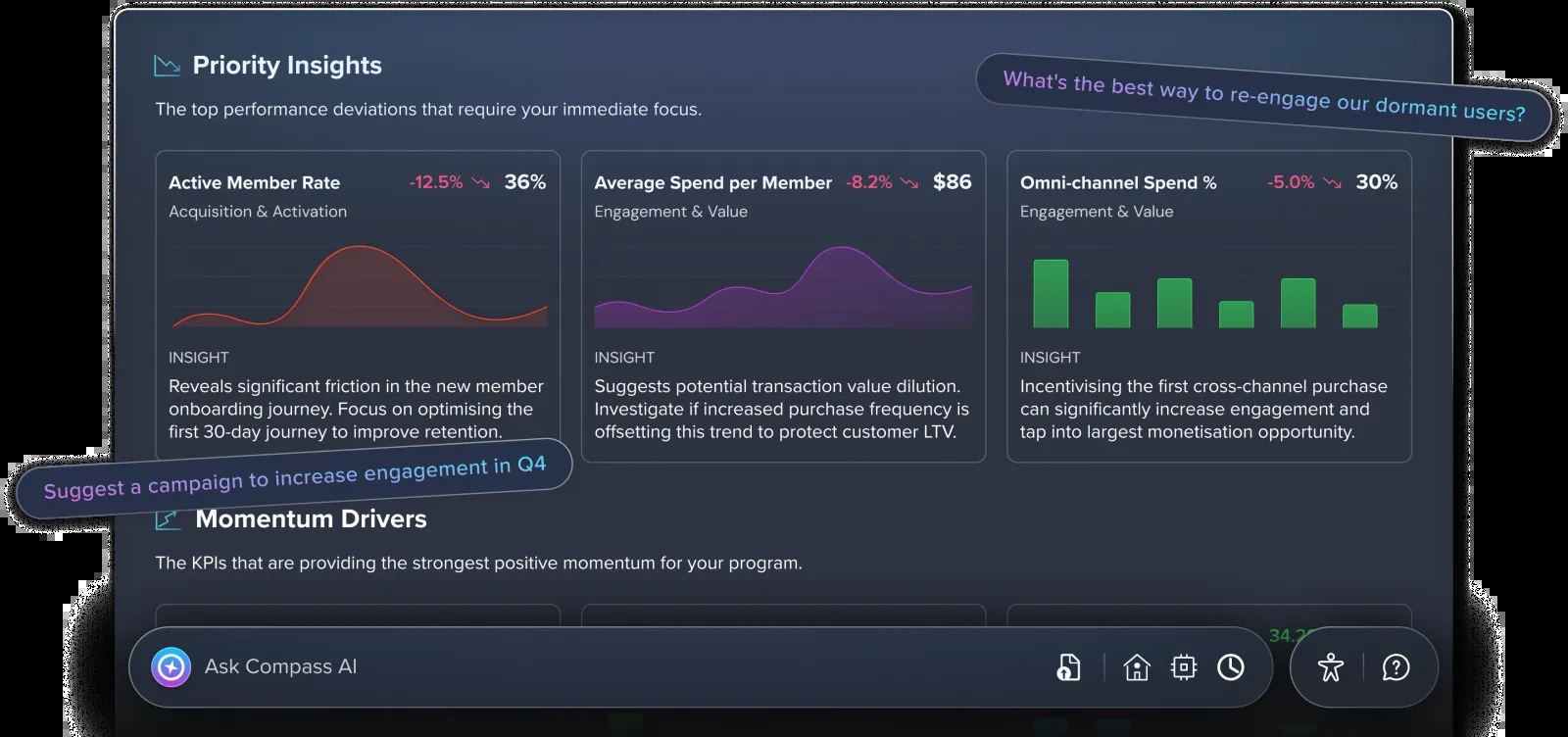
Compass is presented as explainable and auditable, with simulations before execution. That makes reviewability part of the offer. A recommendation to change a promotion has consequences for customers and margins. Useful automation must let an operator examine the reasoning, permissions and proposed action before treating an answer as a decision.
05 / The bill, and the business case
The AWS Marketplace lists a 12-month GRAVTY license at $100,000. Contract scope varies with managed profiles, locations and countries. Implementation, integrations, infrastructure and ongoing services can add cost. It is a reference price for an enterprise purchase, rather than a universal project budget. The buyer is also funding a change in how a program operates.
LJI’s October 2026 partnership with Loyalty Academy Brasil makes the services component explicit: technology alongside local expertise and performance management. The work includes program analytics, financial planning, liability management and partner economics. A shared rewards promise needs commercial oversight as much as a transaction engine.
The transferable idea is to start with the behavior worth changing, give the member an understandable benefit, and make each partner’s contribution measurable. The conditions matter. If integration costs exceed the value of repeat business, the enterprise approach becomes hard to justify. If rewards subsidize purchases that would happen anyway, additional activity can disguise weak economics. LJI’s proposition is most persuasive when partner complexity is real and the business can measure the value of connecting it.