Lou LaRocca went to meet a professor wearing a sweater. It was a reasonable choice for an office visit, and a poor choice for what followed. David Layzer, the Harvard astrophysicist, had a ski jacket on and a walk in mind. The two set off through Cambridge, talking about a computer project they had been working on together. LaRocca tried steering the conversation, and the professor, back toward the Quad. Layzer kept going. They wound up near Alewife.
This was 1991. LaRocca was a Harvard undergraduate, a Cabot House resident and one of Layzer’s undergraduate teaching fellows. The recollection has the pleasing asymmetry of a student story: one person supplying historical observations about Cambridge, the other discovering the limitations of knitwear. It also catches a future technology executive doing something that would remain part of his working life: learning alongside somebody else.
Born in Brooklyn and raised on Staten Island, LaRocca made his way to Harvard and then into the Boston software industry. His later responsibilities would span both code and the business around it. The geographical details give the executive biography a little texture: a New York childhood, a Cambridge education, a company based in Charlestown. The progression involved changes of setting and responsibility, while software remained a continuing part of the work.
Today, LaRocca is the co-founder, president and CEO of J2 Interactive. His résumé includes software development, a company formed after the dot-com boom, and a continuing commitment to a Boston tutoring organization. Read those experiences together and a particular idea emerges. Helping someone should leave them with more ability to act for themselves.
Two colleagues at the end of a boom
LaRocca’s route to founding a company passed through Kenan Systems and JuniorNet. At JuniorNet, he met Mickey Yalon. The dot-com bust put their jobs in jeopardy; the two colleagues responded by starting a business together. J2 Interactive was founded in 2001. The grand opening of a venture can look rather different when the previous door is closing behind you.
That beginning matters because J2’s history is a shared one. Yalon remains its co-founder and chief technology officer, alongside LaRocca as president and CEO. The partnership predates the company. Before there was a business to explain, there were two people who had worked together and decided to keep doing so under circumstances that offered little reassurance.
By 2004, J2 had begun working with InterSystems. Twenty years later, LaRocca sat down with John Paladino, the company’s head of client services, to revisit that relationship. In his public account of the conversation, LaRocca described the usefulness of the courage that comes with ignorance when starting a business. Complete knowledge might make a founding decision considerably harder to get past committee.
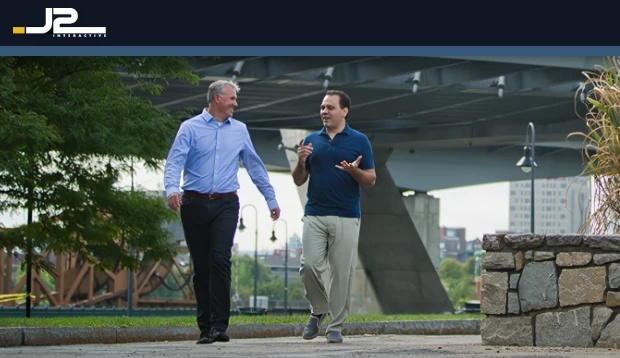
The conversation also prompted a list of thank-yous. LaRocca named colleagues, partners and his brother Michael, and described Paladino as someone whose example had influenced his leadership. A founder can tell a company’s history as a sequence of personal decisions. LaRocca made room for a larger cast. That is useful context for a business built around working with other people’s teams.
Permission to carry on without you
Consulting contains a small commercial puzzle. The consultant knows something the customer needs to know. Keeping that knowledge scarce may prolong the arrangement. Sharing it gives the customer options. LaRocca has explicitly chosen the latter approach: when a client’s internal team wants to become self-sufficient with a delivered solution, J2 should help it get there.
“we will help them get there.”
Lou LaRocca, on clients building their own expertise
The statement gives a concrete meaning to partnership. A customer receives a system, but also needs enough understanding to live with it. Who can maintain it? Who can explain a decision after the original developer has moved on? Who knows which changes are straightforward and which deserve a careful conversation? The handover is part of the work.
LaRocca’s position makes future work depend on a fresh reason to return. It is an argument about the quality of a relationship as much as the quality of software. An internal team with more competence has more freedom. A consultant willing to help create that freedom is placing a bet on being useful again.
His own professional introduction retains a programmer’s identity: he calls himself an “old-school software developer.” The executive title has not erased that description. It is an apt starting point for someone whose early J2 responsibilities included lead development for clients, before a broader remit covering business development, finance, recruiting and operations. The work grew around an understanding of how systems are made.
A company has to be good for its staff, too
J2’s published working practices offer another view of the founders’ choices. Employees are trusted to manage customer relationships, project expectations and their time off. Leadership is responsible for providing the preparation and support that lets them meet their obligations. Responsibility is distributed, and support is supposed to travel with it.
There is a practical distinction here between assigning a task and leaving a person alone with it. J2 describes a team approach even when a consultant is working on a solo assignment: colleagues’ knowledge remains available. The customer may have one principal contact while the work benefits from more than one person’s experience. Shared expertise has a use inside the company as well as outside it.
Then there is the ski trip. The company describes an all-expense-paid winter gathering for staff, a detail refreshingly easy to picture among the abstractions of workplace culture. A ski trip cannot settle every question about an employer. It does, however, involve an actual booking, an actual bill and people spending time together beyond a project schedule.
Growth has also involved bringing another team into the business. In December 2018, J2 acquired Boston-based Saxa Solutions, expanding its Salesforce capabilities. It was a specific extension of the firm’s existing practice, with complementary skills arriving through an established group. For a founder, that kind of expansion adds another responsibility: the working arrangements that made sense for the earlier company have to make sense for the people joining it, too. Culture becomes something that must survive a change in the guest list.
The firm’s record includes Inc. 5000 appearances in 2015, 2016, 2017 and 2024. Those dates describe company growth recognition, rather than a personal decoration for LaRocca. Keeping the distinction is appropriate in a story where the founder repeatedly points toward the team. His role involves building the conditions in which other people can do the work.
The tutor who came back
The connection with teaching began well before J2. In 1988, during his first year at Harvard, LaRocca found EVkids and met co-founder Marie-Claude Thompson. He volunteered as a tutor during the academic year and a camp counselor in summer. After graduating, he continued tutoring for another year. The extracurricular commitment survived the end of college.
In 2013, executive director Eric Thompson invited him onto the board. LaRocca now serves as board president. EVkids works with young people in Boston through tutoring, mentoring, summer camp and support through college. Its board roster identifies him as both president and tutor alumnus, putting the current responsibility beside the original one.
- 1988Starts volunteering with EVkids
- 1992Harvard graduation; tutoring continues
- 2001Co-founds J2 with Mickey Yalon
- 2004J2’s InterSystems partnership begins
- 2013Joins the EVkids board
It would be too tidy to turn those dates into a claim that tutoring produced his business philosophy. The resemblance is nevertheless worth considering. A tutor helps another person develop the ability to do the next piece of work. A consultant who shares expertise makes a similar choice. In each case, the relationship can be judged partly by what the other person can eventually manage.
The commitment also has a public financial dimension. For EVkids’ 2025 gala, LaRocca and his wife Rajani announced that they would match donations made through his fundraising page. J2 sponsored tickets, and the event’s participant leaderboard recorded $18,028.20 raised on his entry. This is a specific campaign result, with a date and a purpose, rather than a vague claim about generosity.
The gala celebrated the organization’s forty-fifth year and honored its founders, Marie-Claude and Brian Thompson. LaRocca’s invitation acknowledged their contribution. Once again, the story he told about his own involvement included the people who had made that involvement possible.
An old system can still know a thing or two
A recent J2 engagement offers a concrete example of the firm’s work beyond its founder’s biography. Chadwicks Group, the Irish builders’ merchant, was modernizing Accustar, an enterprise system developed over four decades. Its older interface presented difficulties, but the system also contained accumulated business knowledge. Starting again would mean accounting for everything already learned.
J2 helped develop AccuPRO, a cloud-hosted, web-enabled successor that retained existing business logic. An initial pilot concentrated on finance and credit control screens. The phased approach let the work expand across further modules. In May 2026, J2 announced that the program had received an InterSystems Impact Award for Supply Chain, while making clear that the wider modernization was still underway.
This is a company achievement, with client teams and J2 specialists doing the work. Its relevance to LaRocca’s story is the problem it addresses: how to help an organization move forward while respecting what its people already know. The same question gives knowledge transfer its value. Progress is easier to sustain when the people responsible understand what they are carrying forward.
LaRocca’s biography has room for a failed boom, an enduring co-founder relationship, a student volunteer’s return and a customer’s eventual independence. The interesting thread is how often other people’s capabilities enter the picture. The professor’s walk ended near Alewife. The tutoring continued after graduation. And the consultant’s work, in LaRocca’s telling, includes helping the customer take the next step without needing someone else to lead it.