In 1992, Byron White had a practical objection to the way graphic designers found work. A résumé could tell a prospective employer where a designer had been. It was a remarkably awkward way to show what that designer could do. Here was a visual profession introducing itself with a sheet of words. White saw a business in the mismatch.
His company, Freelance Access, set up a Mac lab and used a Tektronix dye-sublimation printer to produce 11-by-17-inch samples of freelancers’ work. The idea was pleasingly literal: let people see the design. Years later, describing the experiment, he remembered the uncertainty as clearly as the equipment. The team had no guarantee it would work. They had identified a problem worth trying to fix.
That oversized printout makes a useful starting point for understanding the founder of WriterAccess. His career keeps returning to the arrangements around creative work: how talent gets discovered, how a commission gets organized, how a customer learns enough to become a better customer. The tools change. Someone still has to make the introduction.
A thousand useful things, and a business underneath
By 2000, White was building LifeTips. The premise suited an internet still assembling its everyday habits: bring together people who knew useful things and readers who wanted to know them. Advice could attract an audience; an audience could attract sponsors. The expertise was the attraction, with a business model tucked underneath it.
The site attracted hundreds of expert writers and tens of thousands of readers by 2001. Sponsors included Chase, H&R Block, PETCO and Circuit City. LifeTips later adopted Google AdSense, moving beyond the work of chasing individual topic sponsors. A publishing business was learning to change its machinery while keeping the same basic promise to readers.
The experiments spread into other formats. A weekly radio show launched in 2005, with White as host. Book publishing followed in 2006; more than 50 books appeared over the next five years. LifeTips eventually recorded more than 350 radio episodes. Long before a podcast became an obligatory accessory for a founder, White had made interviewing part of the job.
The assignment behind the assignment
WriterAccess launched in Boston in 2010. It gave businesses a way to find freelance writers and manage the work they commissioned. A marketplace could make introductions repeatedly, across many customers, without handling every relationship like a bespoke agency assignment. Yet the introduction was only the beginning of the practical problem.
In 2013, White took a talk called “Snap, Crackle and Pop Your Way to Conversion” to Conversion Conference in Boston. The title borrowed the cheerful rhythm of a cereal box for the rather less cheerful business of improving marketing copy. He wanted headlines that caught attention and writing that made readers feel something and act.
Some of his advice concerned the customer’s behavior. Write a rough version yourself, then give a professional room to improve it. Supply a creative brief. Set sensible budgets. Make useful revision requests. Reward the writer appropriately. The glamorous business of producing compelling words turned out to require instructions, judgment and a little restraint from the person paying for them.
“Content marketing is now a team sport.”
Byron White, 2014
At Boston’s Inbound Marketing Summit in 2014, he made that team argument explicitly. His presentation moved from workflow and testing to ten strategies for engaging readers. WriterAccess brought a content marketing kit, and White signed his books, Professional Writing Skill and Price Guide and The Content Marketing Roadmap. Education accompanied the sales pitch.
There is an unromantic intelligence in that combination. A buyer who understands the work can commission it more clearly. A writer who receives a useful brief has a better chance of delivering something the buyer wants. Teaching both sides can improve what happens between them. White’s businesses repeatedly put instruction close to the transaction.
What happens when the door gets a price tag?
In autumn 2017, WriterAccess began charging a monthly subscription for access to its platform and talent. White acknowledged uncertainty about how customers would respond. A marketplace asking people to pay for the work was now also asking them to pay to use the machinery around it. Customers had to find that machinery worth the additional expense.
The 2018 release of WriterAccess 5.0 made the direction clearer. Alongside the subscription model came tools, a simpler signup process, premium support and a Growth Hub containing plans, webinars, podcasts and conference videos. White’s content strategy teaching also sat inside the offering. The company was selling a more organized way to get the work done.
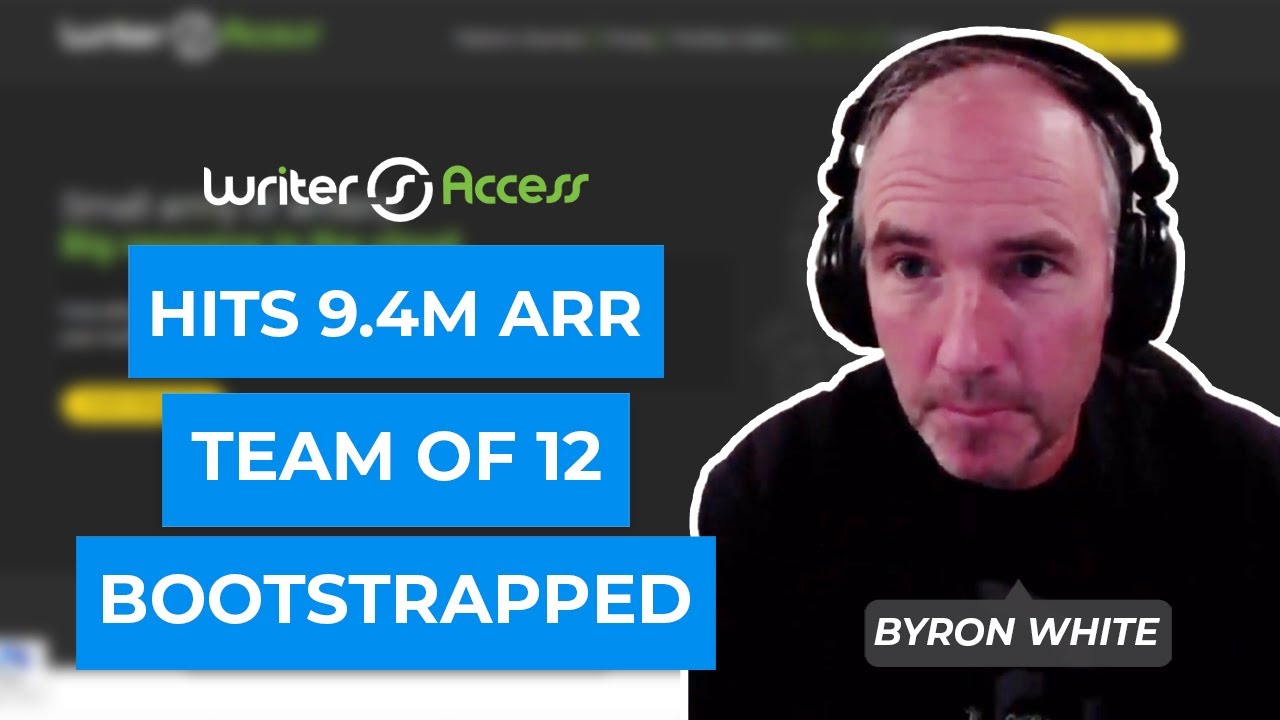
In a later interview with Nathan Latka, White described a marketplace split that sent 70 percent to freelancers and retained 30 percent for WriterAccess. That was his description of the model at the time. It made the underlying bargain easy to follow: the platform needed to earn its place in the relationship by supplying customers, workflow and service.
THE BARGAIN / AS DESCRIBED IN HIS LATKA INTERVIEW
He also resisted treating creative work as a competition in which several people submit finished work and only the winner gets paid. The distinction mattered to someone trying to build a recurring livelihood through a marketplace. Getting an assignment and winning a speculative contest produce very different working weeks.
A conference with permission to laugh
Content Marketing Conference extended the educational side of White’s work into an event. Its subject was serious enough to fill a calendar with sessions on planning, creation, optimization, distribution and performance. White also gave comedy a place on the program. A room full of marketers could, apparently, survive a joke.
The 2022 program included comedy keynotes alongside marketing sessions. Its speaker gallery brought together figures such as Ann Handley, Rand Fishkin and Andy Crestodina, while the comedy lineup included Don McMillan and David Nihill. The juxtaposition gave practical form to a belief running through White’s advice: being useful does not require being dull.
For the virtual 2022 conference, a free three-day ticket opened the event more widely. White explained that recordings had already been shared with WriterAccess customers and writers for four years. He wanted learning to continue as the audience became more international. The conference gave the marketplace a place to gather, ask questions and encounter ideas beyond the next assignment.
His enthusiasm could arrive at conversational speed. Asked what attendees should expect, he began, “Holy Moly”. There followed a considerable inventory of questions marketers might bring with them. He seemed more interested in how much there was to discuss than in presenting the field as settled.
The lunch that never reached the expense form
A smaller story comes from LinkedIn advertising specialist AJ Wilcox. In a public recommendation, Wilcox credits White with giving him an early speaking opportunity at Content Marketing Conference. He also remembers presenting a WriterAccess webinar when a notification for his upcoming lunch appeared on the shared screen.
White noticed the restaurant’s name. Without telling Wilcox, he called ahead and arranged to pay for the meal. Wilcox discovered the gesture afterward. The incident required neither a feature release nor a conference budget. It required paying attention to an inconvenient little popup that most webinar hosts would have politely ignored.
The anecdote gives the larger business story a human scale. A platform may count customers and creators in the thousands; a relationship can still turn on whether one person notices another. Wilcox’s account describes the kind of generosity that is difficult to put in a dashboard and unusually easy to remember.
An exit, followed by more verbs
Rock Content announced its acquisition of WriterAccess on April 19, 2022. White was to move into its marketing organization, working on marketing and business development. The deal connected the marketplace with a larger collection of content products and an educational operation through Rock University.
White’s stated attraction was wider distribution and additional resources for reaching the market and developing the product. The acquisition announcement also proposed bringing the companies’ education programs together. Once again, the business of commissioning creative work arrived with a school attached.
The story acquired another turn. By October 2025, AppSumo had updated its account of WriterAccess to report that the business had reacquired itself from Ion Interactive, identified there with Rock Content, and White had returned as CEO. The update complicates a tidy entrepreneurial ending. Sold businesses sometimes become businesses to build again.
White uses the word “uplift” for growth that comes from useful product changes and the customers those changes attract. It is a characteristic emphasis. Even when discussing acquisitions, he returns to making something people want to keep using. An exit can occupy a headline; the repeated decision to come back is what sustains the business.
Golf has a scheduling problem
White’s newer venture, Club Pilot, moves the setting from content teams to golf clubs. Its origin story describes the irritations of organizing games: sprawling group texts, pencil scorecards and unnecessary planning. Serving on a club board gave him another view of the difficulty, this time from the people trying to communicate with members.
Golf Pilot launched in 2025 with an app for arranging and playing golf. The team then expanded toward services for clubs, developing Club Pilot. White’s attention had landed on another familiar gap between people who want to do something together and the systems available to coordinate it.
Golf also belongs to his life away from work. A public speaker biography describes early rounds and experiments with a Kalamazoo outdoor grill. The detail is reassuringly concrete. For all the talk of workflows, there are still mornings to play and dinners to make.
From a designer’s printed portfolio to a writer’s brief to a golfer’s group message, White keeps finding business questions inside ordinary arrangements. His career suggests an enduring appetite for those questions. Somewhere, a perfectly capable person is being held up by a clumsy process. White tends to notice.
Continue the conversation
Explore the work, hear the interviews, and follow the next chapter.